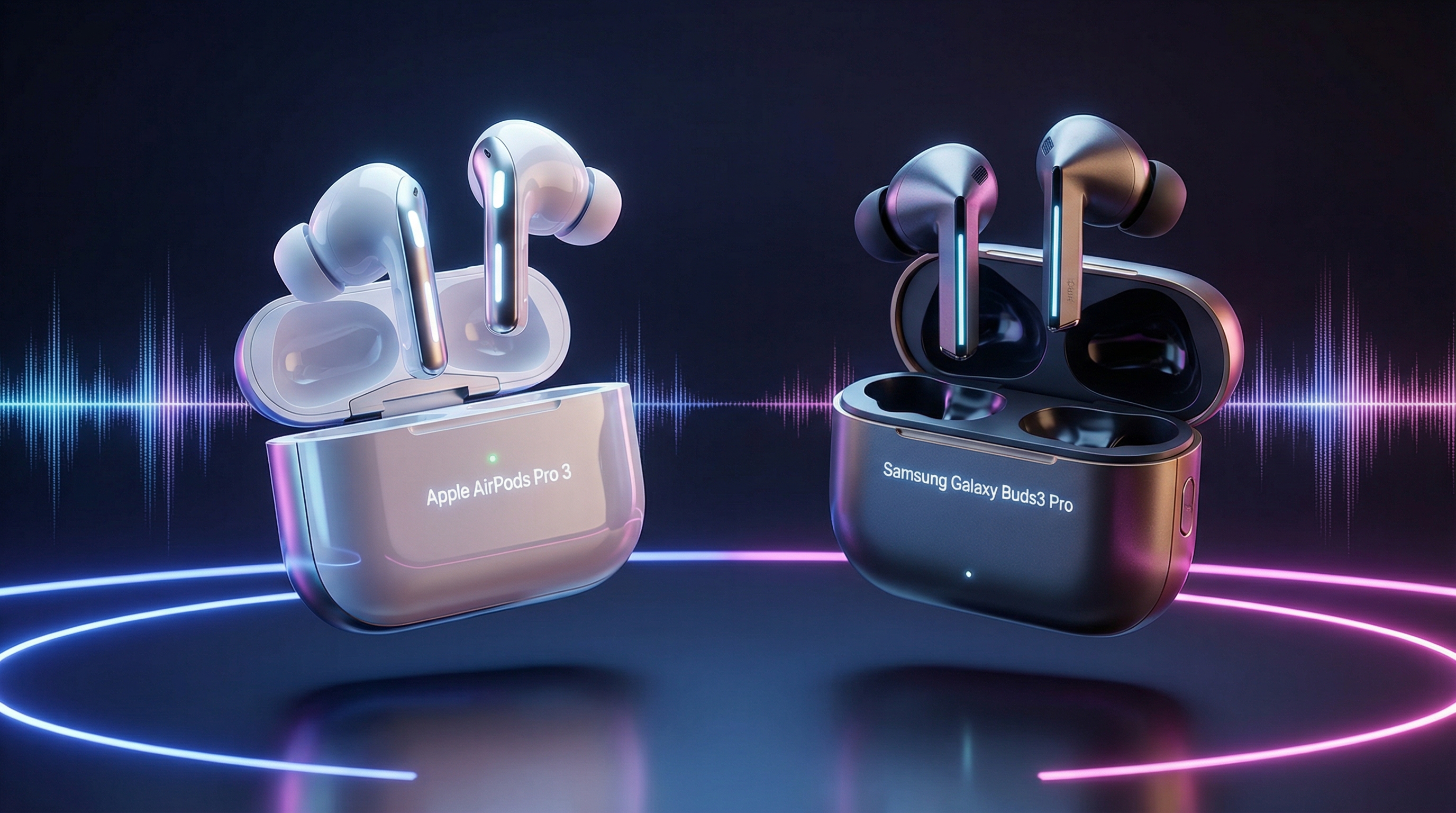
True wireless earbuds have reached a level of maturity where the differences between flagships come down to fine details rather than fundamental gaps. Apple’s AirPods Pro 3 and Samsung’s Galaxy Buds3 Pro both promise premium audio, excellent noise cancellation, and seamless integration with their respective ecosystems. After testing both for over a month across gym sessions, daily commutes, work calls, and weekend listening, I have a clear picture of where each excels and where each falls short.
Design and Fit
Apple refined the AirPods Pro design for the third generation without reinventing it. The stems are slightly shorter than the Pro 2, and the ear tips now come in five sizes instead of four, with the addition of an extra-small option. The buds themselves are a touch lighter, and the silicone tips create a reliable seal that stayed put during runs and gym workouts. The charging case is compact, supports MagSafe, Qi2, and USB-C, and includes a built-in speaker for Find My tracking.
Samsung took a dramatic design turn with the Galaxy Buds3 Pro. The rounded pebble shape of previous generations is gone, replaced by a blade-style design with a short stem and angular housing. It looks modern and distinctive, though opinions on the aesthetic are split. Fit is good with the included ear tips in three sizes, but the harder plastic edges of the housing occasionally caused mild discomfort during extended sessions. The charging case is slim and pocketable, with USB-C and wireless charging support.
Specifications at a Glance
| Specification | AirPods Pro 3 | Galaxy Buds3 Pro |
|---|---|---|
| Weight (per bud) | ~5.3g | ~5.4g |
| Driver | Custom Apple driver | Two-way (planar + dynamic) |
| Ear Tip Sizes | 5 (XS, S, M, ML, L) | 3 (S, M, L) |
| Water Resistance | IP54 | IP57 |
| Case Charging | USB-C, MagSafe, Qi2 | USB-C, Wireless |
| Case Battery | ~6 additional charges | ~5 additional charges |
Samsung wins on water resistance with IP57 versus Apple’s IP54. That higher rating means the Buds3 Pro can handle brief submersion, making them more suitable for intense workouts or unexpected rain. Apple’s five tip sizes give it an advantage in fit customization, which directly impacts both comfort and ANC performance.
Sound Quality
Apple equipped the AirPods Pro 3 with a new custom driver and the H3 chip, and the sonic improvement over the Pro 2 is substantial. Bass hits harder and reaches lower without bloating the midrange. Vocals are clear and present, and high-frequency detail is crisp without sibilance. The overall signature is balanced with a subtle warmth that flatters most music genres. Adaptive EQ continuously adjusts the frequency response based on the seal in your ear, which means the sound stays consistent even as the buds shift slightly during movement.
Samsung’s two-way driver system in the Galaxy Buds3 Pro is the technical highlight. A planar tweeter handles high frequencies while a dynamic driver manages the lows and mids. The result is impressive. High-frequency resolution is outstanding. cymbals shimmer, strings have texture, and breathy vocals feel intimate and detailed. Bass is tight and well-defined, though it does not reach quite as deep as the AirPods Pro 3. The midrange is clean and neutral, which works well for vocal-heavy and acoustic music.
Samsung supports the Samsung Scalable Codec and SSC HiFi for Galaxy devices, plus AAC for broader compatibility. The codec advantage over Apple is notable on paper, though in practice the AirPods Pro 3 with AAC still sounds excellent thanks to Apple’s hardware and software optimization. Apple Lossless is not supported wirelessly on either, which remains a limitation of Bluetooth audio in general.
Where the AirPods Pro 3 pulls ahead is in Spatial Audio with dynamic head tracking. Apple’s implementation is the best in the true wireless category. Watching a movie or listening to a Dolby Atmos mix creates a convincing three-dimensional soundstage that tracks your head movement smoothly. Samsung offers 360 Audio on the Buds3 Pro, and while it works well, the head tracking is less precise and the spatial effect is less convincing.
For straight stereo music listening without spatial effects, I would call it nearly a tie with a slight advantage to Samsung on treble detail and Apple on bass depth.
Noise Cancellation
The AirPods Pro 3 delivers the best ANC I have experienced in true wireless earbuds. The H3 chip processes external sound twice as fast as the H2 did, and the result is noticeably stronger cancellation across all frequencies. Airplane cabin noise is dramatically reduced. Office chatter fades to almost nothing. Even street noise with its unpredictable mix of frequencies is handled well. Apple added a new Adaptive Transparency mode that reacts to sudden loud sounds. like a car horn or construction noise. by instantly dampening them while keeping normal ambient audio audible. It works remarkably well.
Samsung’s ANC on the Galaxy Buds3 Pro is strong but sits a step behind Apple. Low-frequency cancellation is good, effectively reducing engine noise and air conditioning hum. Mid-frequency reduction is solid in controlled environments but lets more sound through on busy streets. The gap is most noticeable in higher frequencies. Apple cancels more ambient conversation and keyboard noise than Samsung does.
Ambient mode tells a similar story. Apple’s Transparency mode is the gold standard. It sounds so natural that first-time users often do not realize it is active. You can hold conversations without removing the buds, and environmental sounds come through with accurate spatial positioning. Samsung’s Ambient Sound mode is competent and improved notably over previous generations, but there is still a slight digital processing artifact that reminds you of the electronics at work.
Both earbuds adapt their ANC based on fit. A poor seal reduces cancellation effectiveness on any earbud, which is why Apple’s five tip sizes matter. Getting a proper seal is easier with more size options, and the Ear Tip Fit Test in Apple’s settings helps you verify you have the right tips installed.
Battery Life
Samsung holds an advantage in raw battery numbers. The Galaxy Buds3 Pro delivers approximately 6 to 7 hours of playback with ANC enabled, and the case provides roughly five additional charges for a total around 30 to 35 hours. That is impressive for earbuds this small.
The AirPods Pro 3 improved to approximately 6 hours with ANC, up from the Pro 2’s 5.5 hours. The case adds about six full charges, totaling around 36 hours. In practice, the per-session difference between the two is small. both will get you through a full workday without needing the case.
Quick charging favors Apple slightly. Five minutes in the case gives roughly 1.5 hours of playback. Samsung’s quick charge is similar at about 1 hour from a five-minute charge. Both support wireless charging, with Apple adding Qi2 magnetic alignment for more reliable pad placement.
Connectivity and Ecosystem
This is where ecosystem loyalty becomes the deciding factor. The AirPods Pro 3 with an iPhone is a seamless experience. Instant pairing, automatic device switching across Apple products, Audio Sharing with other AirPods users, and deep Siri integration make the daily experience frictionless. The Find My network helps locate lost buds with precision, and the case speaker makes it easy to find a misplaced case in your bag.
Samsung’s ecosystem integration with Galaxy phones is similarly smooth. The Galaxy Wearable app provides detailed customization, and the Buds3 Pro pair instantly with Samsung devices via the SmartThings network. Samsung also offers Auracast support for Bluetooth LE Audio broadcasting, which is a forward-looking feature that will become more relevant as public venues adopt the standard.
Cross-platform is where things diverge. AirPods Pro 3 work with Android via standard Bluetooth, but you lose ANC adjustment, Spatial Audio, ear tip fit testing, and firmware updates. Samsung’s Buds3 Pro also work with iPhones via the Samsung Galaxy Buds app from the App Store, preserving basic EQ and ANC controls. Neither is ideal outside its home ecosystem, but Samsung is marginally more accommodating.
Both earbuds support multipoint connection in limited form. AirPods switch automatically between Apple devices signed into the same iCloud account. Galaxy Buds3 Pro can connect to two devices simultaneously and switch audio manually. For mixed-platform users. say, an iPhone with a Windows laptop. Samsung’s approach is more practical.
Call Quality
Phone calls and video meetings are a daily reality, and both earbuds perform well. The AirPods Pro 3 uses a combination of inward and outward-facing microphones with computational voice isolation powered by the H3 chip. Voice pickup is clear, and the noise reduction algorithm is aggressive about filtering out background sound. I took calls from a crowded food court and a windy street, and callers reported my voice came through cleanly in both scenarios.
The Galaxy Buds3 Pro also delivers strong call performance. Samsung’s microphone array captures voice accurately, and the noise reduction handles steady-state background noise well. Wind noise is a known weakness for all earbuds, and the Buds3 Pro manage it better than their predecessors but still struggle in strong gusts. In calm environments, call quality between the two is a toss-up. In challenging conditions, Apple holds a slight advantage in voice clarity and noise suppression.
Additional Features
Both earbuds offer touch and squeeze controls for playback, ANC toggling, and volume adjustment. Apple uses a squeeze gesture on the stem, which is precise and rarely triggers accidentally. Samsung uses a combination of touch and pinch gestures, which work well once you learn the mapping but have a steeper learning curve.
Health features are emerging in this category. The AirPods Pro 3 offers a hearing test, hearing aid functionality, and hearing protection that adjusts volume in loud environments. These are useful features, particularly the clinical-grade hearing test that was validated against professional audiometry. Samsung includes basic wellness features through the Galaxy Wearable app but has not matched Apple’s depth in hearing health.
Both earbuds support wireless audio sharing. listen to the same source with a friend’s earbuds. Both have conversation detection that pauses music when you start speaking. Both offer customizable EQ profiles through their respective apps.
The Verdict
The AirPods Pro 3 is the better true wireless earbud for most people. Superior noise cancellation, the most natural transparency mode on the market, excellent sound quality with the best Spatial Audio implementation available, meaningful hearing health features, and unmatched ecosystem integration for iPhone users make it the complete package. The five ear tip sizes and Adaptive EQ ensure consistent performance regardless of ear shape.
The Samsung Galaxy Buds3 Pro is a compelling alternative, particularly for Android and Galaxy users. The two-way driver system delivers outstanding treble detail, battery life is slightly longer per session, water resistance is stronger, and cross-platform compatibility is better. Samsung also undercuts Apple on price, which matters when the performance gap is this narrow.
If you use an iPhone, buy the AirPods Pro 3 without hesitation. If you use a Samsung or Android phone, the Galaxy Buds3 Pro will serve you exceptionally well and you will not feel like you are settling. Both earbuds represent the peak of true wireless technology in 2025, and the real winner is anyone who picks up either pair.