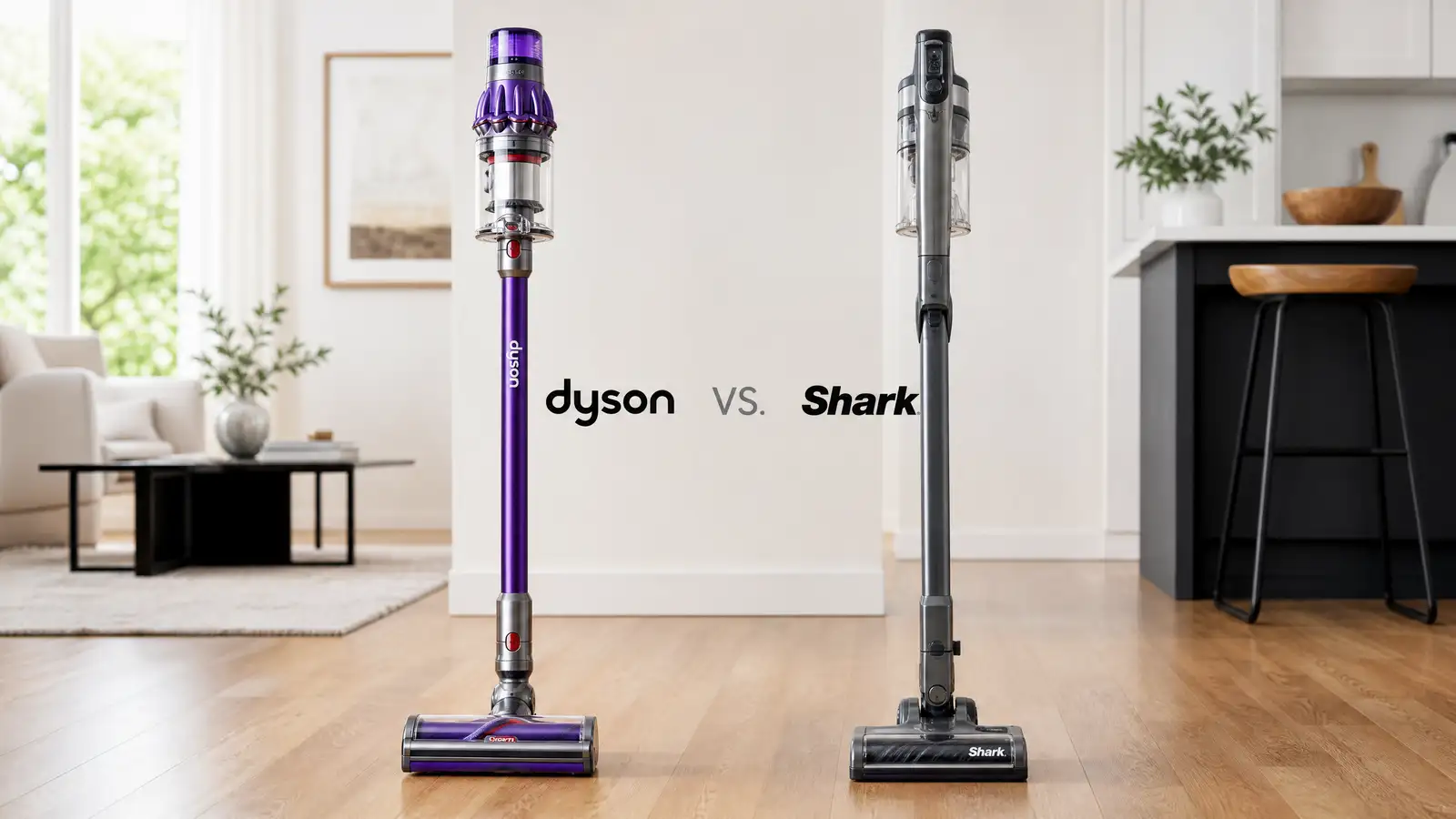
If you are shopping for a premium cordless vacuum in 2026, two names dominate the conversation: Dyson and Shark. Both companies make vacuums that cost $500 or more, and both claim to deliver the best cleaning experience in your home.
But they take very different approaches to solving the same problem.
The Contenders
Dyson Gen5detect is Dyson’s most powerful cordless vacuum. It features a Hyperdymium motor spinning at 125,000 RPM, producing up to 280 Air Watts of suction — the highest in Dyson’s lineup. It includes a laser dust detection system that illuminates particles invisible to the naked eye, and an auto-adjusting suction mode that changes power based on floor type.
Shark Stratos Cordless Vacuum (IZ862H) is Shark’s premium offering, priced significantly below the Gen5detect but claiming comparable cleaning performance. Its standout features include DuoClean floor head (two rollers working together), Anti-Hair Wrap technology, and a flex-to-the-middle wand that bends for under-furniture cleaning.
Suction Power and Cleaning Performance
Dyson’s 280 AW suction is objectively higher than any Shark model on paper. In real-world testing across hard floors and carpets, the Gen5detect picks up fine dust, pet hair, and larger debris in a single pass. The laser dust detection is not a gimmick — it genuinely reveals dust that you would otherwise miss, especially on hard floors in normal lighting conditions.
Shark’s suction is lower (Shark does not publish Air Watts for US models, but independent tests put it in the 150-200 AW range). However, the DuoClean dual-roller system means it often matches Dyson’s performance on hard floors despite lower suction. The two rollers work together: one soft roller captures large debris and fine dust simultaneously, while the second bristle brush digs into carpet fibers.
On carpets, Dyson pulls ahead. The extra suction translates to noticeably better deep-cleaning performance, especially on medium- and high-pile carpets. On hard floors, the difference is marginal.
Battery Life
Both vacuums use removable, rechargeable batteries:
- Dyson Gen5detect: Up to 70 minutes in standard mode, about 10 minutes in Boost mode. The battery is removable and replaceable.
- Shark Stratos: Up to 60 minutes with two batteries included (30 minutes per battery). Both batteries charge simultaneously on the dock.
Shark’s two-battery approach has a practical advantage: when one dies, you swap in the other and keep going without waiting for a recharge. For larger homes, this is meaningful. Dyson’s single larger battery gives you longer total runtime but requires waiting for a full recharge when it is depleted.
Filtration and Allergen Management
Both vacuums feature HEPA filtration that captures 99.97% of particles as small as 0.3 microns. For allergy sufferers, either vacuum will do the job.
Dyson goes a step further with its whole-machine sealing — every bit of air that passes through the vacuum goes through the filter, with no leaks. Shark’s filtration is also effective but some earlier models had minor sealing issues that allowed fine dust to escape. The Stratos appears to have addressed these concerns, but Dyson’s sealing has been consistent across multiple generations.
Design and Usability
This is where Shark has a clear edge. The Stratos’s MultiFlex wand bends in the middle, letting you clean under furniture without moving it and making the vacuum much easier to store upright. The Anti-Hair Wrap technology on the brush roll genuinely prevents long hair from tangling — a feature that anyone with pets or long hair will appreciate.
Dyson’s design is more rigid. It does not fold, and while its attachments are excellent (the Hair Screw tool is the best in class for pet hair on upholstery), it requires more physical maneuvering to reach under furniture.
The Gen5detect’s LCD screen displays particle count, remaining battery time, and maintenance reminders. It is informative and looks premium, but it is also another thing that can potentially fail over time. Shark keeps things simpler with LED indicator lights.
Price and Value
This is the biggest differentiator:
- Dyson Gen5detect: Typically $700-$750
- Shark Stratos IZ862H: Typically $350-$450, and frequently discounted during sales events like Prime Day
Shark delivers about 85-90% of the Gen5detect’s cleaning performance at roughly half the price. For most households, that is an excellent value proposition.
But Dyson’s extra cost buys you real advantages: higher suction power, better deep-cleaning on carpets, the laser dust detection system, and Dyson’s reputation for long-term durability (Dyson vacuums tend to last 5-10 years with proper maintenance).
Who Should Buy Which
Choose the Dyson Gen5detect if:
- You have mostly carpets or a mix of carpets and hard floors
- You or someone in your household has severe allergies (Dyson’s whole-machine sealing is best-in-class)
- You want the best cleaning performance regardless of price
- You appreciate premium design and technology features
Choose the Shark Stratos if:
- You have mostly hard floors
- You want the best value for your money
- You have a large home and want the two-battery convenience
- You have long hair or pets that shed (Anti-Hair Wrap genuinely works)
- You want a vacuum that folds for easier storage
The Bottom Line
Both are excellent vacuums. The Dyson Gen5detect is the better vacuum overall — more powerful, better sealed, more refined. But the Shark Stratos is the smarter buy for most people. It costs half as much, cleans nearly as well on hard floors, and its design features (MultiFlex wand, Anti-Hair Wrap, dual batteries) solve real practical problems that the Dyson does not.
If your budget allows and you want the absolute best, the Dyson Gen5detect delivers. If you want a vacuum that does everything well without the premium price tag, the Shark Stratos is hard to beat.
Sources: RTINGS — The 5 Best Stick Vacuums of 2026, CNET — Amazon Prime Day 2026 Vacuum Deals, AI Journal — Yeedi Prime Day Deals
Related: Dyson V15 Detect vs Shark EZ — our earlier comparison of Shark and Dyson cordless vacuums.