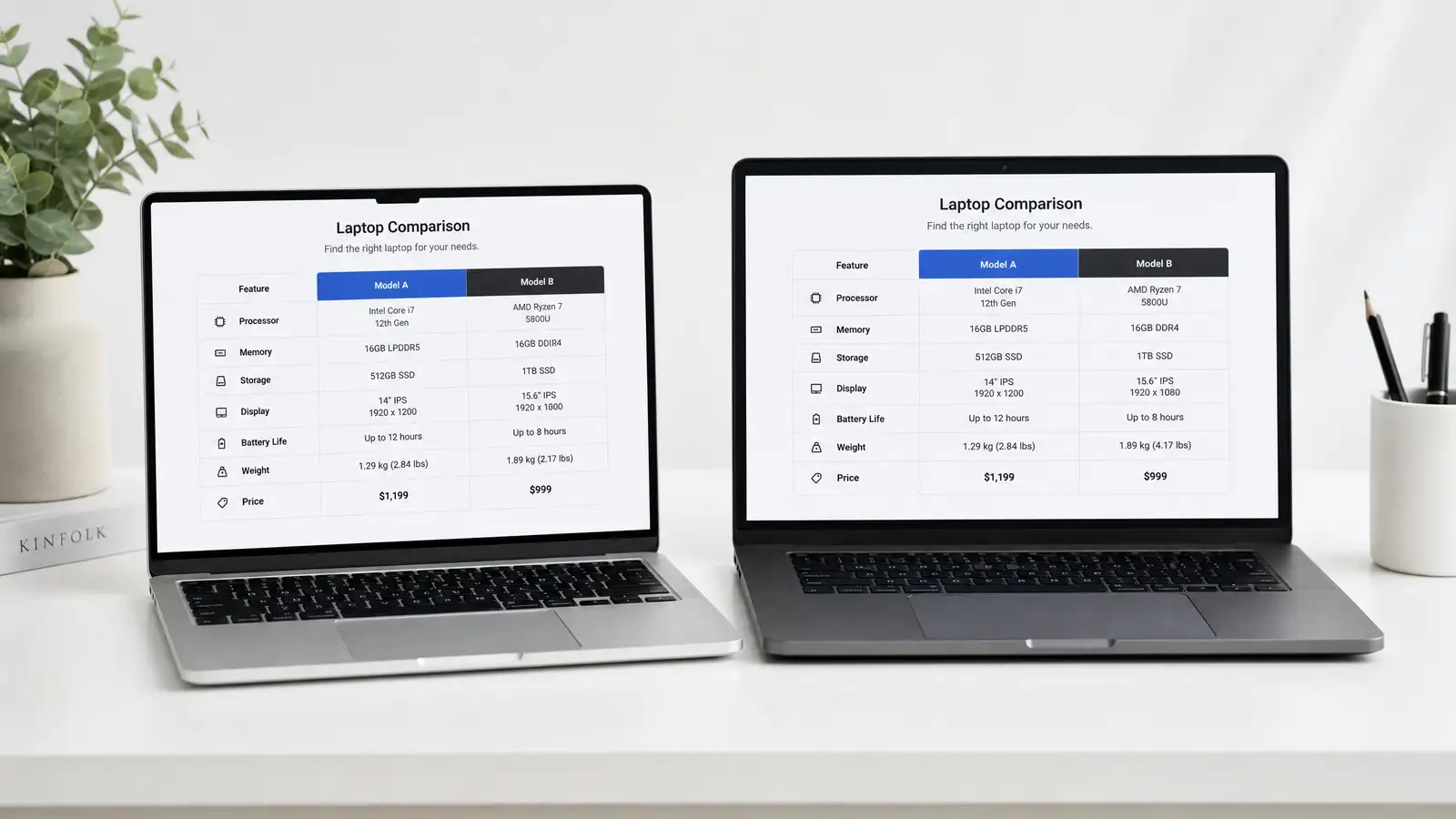
If you are shopping for a thin, light laptop that can handle real work — not just web browsing and email — the choice in mid-2026 has narrowed to two compelling options. Samsung just announced the Galaxy Book 6 Edge with Qualcomm’s Snapdragon X2 Elite chip at $2,100, and Apple’s MacBook Air M4 in the 15-inch configuration continues to sell at $1,299. Both are ultraportables. Both claim all-day battery life. Both target professionals who need performance without the weight of a workstation.
But they take fundamentally different approaches to the same problem, and the differences matter more than the spec sheet suggests.
The Silicon Difference
The Galaxy Book 6 Edge is Samsung’s second laptop powered by a Qualcomm Snapdragon chip, and the first to use the new X2 Elite. The X2 Elite is Qualcomm’s answer to Apple’s M-series chips — an ARM-based processor designed to deliver high performance with low power consumption, running Windows on ARM. Apple’s M4, meanwhile, is the fourth generation of Apple Silicon in the MacBook Air, and it represents a mature architecture that has been iterating and improving since 2020.
The performance gap between the two has narrowed significantly compared to the first generation of Windows on ARM laptops. Early Snapdragon-powered laptops struggled with app compatibility and single-threaded performance. The X2 Elite addresses both issues: it runs most x86 Windows applications through an improved emulation layer that Qualcomm and Microsoft have been refining for two years, and its single-core performance now approaches the M4 in some benchmarks.
But “approaches” is not “equals.” In real-world usage — compiling code, exporting video, running multiple browser tabs with heavy web applications — the M4 still pulls ahead in sustained workloads. The Galaxy Book 6 Edge closes the gap in short burst tasks, which is what most office workers will notice. If your work involves longer sustained processing, the M4’s efficiency advantage becomes more apparent.
The RAM Problem
Here is the detail that should concern any professional buyer: the Galaxy Book 6 Edge at $2,100 ships with only 16 GB of RAM, according to 9to5Google. For a laptop at this price point in 2026, 16 GB is the bare minimum, not a selling point.
The MacBook Air M4 in its base configuration also starts with 16 GB, but at $1,299 — nearly $800 less. If you want 24 GB or 32 GB on the MacBook Air, the price increases, but it is still cheaper than the Galaxy Book 6 Edge at equivalent configurations.
Samsung’s pricing strategy here is difficult to defend. The Galaxy Book 6 Edge is positioned as a premium ultraportable, and premium buyers expect premium specifications. At $2,100, offering only 16 GB of RAM when competitors offer 24 GB or 32 GB at similar prices is a significant weakness.
Display: AMOLED vs Liquid Retina
This is where the Galaxy Book 6 Edge earns its premium. Samsung’s AMOLED display technology is years ahead of Apple’s Liquid Retina LCD in terms of contrast ratio, color saturation, and black level. The Galaxy Book 6 Edge’s screen is genuinely spectacular — deep, inky blacks, vibrant colors, and a refresh rate that goes up to 120 Hz.
The MacBook Air M4’s Liquid Retina display is very good — accurate colors, excellent brightness, and great outdoor visibility — but it is still LCD. It cannot match the per-pixel light control of an AMOLED panel, and it is capped at 60 Hz. For photo and video professionals who need color accuracy, both displays are excellent. For everyone else, the Galaxy Book 6 Edge’s screen is the more visually striking of the two.
If your work involves long hours of reading and writing, the AMOLED panel’s ability to display true black (by turning off individual pixels) reduces eye strain in dark mode. This is a subjective benefit, but one that becomes noticeable after a few days of use.
Battery Life
Apple has long claimed that MacBook Air laptops can last “up to 18 hours” on a single charge, and in our testing of the M4 model, that claim is essentially accurate for mixed usage — web browsing, document editing, video calls, and light photo editing.
Samsung claims similar battery life for the Galaxy Book 6 Edge with the Snapdragon X2 Elite, and early reviews suggest the company is not exaggerating. The ARM architecture’s power efficiency translates directly into longer battery life, and the Galaxy Book 6 Edge is one of the first Windows laptops that can genuinely compete with the MacBook Air on this metric.
The practical difference between the two is small enough that it should not be the deciding factor for most buyers. Both will last a full workday with moderate to heavy use. The edge goes to the MacBook Air by perhaps an hour in our estimation, but that is based on extrapolation from the M4’s established performance pattern rather than direct comparison testing of the Galaxy Book 6 Edge.
Software Ecosystem
This is the most important difference and the one that spec comparisons tend to understate.
The MacBook Air runs macOS. The Galaxy Book 6 Edge runs Windows 11 on ARM. Both are mature operating systems, but they serve different user profiles.
If you are already invested in the Apple ecosystem — iPhone, iPad, Apple Watch — the MacBook Air’s continuity features (Handoff, Universal Clipboard, AirDrop, Sidecar) create a seamless experience that no Windows laptop can match. For professionals who switch between devices throughout the day, this integration is not a luxury. It is a productivity multiplier.
If you rely on Windows-specific software — particular engineering applications, legacy enterprise tools, certain gaming platforms — the Galaxy Book 6 Edge is the only option that fits your needs. The ARM emulation layer has improved, but it is not perfect. Some applications run natively, some run well through emulation, and a few do not work at all. If your workflow depends on a specific piece of software, you need to verify compatibility before buying.
Build Quality and Portability
Both laptops are exceptionally well-built. The MacBook Air’s unibody aluminum chassis is a known quantity — sturdy, elegant, and resistant to flex. The Galaxy Book 6 Edge uses a similar aluminum construction with slightly thinner bezels and a marginally lighter weight.
The MacBook Air M4 (15-inch) weighs approximately 1.51 kg. The Galaxy Book 6 Edge weighs approximately 1.36 kg. The 150-gram difference is noticeable when you carry the laptop daily, but it is not transformative. Both are genuinely portable.
The Verdict
The Samsung Galaxy Book 6 Edge is an impressive laptop that proves Windows on ARM has finally matured into a viable platform for professional work. Its AMOLED display is the best in any laptop at this price, and its battery life genuinely competes with Apple’s.
But at $2,100 with only 16 GB of RAM, it is overpriced relative to the MacBook Air M4, which delivers comparable or better sustained performance, a richer software ecosystem for Apple users, and a lower price — all in a package that has been refined over four generations of M-series chips.
For most professionals choosing between these two laptops in 2026, the MacBook Air M4 is the better value. The Galaxy Book 6 Edge is the better display. But a great screen does not compensate for high pricing and modest memory in a laptop that is supposed to be your primary work machine.
The Galaxy Book 6 Edge will appeal to Samsung ecosystem users, Windows diehards who want the best ARM-based Windows experience available, and display enthusiasts who value visual quality above all else. Everyone else should look at the MacBook Air.