Clamshell foldables have quietly become the most practical folding phones. They fold in half to fit in small pockets and tiny purses. They cost less than book-style foldables. And they appeal to a much broader audience than the spec-obsessed early adopters who bought the first Galaxy Fold.
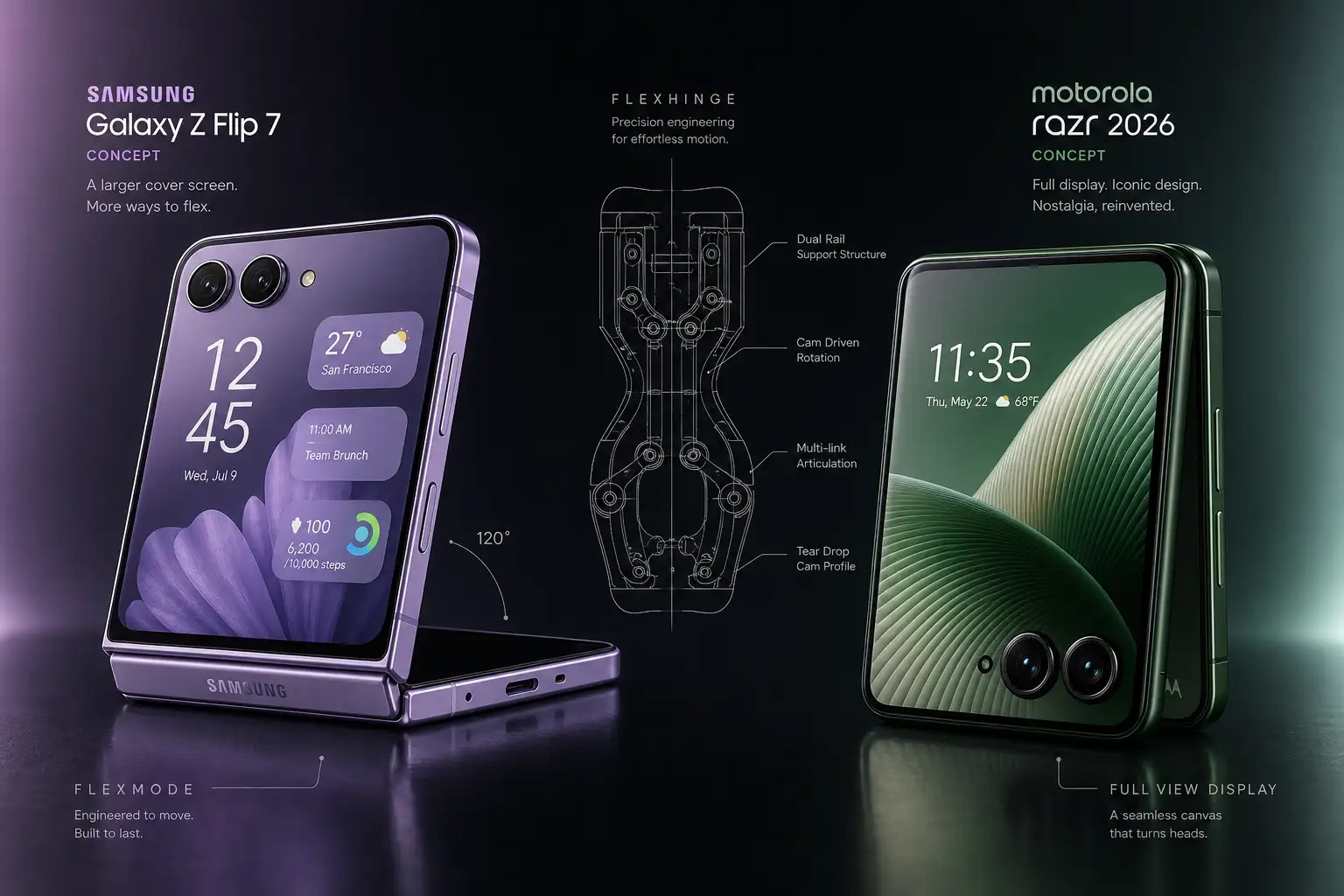
The Samsung Galaxy Z Flip 7 and the Motorola Razr 2026 are the two clamshells that matter. Both cost $999. Both fold vertically into a compact square. Both have large cover screens that let you do more without opening the phone. But they take different approaches to the same form factor, and the differences matter more than the similarities.
Cover Screen
Motorola changed the game with the Razr’s cover screen, and the 2026 model pushes it further. The 4.0-inch pOLED cover display runs at 120Hz and can do almost anything the inner screen can. You can reply to texts, browse Google Maps, scroll Instagram, and even watch YouTube — all on the outside of a folded phone. Motorola’s software lets you run any app on the cover screen, though some are more practical than others.
Samsung’s Z Flip 7 cover screen has grown to 3.9 inches but remains more restrictive. Samsung limits which apps can run on the cover screen to a curated list — messages, calendar, weather, music controls, and a handful of others — plus a few Samsung widgets. You can enable more apps through Good Lock, but it is an extra step that most users will not take.
Motorola’s cover screen is more useful and more fun. Samsung’s is more limited but also more focused, which some people prefer because it reduces the temptation to doom-scroll on a tiny screen.
Durability and Hinge
Samsung has the most refined hinge in the foldable business. The Z Flip 7’s hinge opens smoothly, stays at any angle (Flex Mode), and has an IPX8 water resistance rating. Samsung claims the hinge is rated for 400,000 folds — enough for over 10 years of use at 100 folds per day.
Motorola’s hinge on the Razr 2026 has also improved significantly. The IP52 rating means it handles splashes but cannot be submerged. The hinge feels solid and opens with a satisfying snap, but it does not hold intermediate angles as securely as Samsung’s Flex Mode.
Both have improved dust resistance compared to earlier generations. Samsung’s water resistance is meaningfully better if you live somewhere rainy or spend time near water.
Cameras
The Razr 2026 has a 50MP main camera and a 13MP ultrawide with macro capabilities. The cover screen serves as a viewfinder for selfies, which means you can take photos with the main camera rather than a lower-quality front-facing camera. The results are noticeably better than traditional selfie cameras.
The Z Flip 7 has a 50MP main camera and a 12MP ultrawide. Samsung’s processing produces more saturated, social-media-ready photos. The FlexCam feature — propping the phone half-open on a table for hands-free photos — is genuinely useful for group shots and timelapses.
Neither camera system beats a flagship slab phone in the same price range, but both are good enough for everyday photography. The Razr’s cover-screen selfie advantage is significant if you take a lot of self-portraits.
Battery Life
The Z Flip 7 has a 4,000mAh battery that gets through a full day of moderate use. 25W wired charging and 15W wireless charging are supported but slow compared to non-foldable flagships.
The Razr 2026 has a 4,200mAh battery with 30W wired charging and 15W wireless charging. The slightly larger battery and more efficient cover screen (which reduces the need to open the phone) translate to noticeably better battery life — about 20% more screen-on time in real-world use.
Both will need charging by bedtime on heavy-use days. The Razr lasts longer.
Software and Updates
Samsung promises four years of Android updates and five years of security patches. One UI on the Z Flip 7 is polished, well-optimized for the folding form factor, and packed with features — some useful (Flex Mode panels), some less so (Bixby).
Motorola promises three years of Android updates and four years of security patches. The software is closer to stock Android with Motorola’s gestures (chop for flashlight, twist for camera) that remain genuinely useful. The near-stock experience feels cleaner than Samsung’s One UI but has fewer foldable-specific features.
Samsung wins on software support longevity and foldable optimization. Motorola wins on software cleanliness.
Verdict
The Samsung Galaxy Z Flip 7 is the safer, more refined clamshell foldable. The water resistance is best-in-class, the hinge is the smoothest, the software is the most polished, and the update commitment is longer. If you want a clamshell that feels like a finished product, Samsung has been doing this the longest and it shows.
The Motorola Razr 2026 is the more fun, more practical clamshell. The cover screen actually replaces the main screen for quick tasks, the battery lasts longer, and the design captures the nostalgia of the original Razr without being gimmicky. If you want a foldable that changes how you use your phone rather than just how it fits in your pocket, the Razr delivers.