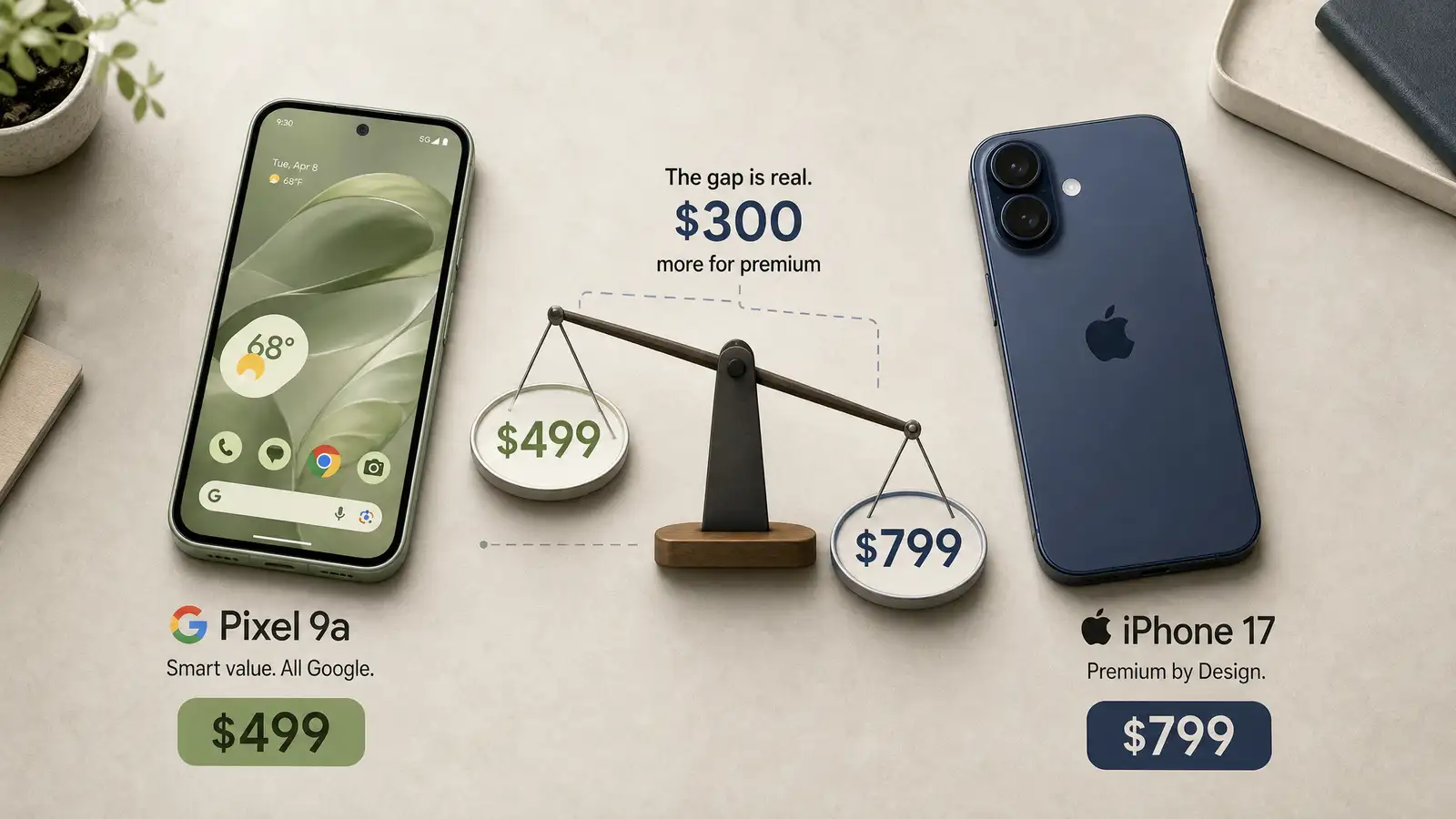
The smartphone market’s most enduring debate isn’t about flagship supremacy — it’s about value. Google’s Pixel 9a has been the budget king for a reason: at $499, it delivers nearly everything most people actually need from a phone. Apple’s iPhone 17, starting at $799, asks you to spend $300 more for the base-model experience.
That $300 gap represents real money. It’s a solid pair of wireless earbuds, a year of cloud storage, or a premium case and screen protector. So the question isn’t just which phone is better — it’s whether the iPhone 17 is $300 better.
Here’s the honest, spec-by-spec comparison.
Design and Build Quality
The Pixel 9a ditches Google’s signature camera bar for a cleaner look — dual lenses in the top-left corner inside a small oval bump, closer to an iPhone’s aesthetic than ever before. It’s a polarizing change for Pixel fans, but it makes for a thinner, flatter profile. At 185.9g and 8.9mm thick, it’s not the lightest phone in its class. The Gorilla Glass 3 front and IP68 rating provide solid everyday protection.
The iPhone 17 weighs in at 177g and 8mm — lighter and thinner than the Pixel 9a — and features Apple’s Ceramic Shield 2 on the front, offering three times better scratch resistance than the previous generation. The aluminum enclosure is clean and premium, available in five colors: black, white, blue mist, sage, and lavender.
The practical difference: Both feel well-built. The iPhone is lighter and has better scratch resistance on the glass. The Pixel’s IP68 rating matches the iPhone’s. Neither will survive a concrete drop without a case, but both can handle rain and spills without issue.
Winner: iPhone 17 (lighter, more scratch-resistant glass)
Display: Same Size, Different Technologies
Both phones feature 6.3-inch OLED displays with 120Hz refresh rates — a remarkable coincidence that makes this a direct comparison. But the underlying technology tells a different story.
The Pixel 9a uses a 6.3-inch Actua pOLED panel at 1080x2424 resolution with a fixed 120Hz refresh rate and 2,700 nits peak brightness. It’s a great display for the price — smooth, bright, and color-accurate.
The iPhone 17 upgrades to an LTPO Super Retina XDR OLED panel at 1206x2622 (~460 ppi) with ProMotion — a variable refresh rate that scales from 1Hz to 120Hz depending on what’s on screen. This means the display can drop to 1Hz when showing a static photo or the always-on clock, conserving battery. Peak brightness hits 3,000 nits, and the always-on display is a welcome addition that the Pixel 9a lacks.
The practical difference: In everyday use, both look excellent. The iPhone’s LTProMotion is smoother when scrolling and more efficient when idle. The Pixel’s fixed 120Hz is still great but can’t match the battery-saving benefits of variable refresh rates. The iPhone’s slightly higher resolution is barely perceptible at this size.
Winner: iPhone 17 (ProMotion LTPO, always-on display, higher brightness)
Performance: Tensor G4 vs A19
This is where the $300 price gap shows up most clearly in the specs.
Google’s Tensor G4 is a 4nm octa-core processor with a Mali-G715 MP7 GPU. In Geekbench 6, it scores around 4,527 (multi-core). It’s a capable chip designed around AI workloads — real-time translation, on-device summarization, Circle to Search, and Call Screen — rather than raw benchmark performance. In day-to-day use, the Pixel 9a feels smooth and responsive.
Apple’s A19 is a 3nm hexa-core processor (2x4.26 GHz performance cores + 4x2.60 GHz efficiency cores) with a 5-core Apple GPU. It outpaces the Tensor G4 by a significant margin in every benchmark category. Single-core performance is roughly 80% faster. GPU-intensive tasks like gaming, video editing, and AR experiences run noticeably smoother on the iPhone 17.
The practical difference: If you’re browsing, messaging, taking photos, and streaming video, both phones feel fast enough. The A19’s advantage only becomes obvious when you push the hardware — editing 4K video, playing demanding games, or using multiple heavy apps simultaneously. For the average user, the Tensor G4 is more than adequate.
Winner: iPhone 17 (but the gap matters less than benchmarks suggest)
Camera: Two Different Philosophies
The Pixel 9a features a dual-camera setup: a 48MP f/1.7 wide sensor with OIS and dual-pixel PDAF, paired with a 13MP f/2.2 ultrawide at 120°. The front camera is 13MP. Video tops out at 4K@60fps with gyro-EIS and OIS stabilization.
The iPhone 17 goes bigger with dual 48MP rear cameras: a 48MP f/1.6 wide with sensor-shift OIS and a 48MP f/2.2 ultrawide at 120° with PDAF. The front camera is an 18MP Center Stage sensor with autofocus. Video matches the Pixel at 4K@60fps but adds Dolby Vision HDR recording.
On paper, the iPhone’s dual 48MP setup looks superior. But Google’s computational photography has been closing the hardware gap for years. The Tensor G4’s image signal processor handles real-time HDR merging, Night Sight computational stacking, Best Take, and Magic Eraser — features that make mediocre hardware produce excellent photos.
The practical difference: In good lighting, both phones produce stunning photos that most people couldn’t tell apart in a blind test. The Pixel excels in challenging conditions — backlit subjects, night shots, and high-contrast scenes — where Google’s computational pipeline shines. The iPhone’s dual 48MP sensors capture more raw detail, which matters if you crop heavily or print large. For video, the iPhone’s Dolby Vision gives it a slight edge.
Winner: Pixel 9a for most users (better computational photography at a lower price), iPhone 17 for videographers
Battery Life and Charging
Here’s where the Pixel 9a pulls ahead on paper. Google packed a 5,100 mAh battery into the 9a — significantly larger than the iPhone 17’s 3,692 mAh. In real-world testing, the Pixel 9a delivers 9-11 hours of screen-on time, with an active use score of 12:42 hours on GSMArena’s battery test.
The iPhone 17 is rated for up to 30 hours of video playback. Apple’s chip efficiency and iOS optimization historically narrow the battery capacity gap, and the A19’s 3nm process is notably efficient. In mixed use, the iPhone 17 lasts a full day but doesn’t match the Pixel’s endurance.
Charging is a mixed bag. The Pixel 9a supports 23W wired charging and 7.5W wireless — neither is class-leading. The iPhone 17 supports roughly 35W wired charging (50% in 20 minutes with a 40W+ adapter), MagSafe, and Qi2 wireless charging.
The practical difference: The Pixel 9a will outlast the iPhone 17 in mixed daily use, often by a noticeable margin. The iPhone charges faster when you do plug in. If you’re a heavy user who needs the phone to last from morning to late night without a top-up, the Pixel’s larger battery is a genuine advantage.
Winner: Pixel 9a (larger battery, longer endurance)
Software and Ecosystem
The Pixel 9a ships with Android 15 and is upgradeable to Android 16, with a commitment of 7 years of major OS updates and security patches. That means support through at least 2032. Google’s AI features — Circle to Search, Add Me, Call Screen, and the Gemini assistant integration — are baked into the OS and improve with each update.
The iPhone 17 runs iOS 26 with Apple Intelligence features including Clean Up, enhanced Siri, and deeper integration across Apple devices. Apple typically supports iPhones for 6-7 years, so the iPhone 17 will likely receive updates through 2031-2032 as well.
The ecosystem question is the real differentiator. If you own a Mac, iPad, or Apple Watch, the iPhone 17’s integration — AirDrop, Handoff, Continuity Camera, iMessage — creates a seamless experience that’s hard to replicate on Android. The Pixel 9a plays well with Google services (Photos, Drive, Gmail) across any device, but doesn’t offer the same hardware-level integration with other Google products.
The practical difference: If you’re already in Apple’s ecosystem, the iPhone 17 is the obvious choice — leaving would mean losing features you didn’t know you relied on. If you’re platform-agnostic or already use Google services heavily, the Pixel 9a’s flexibility is an advantage.
Winner: Tie (depends entirely on your existing ecosystem)
Storage and Value
The Pixel 9a starts at $499 for 128GB or $549 for 256GB. The iPhone 17 starts at $799 for 256GB or $899 for 512GB — Apple dropped the 128GB option entirely.
That $300 starting price difference is the most important number in this comparison. The Pixel 9a gives you a capable phone with a great camera, large battery, 7 years of updates, and a smooth 120Hz display for roughly two-thirds of the iPhone 17’s price.
Google also tends to discount the Pixel more aggressively within six months of launch. Street prices for the Pixel 9a have already dropped below $450 at several retailers. Apple’s pricing is remarkably stable — you’ll rarely find the iPhone 17 discounted meaningfully.
Winner: Pixel 9a (undeniably better value)
Bottom Line
The iPhone 17 is the better phone on paper. It has a faster processor, a more advanced display with ProMotion, dual 48MP cameras with Dolby Vision video, and the polish of Apple’s ecosystem. If budget isn’t a constraint and you’re already invested in Apple’s world, the iPhone 17 is a no-brainer.
But the Pixel 9a is the smarter buy for most people. At $499 (or less on sale), it delivers 90% of the iPhone 17’s experience for 62% of the price. The bigger battery, excellent computational photography, 7 years of software support, and a smooth 120Hz display make it one of the best-value phones you can buy in 2026.
For anyone switching phones this year who isn’t locked into Apple’s ecosystem, the Google Pixel 9a is the clear winner. Save the $300, buy a good case, and you’ll barely notice what you’re missing.