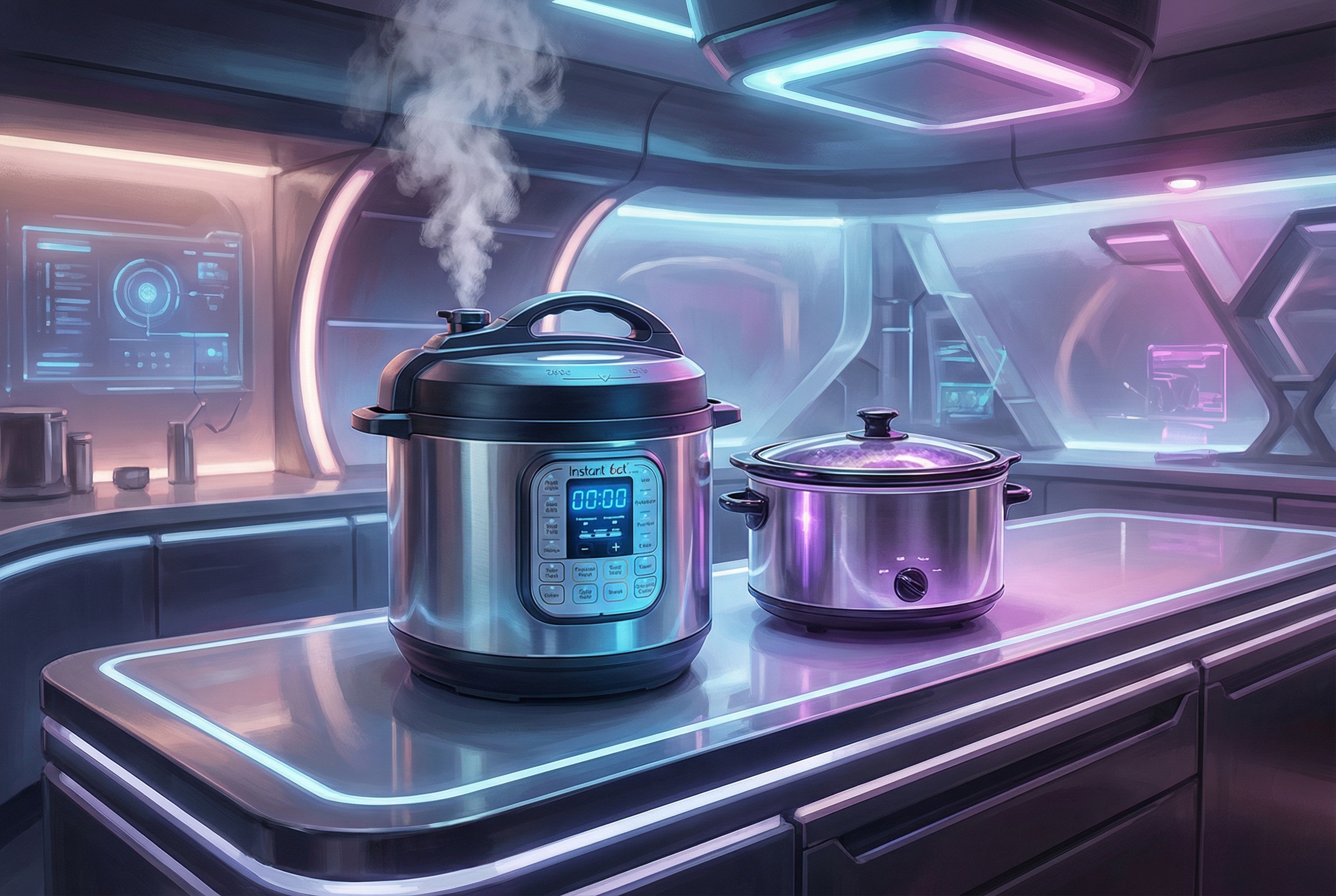
The debate between Instant Pot and Crock-Pot represents something deeper than just appliance preferences. it’s about different approaches to home cooking. One promises convenience through speed; the other champions the virtue of patience. I spent months testing both, cooking dozens of meals in each, to give you a definitive answer on which belongs in your kitchen.
Understanding the Difference
Before comparing specific products, let’s clarify the terminology. Crock-Pot is a brand name that has become synonymous with slow cookers. much like Kleenex is to tissues. Instant Pot, conversely, is an electric pressure cooker that also functions as a slow cooker, rice cooker, steamer, and more.
These are different cooking appliances that happen to share some functionality. Comparing them is like comparing a sports car to an SUV. both are vehicles, but they excel in different conditions.
The Instant Pot: Modern Versatility
The Instant Pot Duo Plus 6-quart represents the most popular model in Instant Pot’s lineup. It combines seven appliances in one: pressure cooker, slow cooker, rice cooker, steamer, sauté pan, yogurt maker, and food warmer.
The pressure cooking function is the star of the show. By trapping steam and raising internal pressure, the Instant Pot cooks food at temperatures up to 242°F. notably higher than boiling point. This dramatically reduces cooking times. A pot roast that would need eight hours in a slow cooker finishes in about an hour. Dried beans that typically soak overnight cook in 30 minutes.
The slow cooker function works adequately for times when you want traditional results, though the heating element sits at the bottom rather than surrounding the pot like in dedicated slow cookers. This affects some recipes but isn’t a dealbreaker.
The sauté function allows you to brown ingredients directly in the pot before pressure cooking. a crucial step for building flavor that slow cookers can’t replicate without a separate pan.
The Crock-Pot: Tried and True
The Crock-Pot 7-quart slow cooker is the gold standard for set-and-forget cooking. Its simple design has remained essentially unchanged for decades: a ceramic pot surrounded by a heating element, controlled by a simple dial or digital timer.
What the Crock-Pot lacks in features it makes up for in reliability. There are no complex settings, no electronic displays to malfunction, no pressure valves to troubleshoot. You set it on low or high, add your ingredients, and walk away for six to eight hours.
The slow cooker’s gentle heat. typically 180-210°F. transforms tough cuts like chuck roast and pork shoulder into fall-apart tender masterpieces. The long cooking time allows flavors to meld and develop in ways that faster cooking methods simply cannot replicate.
Cooking Time: The Dramatic Difference
This is where the Instant Pot shows its most dramatic advantage. Consider these comparisons:
- Pot roast: 8 hours (Crock-Pot) vs. 60-90 minutes (Instant Pot)
- Pulled pork: 8 hours vs. 60-75 minutes
- Dried black beans: 6-8 hours vs. 25-30 minutes
- Chicken soup: 6-8 hours vs. 20-25 minutes
The Instant Pot doesn’t technically cook “instant” meals. You must account for 10-30 minutes for the pot to come to pressure, plus natural pressure release time of 10-20 minutes for many recipes. Even with these additions, pressure cooking is 70-90% faster than slow cooking.
However, the Crock-Pot offers something Instant Pot cannot: true unattended cooking. You can start dinner in the morning, leave for work, and return to a ready meal. Instant Pots require you to be home when cooking completes to release pressure and serve.
Specifications
| Feature | Instant Pot Duo Plus | Crock-Pot 7qt |
|---|---|---|
| Primary Function | Multi-cooker | Slow cooker |
| Cooking Speed | 25-30 min (pressure) | 6-8 hours |
| Versatility | 7-in-1 | Single purpose |
| Flavor Development | Good | Excellent |
| Meat Texture | Tender | Fall-apart |
| Learning Curve | Moderate | Minimal |
| Price Range | $80-150 | $30-80 |
| Energy Efficiency | High | Lower |
Flavor and Taste Comparison
Here’s where opinion diverges sharply. In side-by-side testing of identical recipes, the Crock-Pot consistently produced deeper, more developed flavors.
The slow cooker’s long exposure to gentle heat creates what food scientists call the Maillard reaction over extended time. Sugars caramelize, proteins break down into savory amino acids, and individual flavors meld into something greater than the sum of parts.
The pot roast cooked in the Crock-Pot had a rich, roasted quality with deep brown gravy. The same recipe in the Instant Pot produced tender meat, but the gravy tasted thinner and less complex. The beef itself lacked the concentrated, almost caramelized exterior that hours of slow heat produce.
That said, Instant Pot’s sauté function helps bridge the gap. Browning meat before pressure cooking adds depth that slow cookers can’t match without using a separate pan. The high pressure also extracts flavor from bones for exceptionally rich broths in a fraction of the time.
For soups and stews, both appliances produce excellent results. The Instant Pot’s speed means you can make chicken soup on a weeknight without planning eight hours ahead. The Crock-Pot’s longer cook time creates marginally deeper flavor, but the difference is minor compared to the convenience advantage.
Texture: The Tenderness Factor
Both appliances excel at tenderizing tough cuts, but they achieve different textures.
Crock-Pot meat literally falls apart. The extended cooking completely renders fat and breaks down collagen, creating that prized pull-apart texture where meat shreds with minimal resistance. Pork shoulders become so tender they disintegrate at a touch.
Instant Pot meat is tender but retains more structure. The pressure cooking tenderizes efficiently, but the meat typically stays in one piece. This is actually preferable for dishes like pot roast where you want slices rather than shreds.
The Crock-Pot’s extended cooking time can overcook delicate vegetables. Carrots become mushy; potatoes can disintegrate. Instant Pot handles vegetables better since the shorter cooking time preserves more texture.
Energy Efficiency
Modern Instant Pots are remarkably energy-efficient despite their high wattage (around 1000W). They cook so quickly that total energy consumption is lower than appliances running for hours. The tight sealing and insulation mean the heating element operates only about 60% of the cooking cycle.
Crock-Pots use much less wattage (typically 200-300W) but run for 6-8 hours. The total energy consumption is actually comparable to pressure cooking, but the Crock-Pot draws power over a much longer period.
For environmentally conscious cooks, the Instant Pot has a slight edge. For those concerned about instantaneous power draw on older electrical systems, the Crock-Pot’s low draw is gentler.
Ease of Use and Learning Curve
The Crock-Pot is arguably the easiest kitchen appliance to operate. Add ingredients, set the dial to low or high, and walk away. There’s no timing to calculate, no pressure to monitor, no technique to master.
The Instant Pot has a steeper learning curve. Beyond basic pressure cooking, there are multiple functions to understand: pressure release methods (quick vs. natural), sauté temperature control, yogurt-making protocols, and more. The digital interface and multiple buttons can overwhelm newcomers.
However, once mastered, the Instant Pot offers vastly more flexibility. You can pressure cook, slow cook, make rice, steam vegetables, prepare beans from dry, and even bake cheesecake. This versatility means it can replace multiple appliances cluttering your counter.
Which Should You Choose?
After months of testing, here’s my recommendation:
Choose the Instant Pot Duo Plus if:
- Weeknight cooking speed matters to you
- You want versatility to replace multiple appliances
- You frequently forget to defrost ingredients
- Energy efficiency is important
- You enjoy experimenting with different cooking methods
- You don’t mind a moderate learning curve
Choose the Crock-Pot if:
- Set-and-forget convenience is your priority
- You work long hours and want dinner ready when you return
- Deep, slow-developed flavors are essential to you
- You prefer simple, foolproof operation
- Budget is a primary concern
- You primarily cook stews, roasts, and braises
The Final Verdict
The Instant Pot Duo Plus wins as the more versatile, modern kitchen appliance.
Here’s my reasoning: While the Crock-Pot produces marginally better flavor for specific dishes, the Instant Pot’s versatility and speed transform how you cook. The ability to make restaurant-quality chicken stock in an hour instead of eight, to pressure cook frozen chicken breasts to perfection, to make yogurt and rice and desserts in one device. these capabilities fundamentally change home cooking for the better.
The flavor difference, while real, is smaller than enthusiasts claim. For most home cooks, the convenience advantage of Instant Pot far outweighs the subtle flavor benefits of slow cooking. You can always slow cook in the Instant Pot when you want those traditional flavors.
However, many households benefit from owning both. Use the Instant Pot for quick weeknight meals and the Crock-Pot for weekend comfort food projects. Together, they cover all your slow-cooking bases.
If you must choose one, go Instant Pot. Its adaptability makes it the better investment for modern cooking needs.