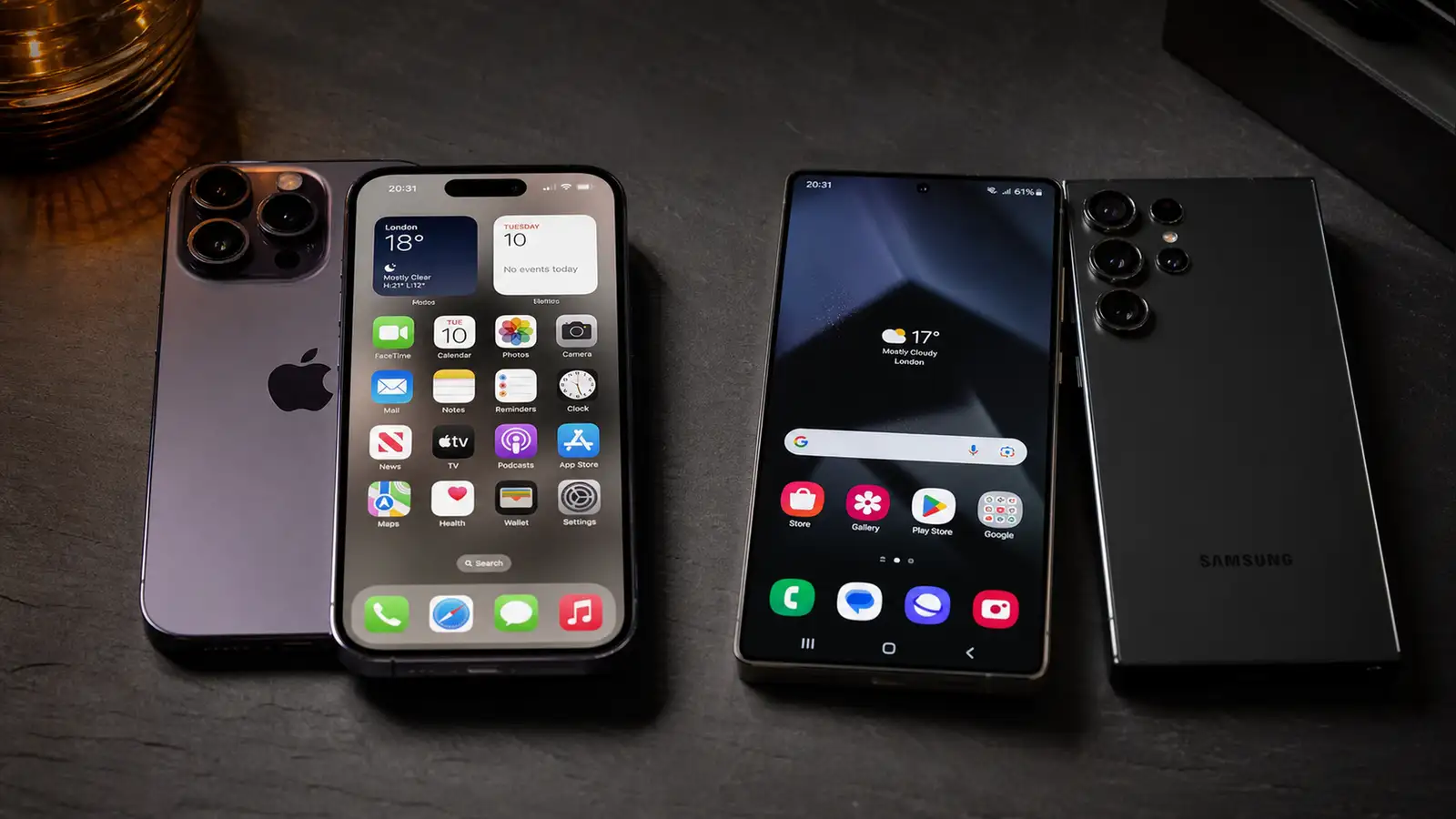
The $1,200 smartphone is not a rational purchase. Nobody needs a phone that costs as much as a used car. But if you are going to spend that kind of money anyway — and millions of people do, every year — you should at least know what you are actually getting for it. The iPhone 17 Pro Max and the Samsung Galaxy S26 Ultra are the two phones most people mean when they say “the best phone you can buy.” They are also different enough that choosing between them is not just a matter of brand loyalty. Here is how they compare across the categories that actually matter after the unboxing excitement wears off.
Design and Build: Titanium vs Armor Aluminum
Both phones are large. At 6.9 inches, neither one is comfortable to use one-handed, and both will struggle to fit in smaller pockets. The iPhone uses a titanium frame with a matte glass back, which gives it a slightly lighter feel despite the size — about 221 grams. The S26 Ultra uses Samsung’s Armor Aluminum frame with Gorilla Glass Armor on both sides, coming in around 234 grams. The weight difference is noticeable if you hold them side by side, but neither is light.
Durability is a wash. Both have IP68 water and dust resistance. Both survive drops from waist height onto concrete most of the time. The S26 Ultra’s squared-off corners and flat edges make it feel more substantial in hand but also make it slightly more prone to digging into your palm during long reading sessions. The iPhone’s rounded edges are more comfortable to hold for extended periods but also more slippery without a case. The S Pen slot on the S26 Ultra — a feature Apple has no equivalent for — adds utility for note-takers and people who sign documents on their phone, but it also takes up internal space that could have gone to a slightly larger battery.
Camera: Three 48MP Sensors vs a 200MP Megazoom
Apple packed three 48-megapixel sensors into the iPhone 17 Pro Max — wide, ultrawide, and telephoto. That means you get consistent image quality across all three lenses, which is not true on most phones, where the ultrawide or telephoto sensor is noticeably worse than the main one. TechRadar’s review called the photos “some of the best I have ever seen from a smartphone,” and the 8x optical-quality zoom holds up well against dedicated telephoto lenses on other flagships.
Samsung’s S26 Ultra takes a different approach. It uses a 200-megapixel main sensor that bins down to 12-megapixel images by default, which gives it an edge in detail when lighting is good and you are shooting at 1x. The telephoto system — a 50-megapixel periscope lens with 10x optical zoom — goes further than Apple’s zoom, but the quality drops off faster once you push past 10x into digital territory. Both phones do computational photography well, but they do it differently: Apple leans toward natural color and conservative exposure, while Samsung pushes saturation and contrast harder, which some people love and others find artificial.
For video, the iPhone still has a meaningful lead. Apple’s video stabilization and exposure adjustment during recording are smoother than Samsung’s, and the ProRes recording pipeline gives videographers a lot more flexibility in post. Samsung’s video is good but tends to hunt for focus more during motion and doesn’t handle mixed lighting as gracefully. If you shoot a lot of video, especially for anything beyond social media, the iPhone is the safer bet. If your camera use is mostly photos and you want the longest possible zoom, the S26 Ultra pulls ahead.
Looking ahead, Apple is expected to add a variable-aperture camera to the iPhone 18 Pro lineup this September — a mechanical aperture that physically opens and closes to control light intake, like a real camera lens. That upgrade, reported by MacRumors in late July, would improve outdoor video smoothness (more natural motion blur instead of the jerky look you get from very fast shutter speeds in bright light) and make Portrait Mode bokeh look more optical and less computational. If camera hardware is the deciding factor for you, waiting two months to see what Apple announces might be worth it. Samsung typically doesn’t refresh the Ultra until early the following year, so the S26 Ultra has another six-plus months as Samsung’s best camera phone.
Display: 6.9 Inches vs 6.9 Inches, Very Different Philosophies
Both phones have 6.9-inch displays. Both use LTPO panels that scale from 1Hz to 120Hz. Both get bright enough to read in direct sunlight. The differences are mostly about color tuning and the anti-reflective coating.
Samsung’s display pushes higher peak brightness — useful if you use your phone outdoors a lot — and the anti-reflective treatment on the screen glass is genuinely better at cutting glare than Apple’s Ceramic Shield. Apple’s display, on the other hand, has better color accuracy out of the box, which matters if you edit photos on your phone or care about how things actually look versus how vivid they look. The True Tone adjustment on the iPhone is also more subtle and effective than Samsung’s equivalent adaptive color mode, which sometimes overcorrects in warm indoor lighting.
Battery and Charging
Battery life on both phones is excellent. You will get through a full day of heavy use on either device. The S26 Ultra has a slight edge in battery endurance tests — roughly 10 to 15 percent longer in most benchmarks — largely because Samsung packs a physically larger battery into a slightly thicker frame. Apple compensates with better power efficiency from the A19 Pro chip, but the raw capacity difference shows up in screen-on time.
Charging is where Samsung pulls ahead clearly. The S26 Ultra supports 65W wired charging, which takes the battery from zero to about 70 percent in 30 minutes. The iPhone 17 Pro Max still tops out around 35W, which means an hour or more to get to the same level. Wireless charging speeds are closer — 25W on Samsung versus 15W on Apple with MagSafe — but Samsung still wins on raw speed. If you habitually forget to charge overnight and need a fast top-up in the morning, Samsung’s charging advantage is not trivial.
Software and Ecosystem
This is the part of the comparison where specs stop mattering and what you already own starts mattering a lot. If you use a Mac, an iPad, AirPods, or an Apple Watch, the iPhone 17 Pro Max integrates with those devices in ways Samsung cannot replicate. AirDrop, Handoff, iMessage sync, and the way AirPods switch between Apple devices without you touching anything — none of this has a Samsung equivalent that works as smoothly.
If your computing life runs on Windows and you use services like Google Photos, Google Drive, and Gmail as your primary tools, the S26 Ultra integrates better with that setup. Samsung DeX — the feature that turns the phone into a desktop computer when connected to a monitor — is genuinely useful if you travel light and sometimes need a bigger screen for work. Apple has nothing comparable.
Both phones receive long software support. Samsung now promises seven years of OS updates, matching Apple’s track record of supporting iPhones for roughly the same period. The difference is in update timing: Apple pushes iOS updates to all supported devices on the same day. Samsung staggers Android updates by region and carrier, which means some S26 Ultra owners wait weeks longer than others for the same feature release. If you care about getting new software features immediately, Apple’s rollout model is strictly better.
The Verdict
If camera consistency, video quality, and ecosystem integration are your top priorities, the iPhone 17 Pro Max is the better phone. If you want longer zoom, faster charging, and a display that performs better outdoors, the S26 Ultra makes a stronger case. Neither phone is a bad purchase. At $1,200, neither one is a rational purchase either. But if you are going to spend the money, the choice comes down to whether you value Apple’s polish and ecosystem lock-in or Samsung’s hardware flexibility and charging speed. That is not a tie in the sense that both phones are equal. It is a tie in the sense that which one is better depends entirely on what you personally care about.
A few concrete tiebreakers, since “it depends” is a frustrating way to end a comparison. Buy the iPhone 17 Pro Max if you already use Apple devices and the thought of switching ecosystems sounds exhausting — the integration benefits are real and they compound. Buy the S26 Ultra if you want the S Pen, if you need faster charging, or if the 10x optical zoom is something you will actually use (not just something that sounds good in a spec sheet). Buy neither if your current phone is less than two years old and still works fine, because the upgrade from a 2024 flagship to either of these is incremental, not transformative.