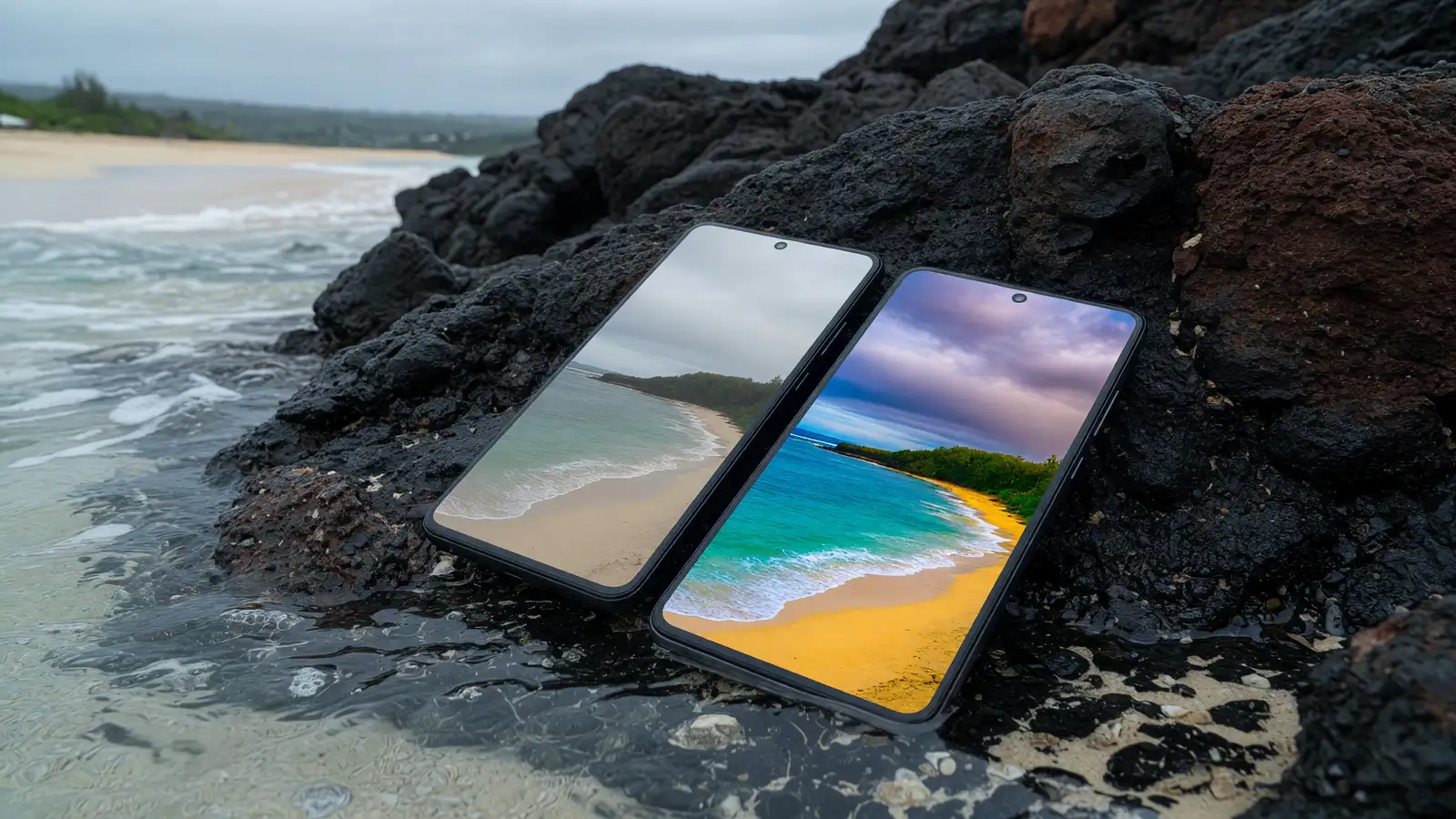
Axel Metz at TechRadar took an iPhone 18 Pro and a Galaxy S26 Ultra to Hawaii and shot them on the settings each phone ships with. His first line after the headline is the review: the difference is not detail. It is color science.
We already ran Pixel 11 Pro against this Ultra and Pixel 11 Pro against 18 Pro. The Pro Max versus Ultra page is a different chassis. This week’s increment is the smaller Pro, default processing, outdoor light, and a verdict that still gives Samsung the zoom.
Andrew Lanxon at CNET, writing October 3, parks both phones in the $1,000-and-up bin with Pixel 11 Pro, then warns that RAM and flash shortages are pushing electronics prices. That is the receipt. You are not picking a bargain. You are picking a look.
The spec sheet is a trap if you stop there
TechRadar’s table, condensed:
iPhone 18 Pro: 48MP wide, f/1.5–4.0, 24mm; 48MP ultra-wide, f/2.2, 13mm; 48MP tele, f/2.8, 100mm, 4x optical; 18MP front, f/1.9, 20mm. Default stills run a 24MP pipeline. Extra 8x is a crop.
Galaxy S26 Ultra: 200MP wide, f/1.4, 23mm; 50MP ultra-wide, f/1.9, 13mm; 10MP f/2.4 67mm 3x plus 50MP f/2.9 111mm 5x; 12MP front, f/2.2, 23mm. Default stills are 12MP pixel-binned. Extra 2x and 10x are crops.
200 versus 48 is the slide that sells the Ultra. Metz did not shoot the slide. He shot defaults. Apple’s “super-high-resolution” path still lands at 24MP files. Samsung bins to 12MP unless you go digging. If you wanted the 200MP file, you are not in this comparison. You are in a menu.
Timeline from the same page: S26 Ultra shipped globally in January. Oppo Find X9 Ultra and Xiaomi 17 Ultra showed up for UK buyers (Xiaomi also Australia; Oppo not). Pixel 11 Pro in August. iPhone 18 Pro is the new one, with a variable aperture people have already written separate love letters about, plus the video stack Metz is saving for another article.
Lanxon’s shopping piece adds the size joke both companies walked into: iPhone 18 Pro Max and Galaxy S26 Ultra are both 6.9 inches. Small phones are a rumor. The Pro in this test is not the Max. If your pocket is the constraint, do not borrow Max dimensions from CNET’s aside.
Optical-quality zoom marketing is the other trap. Both phones advertise extra steps via sensor crop. Metz scored zoom on true optical distances and said so. 4x on Apple. 3x and 5x on Samsung. If a store demo is an 10x crop, it is a crop.
Wide: muted versus punchy
The first Hawaii frame Metz describes is John Robinson’s “The Acrobats” by the beach. iPhone: more natural, heavier shadows, muted color. Samsung: brighter, more contrast, punchier, “arguably more artificial.” Torso of the statue and a patch of grass are where he says you see it immediately.
Later wide frames compress the gap. Detail looks even. Leaves still go greener on the Galaxy. That is a repeatable Samsung habit, not a one-off tropical white balance. If you like a postcard, the Ultra is already doing the postcard. If you like a file you can grade without fighting saturation, the iPhone is the calmer starting point.
This is why megapixels were the wrong fight. Both files have enough detail in good light that Metz will not give either a sharpness medal. The argument is taste. Taste is not a cop-out when the reviewer shot the same statue twice.
Low light, still on defaults: iPhone a bit brighter, sometimes more of the scene. Samsung’s style can still win depending on the subject. There is no “Ultra owns night” sentence on this page. There is a “depends” that should annoy anyone who wanted a lock. If your night shots are neon signs, Samsung’s contrast may look like the better camera. If your night shots are a face under a porch light, Apple’s extra brightness may keep the face.
Variable aperture on the 18 Pro was not used in these stills, on purpose. Metz wanted out of the box. Samsung has no equivalent control. His colleague Lance already wrote the aperture love note separately. Metz’s own summary: useful for how much background stays sharp, and for some flare in low light, and most people will never touch it. Do not buy 18 Pro only for a control you will leave on automatic. Do not ignore it if you already shoot phones like cameras.
Zoom is Samsung’s, selfies are Apple’s
Metz would take the Ultra if the job is versatile zoom. 5x optical versus 4x, plus the extra 3x Samsung has and Apple does not. He says the Galaxy gets you closer without giving up detail. That is the sentence to steal if you actually shoot signs across a street, wildlife you are not supposed to approach, or a stage from the back row.
Apple’s 4x 100mm is not a disaster in this write-up. It is shorter. Crop 8x exists and is labeled as crop. If your Instagram is 1x faces, zoom is a spec-sheet ghost. If your Instagram is architecture, the Ultra’s 3x+5x pair is the hardware.
Selfies go the other way, and Metz does not hedge. iPhone is the clear winner: larger 18MP sensor, framing tricks that are “genuinely useful.” Ultra’s 12MP f/2.2 front camera is the one you use because it is there. If the camera you share is the front one — it is, for a lot of people — Apple’s stills win is not a footnote. It is the camera.
Ultra-wide and macro get less of a sermon in the extract we have. Treat them as “both do it” until you care. The fight Metz is willing to pick is color on the wide, reach on the tele, faces on the front.
Do not bring last year’s “Samsung oversharpens” rant without looking at the Hawaii files. He is talking color and contrast, not a crunchy HDR halo, in the paragraphs we have. If you still hate Samsung processing, you will hate this Ultra. If you hated it in 2023 and have not looked since, this page is not your update. Metz is looking now.
Price, RAM, and the phone you will not buy
Lanxon, October 3: iPhone 18 Pro, S26 Ultra, and Pixel 11 Pro are among the best phones you can buy, they share fast chips and competent photography and large bright displays, and they share “AI tricks nobody asked for” and “whopping price tags.” Component shortage on RAM and flash is pushing costs. Foldables get worse. iPhone Duo is cited up to $3,199. That last number is why we already wrote 18 Pro versus Duo as a different product.
Midrange still exists. Lanxon names Pixel 10A and Nothing Phone 4A Pro as the “will not break the bank” lane. Wireless charging and multi-lens cameras leaked down. If your actual need is WhatsApp and a decent camera, this comparison is a spectator sport. Watch it, then buy the 10A.
If you are in the $1,000 lane anyway, Metz’s stills comparison is the one that maps to how you will use the object. Not Duo money. Not 200MP files you will never export. Default 1x, default zoom, default selfie, Hawaii sun.
Storage and RAM shortages mean street prices will move after this page. We are not printing a fake MSRP table from memory. Shop the two SKUs the same week you read this. The camera look will not change with a $40 coupon.
6.9-inch Max/Ultra sizes are Lanxon’s warning, not Metz’s test device. If you want the 18 Pro because it is not the Max, keep that. Do not let a 6.9-inch chart talk you into the wrong Pro.
What this test did not do
Metz stayed on defaults. That is the right test for a phone you will hand to someone who never opens Pro controls. It is the wrong test if you already shoot Samsung in Expert RAW or Apple in a locked 48MP mode. Those files exist. They were not Hawaii in this article. If your buying reason is a mode you have to enable every time, you are not Metz’s reader. You are a camera person who happens to carry a phone.
He also did not put Pixel 11 Pro in the suitcase. Color science arguments in 2026 are a three-body problem. Pixel’s look is the third body. We already did that pairing. Do not use this page to declare a “best camera phone of 2026” crown. TechRadar’s own intro said the race is open and that Chinese ultras are in the UK even when they are not in the US. Availability is part of the product. A Hawaii file from two phones you can buy at a US carrier is a US carrier story.
Video is the other hole. 18 Pro’s “pro-level video” is a bullet Metz postponed. Ultra’s video stack is a bullet he also postponed. If you shoot talking-head or concert clips, wait for that follow-up or go watch a dedicated video test. Stills color will not tell you about rolling shutter or mic placement.
Battery, weight, and display are not in Metz’s camera piece and not in Lanxon’s shopping tips as a head-to-head. Do not invent an S-Pen paragraph because the Ultra has always had one. This comparison is stills. The S-Pen does not take the statue photo.
Winner, with the zoom asterisk
Metz’s close is split and then not split. Galaxy S26 Ultra is his preferred camera phone for zoom and stylized shots. iPhone 18 Pro is the more consistent wide shooter in good light and low light, with the better selfie camera, plus the aperture controls he did not even use in the test. He is sticking with the iPhone until the next wave of camera-first Chinese flagships.
This site needs one winner field. We are putting iPhone 18 Pro there because Metz is keeping it, and because the default camera for most owners is wide plus front, not 5x. If you are the person who actually lives at 3x and 5x, you should buy the Ultra and ignore the field. That is a real fork, not a hedge.
Portrait and video are explicitly not in this article. Metz says those comparisons are coming. Do not pretend this page covered bokeh or 4K. It covered color, zoom reach, and selfies on defaults.
Samsung will keep selling 200MP. Apple will keep selling variable aperture. Hawaii, in this test, did not care about either number as much as it cared about whether the grass looked like grass or like a filter. If you want grass, 18 Pro. If you want the postcard and the extra optical steps, Ultra. If you want Pixel color, that is a third phone we already compared, and it is not in Metz’s suitcase.