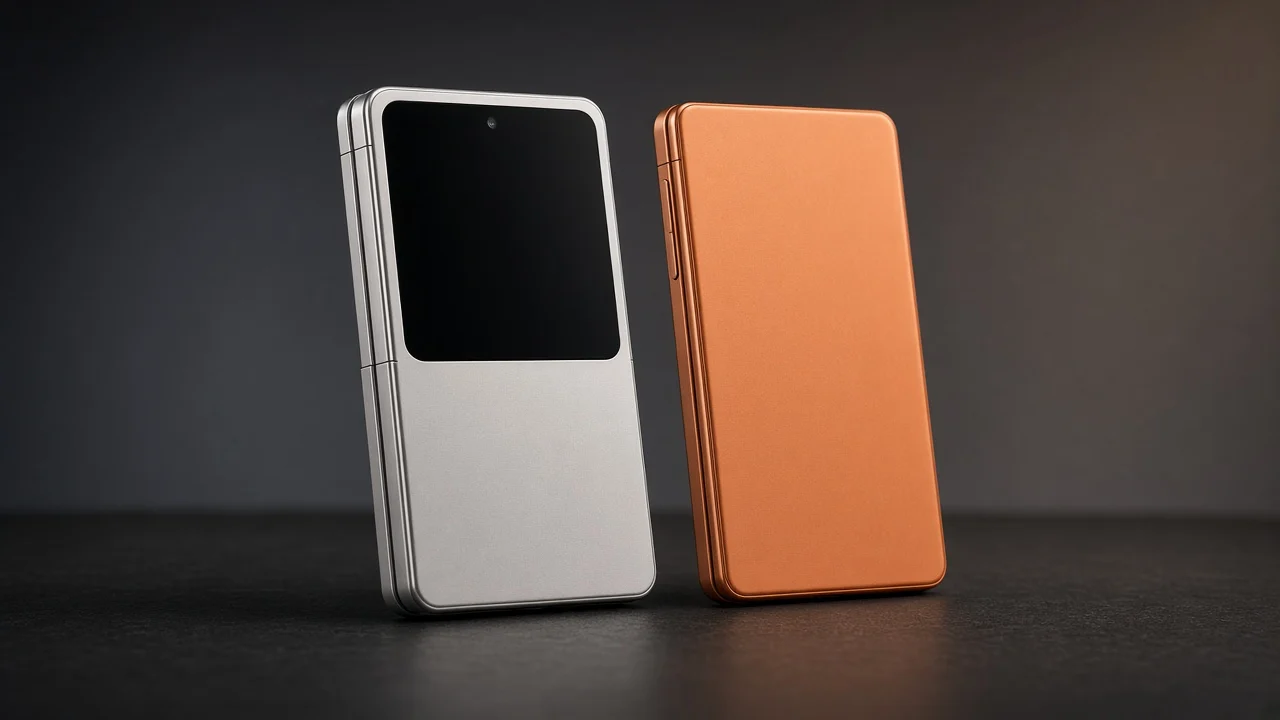
A November 15, 2026 comparison from Engadget put two book-style foldables on one spec sheet: Apple’s iPhone Duo and Oppo’s Find N6. The piece is by Gabriela Vătu, with photo credit to Sam Rutherford and Mat Smith. It is not a new launch week for either phone. Engadget dates Find N6 availability to spring 2026 and Duo sales to October 23 in more than 70 countries. What is current, as of that mid-November page, is the side-by-side itself: displays, thickness, water ratings, cameras, battery claims, and price.
This site did not put either phone in a lab. The figures below come from that Engadget page and from the Apple iPhone Duo shop page opened against it. Where the two pages agree, the number is on firmer ground. Where only Engadget prints a figure, that is labeled as Engadget’s reading of a company claim or of a hands-on note, not as a measurement from this site.
The useful question is narrower than which foldable is better. These phones do not compete on the same constraint. One row is an Apple Store SKU with a published video-playback claim, a dual rear camera, and a titanium frame. The other is a thinner Oppo book with a published 6,000mAh cell, a periscope, and no United States launch. If your work needs a telephoto, a known cell size, or a cover screen large enough to use like a normal phone, the Find N6 sheet answers that before the price does. If you need a water rating Engadget reads as full IP68, an Apple configurator, and video-hour claims Apple repeats on its own shop page, the Duo sheet answers that instead. Engadget’s close is the right one to keep: neither page declares an overall winner.
How to read the two sheets
The comparison locks each side to one product, not to a whole family. On the Apple side the shop page is the iPhone Duo, not the iPhone 18 Pro that sits in the next column of the same comparison block. On the Oppo side Engadget is writing about the Find N6, and the retailer link on that page uses the model code CPH2765 for a dual-SIM global version. A different Duo storage tier changes the price. It does not change the camera count. A different Find N6 region changes whether you can buy it in a local store. It does not change the hinge story Engadget tells.
That lock-in matters because Engadget is explicit about the evidence standard. At the top of the piece, the writer says the Duo had not been tested in full beyond a few hands-on experiences, so the comparison sticks to specs on paper. Later, the same page says Duo sales began October 23. Both sentences are on the page. This article does not invent a shipping calendar to smooth them over. Treat the Engadget numbers as a published spec comparison with limited hands-on color, not as a finished battery rundown.
Apple’s shop page is a different kind of source. It is a configurator, not a review. It confirms display sizes, the dual-camera layout, the video-hour claims, the chip name, the colors, and the storage prices. It does not, in the text extracted from that page, print an IP code, a weight, a folded thickness, a milliamp-hour capacity, a nit peak, or a 50 percent charge time. Those gaps are part of the comparison. A missing number is not a zero.
This site already has other Duo pairings, including iPhone Duo vs iPhone 18 Pro Max and iPhone Duo vs Galaxy Z Fold 8. Those are different opponents. Do not borrow a camera verdict or a battery verdict from them and paste it onto the Find N6.
The spec sheet, with the source on each row
| Spec | Apple iPhone Duo | Oppo Find N6 |
|---|---|---|
| Outer / cover display | 5.4-inch Super Retina XDR (Apple). Engadget: same OLED family as the inner panel, 120Hz ProMotion, up to 3,000 nits | 6.62-inch cover, 120Hz, up to 3,600 nits (Engadget) |
| Inner display | 7.6-inch Super Retina XDR with nano-texture (Apple). Engadget: OLED, 120Hz ProMotion, HDR10 and Dolby Vision, up to 3,000 nits | 8.12-inch, near-square 1.1:1, 120Hz, up to 2,500 nits (Engadget) |
| Aspect ratio | Consistent 1.4:1 on both panels (Engadget) | Inner panel near-square 1.1:1 (Engadget) |
| Folded thickness | 0.44 inches (Engadget) | 0.35 inches (Engadget) |
| Unfolded thickness | 0.21 inches (Engadget) | Not stated on the Engadget sheet |
| Weight | 8.96 ounces (Engadget) | 7.94 ounces (Engadget) |
| Water and dust | IP68, glossed as immersion up to 19.7 feet for 30 minutes (Engadget). Not printed on the Apple shop text extracted here | IP56, IP58, and IP59, glossed as jets and submersion up to 4.9 feet for 30 minutes (Engadget) |
| Rear cameras | 48MP Fusion Main and 48MP Fusion Ultra Wide. Optical zoom options 0.5x, 1x, 2x (Apple). No telephoto on either page | 200MP Hasselblad main, 50MP ultrawide, 50MP periscope, 3x optical, tele-macro to 3.94 inches (Engadget) |
| Front camera | 12MP Center Stage (Apple) | Not stated on the Engadget sheet |
| Battery capacity | Not disclosed, per Engadget. Not printed on the Apple shop text | 6,000mAh (Engadget) |
| Video playback claim | Up to 44 hours on the outer display, up to 31 hours on the inner display (Apple and Engadget) | Roughly 26 hours of video on the larger screen, plus 25.8 hours of social browsing (Engadget, company claim) |
| Charging | About 50 percent in 20 minutes, wired (Engadget). Not on the extracted Apple shop text | 80W wired SuperVOOC, 50W wireless AirVOOC (Engadget) |
| Chip | A20 Pro, 6-core CPU, 7-core GPU with Neural Accelerators (Apple) | Not stated on the Engadget sheet |
| US buy path | Apple shop, from $1,999 for 256GB | Not launched in the United States (Engadget) |
| Colors named | Night Sky, Star White (Apple) | Blossom Orange, Stellar Titanium on the global shop listing Engadget cites |
Read the table as two columns with different evidence grades. Apple-labeled rows were on the shop page. Engadget-labeled rows were on the November 15 comparison. A row that names both means the two opened pages agree.
Displays: cover size versus inner shape
The display fight is the clearest split on the sheet, and it is not a nit contest alone.
Apple’s shop page calls the Duo the largest display of any iPhone, then specifies a 7.6-inch Super Retina XDR folding panel with nano-texture and a 5.4-inch Super Retina XDR outer display. It lists ProMotion, an Always-On display, and Dynamic Island on that Duo block. Engadget describes the inner panel as OLED with 120Hz ProMotion, HDR10, Dolby Vision, and peak brightness up to 3,000 nits, and says the smaller outer panel is the same OLED family. The shop page extracted here does not print a nit number or the letters HDR10. It does print Dolby Vision, but as a video format: Dolby Vision up to 4K at 120 fps. That is a recording spec, not a panel-brightness spec. Do not collapse them into one sentence.
Engadget’s Find N6 numbers are larger on the cover and larger on the inside, with a different shape. The cover is 6.62 inches. The inner panel is 8.12 inches at a near-square 1.1:1. Both Find N6 screens are listed at 120Hz. Peak brightness is uneven across the two panels: up to 3,600 nits on the cover, 2,500 nits on the inner display. The Duo, on Engadget’s telling, holds one peak, 3,000 nits, on both panels, and holds one aspect ratio, 1.4:1, on both panels.
The practical difference is what you do before you unfold. A 5.4-inch outer display is a glance screen and a camera preview. Engadget says Apple positions the shared 1.4:1 ratio for immersive video and for side-by-side multitasking once the phone is open. A 6.62-inch cover is closer to a normal slab. You can type, map, and message without opening the hinge. The Find N6 inner panel, at 1.1:1, is the book or small tablet shape. Engadget says that shape suits people who want that unfolded layout, and that both phones support tent and tabletop modes for hands-free video calls or streaming.
If your day is mostly closed-phone use, the Find N6 cover is the larger tool. If your day is mostly open-phone video at a consistent ratio, the Duo’s matched 1.4:1 panels are the design Engadget attributes to Apple. Brightness, on the numbers Engadget prints, favors the Find N6 cover outdoors and favors the Duo inner panel against the Find N6 inner panel: 3,000 nits versus 2,500 nits. Those are peak figures from one comparison page, not a side-by-side meter reading from this site.
Thickness, weight, and water
This is the row where the Find N6 wins on paper, and the row where the Duo wins on the rating Engadget prints.
Engadget measures the Find N6 at 0.35 inches folded and 7.94 ounces. The Duo is 0.44 inches folded, 0.21 inches unfolded, and 8.96 ounces. The weight gap is about one ounce. Engadget’s own gloss is fair: one ounce may matter after a full day of one-handed use, and it is not a dramatic gap. Thickness is the more pocket-relevant number. Nine hundredths of an inch does not sound like much until you are sliding a folded phone into a jacket next to keys, or holding it with a cup. The Find N6 is the thinner folded object on this sheet. The Duo’s unfolded thickness, 0.21 inches, has no Find N6 counterpart on the page, so that row stays one-sided.
Water is the reverse. Engadget says the Duo carries IP68 and glosses that rating as immersion up to 19.7 feet for 30 minutes. The Find N6 is listed with IP56, IP58, and IP59, glossed as powerful water jets and submersion up to 4.9 feet for 30 minutes. Engadget calls the Oppo protection solid and still short of Apple’s rating. The Apple shop text extracted for this article does not print those IP codes. If you need the rating on a first-party page before you trust a rain claim, the shop page opened here does not give it to you. The comparison page does.
Frame material is on Apple’s page: titanium frame and hinge cover. Engadget does not give a competing frame alloy for the Find N6 in the sections used here. Do not invent one.
Hinge and crease
Both companies are selling a crease story. Neither page says the crease is gone.
Engadget says Oppo built the Find N6 hinge as a Titanium Flexion Hinge and reduced hinge height variance to 0.002 inches. Oppo’s phrase, as the page reports it, is a zero-feel crease. Engadget then defines the phrase: it means the crease is not easily visible in normal use. It does not mean the crease is physically absent. The page’s hands-on note matches that definition. The crease felt shallower than on older devices. It was still visible. The line Engadget uses is that you might not feel it as much, and you can still see it.
Apple’s approach, on the same page, is a hinge built from more than 100 components to control opening and closing. The hands-on note there is almost the mirror image: the crease was very faint, often easier to feel with a finger than to see. It was still there. Apple’s shop page does not describe crease depth. It does say the phone is foldable, posable, and durable, and it names a titanium hinge cover. “Posable” is the shop-page word for tent and tabletop use. Engadget already said both phones support those modes. The shop page does not quantify hinge variance in thousandths of an inch. That 0.002-inch figure stays an Oppo claim as printed by Engadget.
A buyer who cares about crease should read both notes as partial. They are hands-on impressions attached to a spec piece, not a crease-depth lab with a shared instrument. They do agree on one point: both creases remain.
Cameras: two lenses against three
The camera split is structural, not a matter of taste in color science. This page does not have a shared photo set. It has module lists.
Apple’s shop page lists a 48MP Dual Fusion system: 48MP Fusion Main and 48MP Fusion Ultra Wide. Optical zoom options on that Duo block are 0.5x, 1x, and 2x. Duo Preview is on the list. The front camera is a 12MP Center Stage camera, with the page also naming tap to zoom and rotate, Center Stage for photos, ultra-stabilized video, Dual Capture, and Center Stage for video calls. Video on the Duo block includes Dolby Vision up to 4K at 120 fps. The same shop comparison, in the iPhone 18 Pro column, lists a telephoto and a variable aperture on the main camera. Those items are not in the Duo camera line. Engadget says the same thing in plainer words: no telephoto, and Duo Preview puts a live view on the outer display so a subject can see the frame.
The Find N6, on Engadget’s sheet, is a three-camera flagship layout. The main sensor is a 200MP Hasselblad unit. The ultrawide is 50MP. The periscope is 50MP at 3x optical, with tele-macro focus down to 3.94 inches. All three rear cameras are listed for 4K video at up to 60fps in Dolby Visual, and the main sensor is listed as capable of 120fps. Engadget’s hands-on sentence on that array is short and strong: the camera array was incredible. The Duo hands-on sentence is also short: crisp shots across a range of lighting, and disappointment at the missing telephoto.
Megapixels are not image quality. Engadget says that outright, and it is the right caution. A 200MP main sensor is a detail claim and a crop claim. It is not, by itself, a win in night color or in moving subjects. What the module list does settle is reach. The Find N6 sheet has a 3x optical step and a close-focus tele-macro distance. The Duo sheet tops out at 2x in the optical-zoom list Apple prints, which on a dual-camera phone is the usual crop from the main sensor, not a separate telephoto. If the shot you take most often is a distant sign, a stage, or a document across a table, the Find N6 list is the one that names a lens for it. If the shot you take most often is a person who needs to see themselves on the cover screen, Duo Preview is a feature the Oppo sheet in this comparison does not claim.
Front-camera numbers are one-sided. Apple prints 12MP. Engadget’s Find N6 sections used here do not print a front-camera resolution. Leave that cell blank rather than guessing.
Battery claims, and the number Apple still does not print
Battery is where the sheets refuse to line up, and where a careless comparison invents a winner.
Engadget says Apple has not disclosed the Duo’s battery capacity. The shop page opened for this article agrees by omission: it prints hour claims and does not print a milliamp-hour figure. The hour claims match across both opened pages. Up to 44 hours of video playback on the outer display. Up to 31 hours on the inner display. Engadget adds a charging line the shop text did not contain: fast wired charging to about 50 percent in around 20 minutes.
The Find N6 side is the reverse shape. Capacity is published: 6,000mAh. Charging watts are published: 80W wired SuperVOOC and 50W wireless AirVOOC. The endurance claim is shorter than Apple’s video claim and is tied to the larger screen: roughly 26 hours of video playback and 25.8 hours of social browsing. Those are company claims as Engadget prints them, not a shared test protocol. Video hours on a 5.4-inch outer panel are not the same job as video hours on an 8.12-inch inner panel. A higher hour number on the smaller screen can be true and still tell you less about a day of maps, camera, and messaging than a capacity figure does.
Engadget’s own weighing is the one to keep. On time-in-use claims, the Duo looks stronger on paper. On recharge speed, Oppo’s watt numbers are the ones with a published fast-charge story. You cannot add the two stories into a single endurance score without a test neither opened page provides.
There is a second Apple number on the shop page that does not belong in this battery paragraph unless it is fenced off. The iPhone 18 Pro column lists up to 45 hours of video playback. That is not the Duo. The Duo figures are the 44-hour outer claim and the 31-hour inner claim.
Chip, video tools, and what the Oppo sheet leaves out
Apple’s shop page names the Duo’s chip as A20 Pro, with a 6-core CPU, a 7-core GPU with Neural Accelerators, a dual 16-core Neural Engine, and hardware-accelerated ray tracing. Engadget’s comparison does not restate that chip line in the sections used here. It also does not name a Find N6 processor at all. A performance winner cannot be called from these two pages. One side has a chip name. The other side has a silence. Silence is not a loss. It is a missing row.
What the shop page does add, beyond Engadget’s camera summary, is a short feature list that explains how Apple wants the fold used. Duo Preview, Smart Take, and Kid Cue sit on the Duo camera block. The 18 Pro column on the same page marks several of those as absent. Photographic Styles are listed. Macro photography is listed. An under-display FaceTime camera and Edge Light for video calls are listed on the Duo block that follows the front-camera line. Those are software and hardware extras on a first-party page. They are not a reason to ignore the missing telephoto. They are a reason the Duo’s camera story is not only “two 48MP sensors.”
Engadget’s software paragraph, in the opening, says the Duo leans on Apple’s design language and ecosystem, and the close repeats that ecosystem fit matters if you already own other Apple devices. The Find N6 software story on that page is thinner. The comparison promises a software section in the introduction and then spends its concrete sentences on specs. Do not invent an update-year promise for either phone. Neither opened page prints a year count for operating-system support in the text used here.
Price, and the buy path that is not a discount
Price is the row most likely to be misread, because the two numbers are not from the same store.
Apple’s configurator, opened for this article, prices the Duo the same in Night Sky and Star White:
| Storage | Price on Apple’s shop page |
|---|---|
| 256GB | $1,999.00 |
| 512GB | $2,199.00 |
| 1TB | $2,599.00 |
| 2TB | $3,199.00 |
That matches Engadget’s endpoints: $1,999 for 256GB and $3,199 for 2TB. Engadget does not print the 512GB and 1TB steps. The shop page does. The shop page also advertises trade-in language and carrier financing. Those are offers with footnotes, not a lower sticker. The sticker used here is the “connect on your own later” price next to each storage tier.
The Find N6 price on Engadget’s page is a China launch price, not a US Apple-style configurator price. For 12GB of RAM and 256GB of storage, the page prints ¥9,999 and converts that to roughly $1,490. The page then says the phone has not launched in the United States, and that some shops offer a global version for $1,729.99 in Blossom Orange or Stellar Titanium. The retailer link on the page points at a dual-SIM global listing under the model code CPH2765. That shop page was not opened for this article. The $1,729.99 figure is Engadget’s report of those listings, not a price checked live here, and not an Oppo US MSRP. There is no Oppo US MSRP on the page, because the page says the phone has not launched there.
The gap people will quote is $1,999 versus roughly $1,490, or $1,999 versus $1,729.99. Both comparisons mix a live Apple sticker with a figure Engadget reported from another market or from a third-party shop. The China figure is also a 12GB RAM phone. The Duo configurator does not offer a RAM choice. Memory on that Apple page is tied to the storage tier you pick, and the page does not print a separate RAM number in the price block used here. You are not looking at two 256GB phones on one shelf with a $500 coupon between them. You are looking at an Apple SKU you can configure in Night Sky or Star White, and an Oppo SKU Engadget says you have to route around a missing US launch to obtain.
Engadget’s close still holds on cost: the Find N6 is the cheaper phone on the numbers that page prints, and it is the harder phone to buy if you are in the United States. The Duo is the phone with a first-party price ladder and a first-party color list. That polish is the cost.
What the two pages actually decide
The original read of these two sheets is that they answer different purchase constraints, and that several popular “winner” shortcuts fail the source test.
The shortcut that says the Find N6 is the better camera because 200 is larger than 48 fails Engadget’s own caution, and it also ignores what the lens list is for. The Find N6 is the phone with a named 3x periscope and a named tele-macro distance. That is a reach advantage on the sheet. It is not a blanket image-quality verdict. The Duo is the phone whose first-party page spends its camera lines on a dual Fusion pair, a 2x ceiling, Duo Preview, and 4K Dolby Vision at 120 fps. That is a different job: cover-screen framing and high-frame-rate video, not optical reach.
The shortcut that says the Duo lasts longer because 44 is larger than 26 fails the screen-size problem. Forty-four hours is the outer-display video claim. Twenty-six hours is a larger-screen video claim. The Duo’s inner-display claim is 31 hours, closer to Oppo’s 26, and still not the same test. The number that would let a buyer compare cells, milliamp hours, is printed only for the Find N6. Apple’s silence on capacity is a fact. It is not permission to treat the hour claim as a capacity.
The shortcut that says the Find N6 is simply $500 cheaper fails the store problem. ¥9,999 is a China launch price Engadget converts to roughly $1,490. $1,729.99 is a global shop figure on the same page. $1,999 is an Apple 256GB sticker confirmed on the shop page. Shipping, warranty, band support, and return rights are not in those three numbers. Engadget already flags the US availability problem. A lower figure you cannot buy locally is not the same object as a higher figure you can.
The shortcut that says the crease is solved on one side fails both hands-on notes. Oppo’s 0.002-inch variance claim and Apple’s 100-component hinge are different marketing units. Engadget saw a crease on both.
What the pages do decide is a short list. The Find N6 sheet is the thinner folded phone, the lighter phone, the phone with the larger cover, the phone with the published cell and the fast-charge watts, and the phone with three rear cameras including a 3x periscope. The Duo sheet is the phone with IP68 as Engadget reads it, the phone with matched aspect ratios, the phone whose video-hour claims appear on Apple’s own shop page, and the phone you can price in four storage steps without leaving apple.com. If two of those constraints dominate your week, the sheet already picked. If you need all of them, neither phone on these pages is that phone.
Who each sheet fits
Choose the iPhone Duo if the non-negotiables are an Apple shop listing, Night Sky or Star White, a titanium frame and hinge cover, and video-playback claims you can see on Apple’s page as well as on Engadget’s. The 256GB start is $1,999. The 2TB end is $3,199. Plan for a 5.4-inch cover, a 7.6-inch inner panel, a dual rear camera, and no telephoto. Treat IP68, the 8.96-ounce weight, the 0.44-inch folded thickness, the 3,000-nit peak, and the 20-minute charge-to-50-percent line as Engadget’s account, because the shop text opened here does not repeat them. Treat the missing milliamp-hour figure as unknown, not as small and not as large.
Choose the Oppo Find N6 if the non-negotiables are a 6.62-inch cover, an 8.12-inch near-square inner panel, a 6,000mAh cell, 80W wired charging, and a 3x periscope with tele-macro down to 3.94 inches. Engadget’s weight and thickness, 7.94 ounces and 0.35 inches folded, are the slimmer column. The water rating on that page is IP56, IP58, and IP59, not the IP68 line attached to the Duo. The price you can cite from the page is ¥9,999 in China for 12GB and 256GB, roughly $1,490 in Engadget’s conversion, or $1,729.99 at the global shops the page mentions, in Blossom Orange or Stellar Titanium. If you need a US launch, a US warranty counter, and a chip name, this sheet does not give them to you.
Skip both, for this week’s decision, if you needed a shared lab test. Engadget said the Duo had not been fully tested beyond hands-on notes, and the Find N6 camera praise on that page is a hands-on sentence, not a scored photo comparison. The two opened pages are enough to refuse a bad match. They are not enough to rank image quality, radio bands, or repair cost.
The pair is a spec comparison with a date on it: Engadget on November 15, 2026, checked against Apple’s Duo shop page. Storage prices and the dual-camera list are first-party. Find N6 capacity, watts, hinge variance, and the US availability gap are Engadget’s report of Oppo’s sheet and of the buy path. Keep those sources separate, and the choice is narrower than the headline makes it sound.