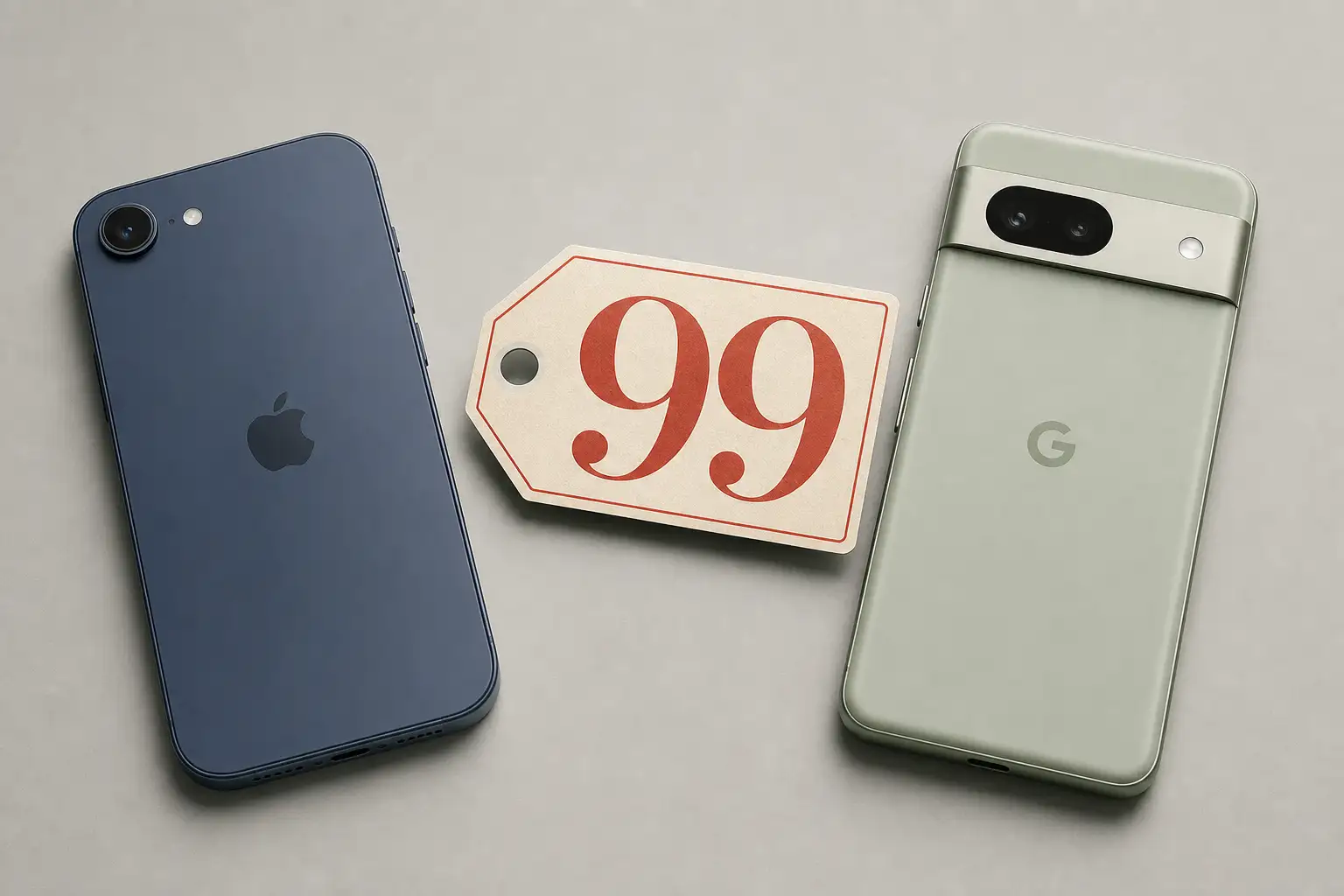
Not everyone needs a $1,000 phone. The iPhone SE 4 and Google Pixel 9a both cost $499 and do 90% of what their flagship siblings do. The question is which 10% you give up, and whether that trade-off matters to you.
Apple and Google have very different ideas about what a budget phone should be. Apple gives you last year’s flagship processor in a familiar body. Google gives you this year’s camera software in a colorful plastic shell. After testing both, here is which $500 phone earns its spot in your pocket.
Design and Build
The iPhone SE 4 finally abandons the iPhone 8-era design. It now looks like an iPhone 14 — 6.1-inch OLED display, flat aluminum sides, Face ID in the notch — with a single rear camera. The glass back supports wireless charging, and the IP68 water resistance matches flagships. It comes in black, white, and Product Red. It feels like an iPhone, because it is one.
The Pixel 9a is colorful and playful: matte polycarbonate back with aluminum frame, available in Peony pink, Iris purple, and Obsidian black. The camera bar across the back is distinctive without being obnoxious. The IP67 rating handles splashes but not submersion. It feels lighter and more casual than the iPhone — more fun but less premium.
The iPhone feels more expensive. The Pixel feels more approachable. Both are well-built. Apple wins on water resistance.
Display
Both have 6.1-inch OLED displays at 60Hz. This is the biggest shared compromise: neither phone has the 120Hz refresh rate that makes flagship phones feel smooth. If you are coming from a 60Hz phone, you will not notice. If you have used a 120Hz display, the difference is obvious.
The iPhone’s display is brighter — 1,200 nits peak versus 1,000 nits for the Pixel. Both are usable outdoors. The iPhone also supports HDR content with Dolby Vision. The Pixel’s display is perfectly fine but unremarkable.
Neither display is bad, but neither is exciting. At $499, that is expected.
Performance
The iPhone SE 4 uses the A18 chip — the same processor in the iPhone 17. It is absurdly fast for a $500 phone. Apps launch instantly. Games run at high settings. Video exports are faster than on some $800 Android phones. Apple’s silicon advantage means the SE 4 will still feel fast in five years.
The Pixel 9a uses the Tensor G4 chip, which prioritizes AI tasks over raw speed. It handles everyday apps smoothly but occasionally stutters during heavy multitasking or demanding games. The performance is adequate but not exceptional. Google promises seven years of software updates, which is industry-leading and makes the Pixel a better long-term investment than its processor suggests.
For raw speed, the iPhone dominates. For software longevity, Google’s seven-year commitment is unmatched at this price.
Cameras
The Pixel 9a has a single 48MP camera that uses pixel-binning to produce sharp 12MP photos. Google’s computational photography — Night Sight, Magic Eraser, Photo Unblur, Best Take — makes this single camera punch well above its hardware. Photos look detailed, colors are natural but vibrant, and portraits have convincing background blur without a dedicated depth sensor. This is the best single camera on any phone under $600.
The iPhone SE 4 has a single 48MP camera with Apple’s latest image processing. Photos are true-to-life with excellent dynamic range. Portrait mode works on people, pets, and objects. The camera app is fast and reliable. But without a telephoto or ultrawide, creative options are limited. The Pixel’s camera software offers more tools to play with.
Both take excellent photos for $500 phones. The Pixel’s computational photography edge gives it more versatility.
Battery Life
The iPhone SE 4 lasts a full day with moderate use — social media, browsing, streaming, photography. Heavy users will need a top-up by evening. 20W wired charging and 15W MagSafe wireless charging are supported.
The Pixel 9a’s 5,100mAh battery is the star of the show. It easily lasts a full day and well into the next with the same usage. This is the best battery life on any phone under $600. 18W wired charging and 7.5W wireless charging are slower than the iPhone’s.
The Pixel lasts significantly longer. The iPhone charges faster. If battery anxiety is your top concern, the Pixel is the clear choice.
Software
iOS 19 on the iPhone SE 4 is the full iOS experience: iMessage, FaceTime, Apple Pay, the App Store with every app optimized for iPhone. The experience is identical to a $1,000 iPhone. Apple typically provides 5-6 years of updates.
Android 15 on the Pixel 9a is clean, fast, and comes with Google’s best features: Call Screen, Hold for Me, Now Playing, and the Pixel-exclusive AI tools. Google promises seven years of updates — the Pixel 9a will get Android 22. No other $500 phone comes close.
Both software experiences are excellent. The iPhone integrates better with Apple’s ecosystem. The Pixel gets updates longer.
Verdict
The iPhone SE 4 is the better buy for people who want an iPhone at the lowest possible price without sacrificing performance. The A18 chip means it will age gracefully, and the iOS experience is identical to phones costing twice as much. The single camera and 60Hz display are the trade-offs, and they are reasonable at $499.
The Google Pixel 9a is the better buy for people who want the most value for $500. The battery life is exceptional, the camera software is best-in-class, and the seven-year update commitment is unmatched. The processor is not as fast as Apple’s, but it is fast enough for almost everything.
Both phones prove that $500 buys a genuinely great smartphone in 2026. You cannot make a wrong choice — just a preference between ecosystems.