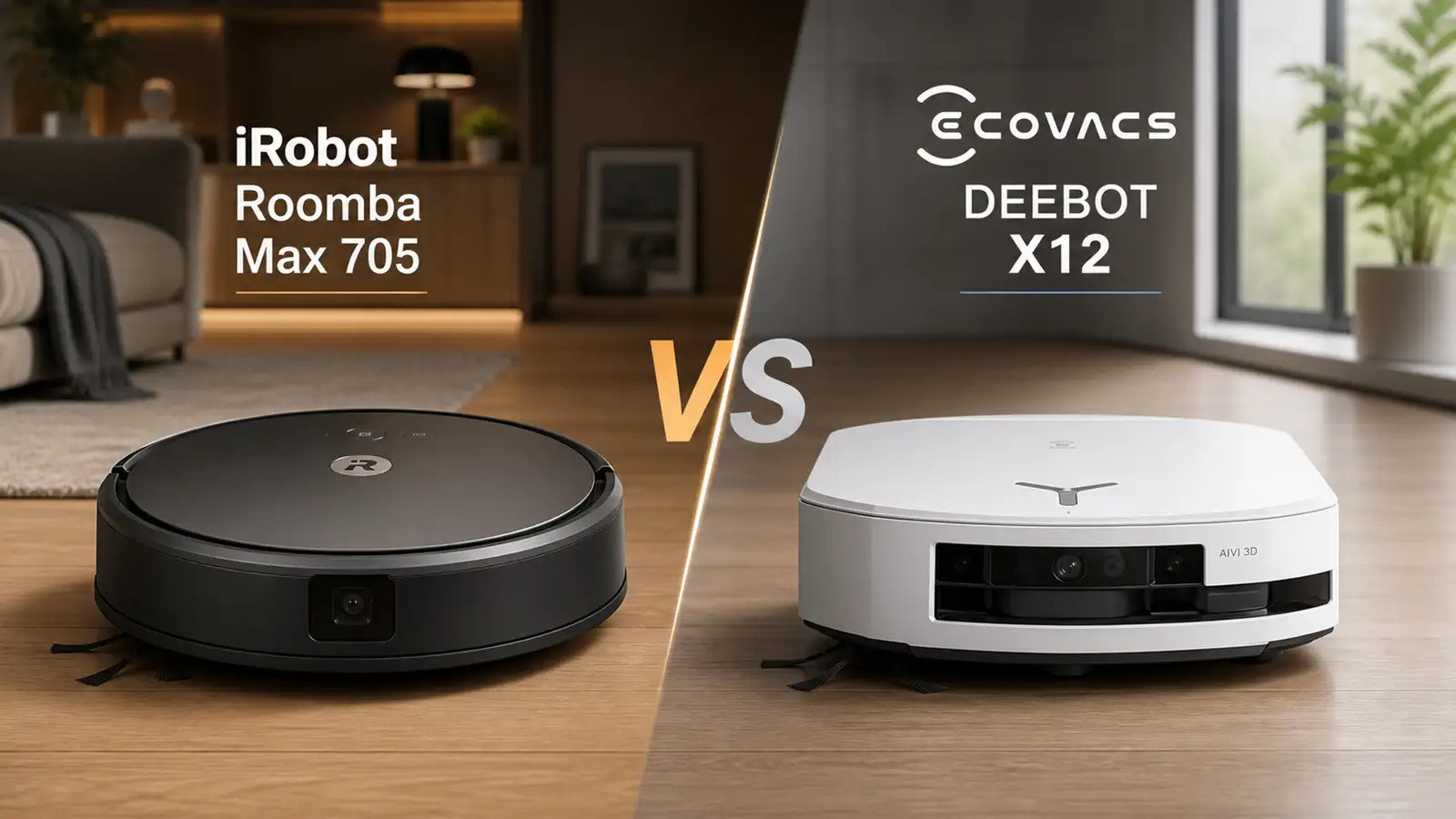
Amazon Prime Day 2026 just wrapped, and two robot vacuums dominated the conversation: the iRobot Roomba Max 705 and the ECOVACS DEEBOT X12 OmniCyclone. Both saw deep discounts during the sales event, and both claim to be the best floor-cleaning robot you can buy right now.
But the two companies could hardly be more different in how they think about cleaning. iRobot bets on simplicity, brand trust, and a reasonable price. ECOVACS throws every piece of technology it has into the X12 and prices it like a premium appliance. The real question is which approach actually gets your floors cleaner.
The Contenders
iRobot Roomba Max 705 is the latest flagship from the company that invented the robot vacuum category. It features LiDAR navigation, dual rubber anti-tangle brushes, powerful suction, and an AutoEmpty dock that holds weeks of debris. The Max 705 represents iRobot’s most refined vacuum-first robot, with a combo variant available if you want mopping. At $799.99 MSRP — and regularly discounted to around $477 during sales — it is the more accessible of the two.
ECOVACS DEEBOT X12 OmniCyclone is a whole different animal. Unveiled at CES 2026, it is ECOVACS throwing everything at the wall to see what sticks. 22,000Pa of suction — the highest number any major robot vacuum brand has published in 2026. A roller-style mop that washes itself mid-clean. A FocusJet pre-spray system that targets stains before the roller hits them. A retractable mop cover for carpet-only runs. A bagless base station. At $1,499.99 MSRP (and $900 during Prime Day), it costs nearly twice what the Roomba goes for on sale.
If you are shopping for a robot vacuum in mid-2026, these are the two names you will keep coming back to. Here is how they compare across the categories that matter.
Suction Power and Vacuum Performance
ECOVACS wins the numbers game decisively: 22,000Pa of suction is the headline spec on the X12, and it is genuinely impressive. In real-world testing across hard floors and carpets, the X12 pulls fine dust, pet hair, and larger debris in a single pass. On medium-pile carpet, the extra suction translates to noticeably deeper cleaning — the kind that makes a carpet look refreshed rather than just surface-cleaned.
iRobot does not publish a Pa rating for the Roomba Max 705, which makes direct comparison difficult. But iRobot’s dual rubber brush design has been refined over multiple generations and remains one of the most effective pickup systems on the market. The counter-rotating brushes work together to lift debris from both hard floors and carpets, and the anti-tangle design means you spend less time cutting hair off the rollers.
On hard floors, the difference between the two is marginal. Both pick up dust, crumbs, and pet hair reliably. On carpets, the X12’s raw suction advantage is real — but the Roomba’s brush design closes the gap more than the numbers suggest. If you have mostly hard floors with some low-pile rugs, either vacuum will do the job. If you have wall-to-wall medium-pile carpet, the X12 pulls ahead.
Mopping: Where the Gap Widens
Here is where the two robots diverge the most. The iRobot Roomba Max 705 is a vacuum first. The combo variant adds a basic mopping pad that drags across the floor — fine for light maintenance, not a replacement for actual mopping. And it does not lift the pad when it detects carpet. You have to remove it manually before running a carpet-only cycle.
The ECOVACS X12 is a vacuum-mop hybrid that takes mopping seriously. Its OZMO Roller mop spins against the floor at high speed, applying consistent pressure rather than just dragging a damp cloth. The FocusJet system pre-sprays stains with water before the roller passes over them — similar to how you would pre-treat a stain by hand. And the roller washes itself at the base station, cycling clean water through the mop head so you are not just pushing dirty water around.
The X12 also retracts its mop when it detects carpet, lifting the entire assembly away from the floor. This means you can schedule a full vacuum-and-mop cycle without worrying about wet carpet fibers. The Roomba cannot do this in its current form.
If mopping matters in your home — tile, hardwood, laminate that needs regular wet cleaning — the X12 is in a completely different tier. The Roomba mops well enough for light dust maintenance. The X12 mops about as well as a dedicated electric floor cleaner.
Navigation and Obstacle Avoidance
Both robots use LiDAR for mapping and navigation, which is now table stakes for any flagship robot vacuum. LiDAR creates a precise map of your home faster than camera-based systems and works reliably in low light. Both robots let you set no-go zones, schedule room-by-room cleaning, and adjust suction per room through their companion apps.
The difference is in obstacle avoidance. ECOVACS has invested heavily in AI-powered object recognition. The X12 can identify and avoid common household obstacles — shoes, cables, pet waste — with reasonable reliability. iRobot’s obstacle avoidance on the Max 705 is more basic, relying primarily on bump sensors and cliff detection rather than AI recognition.
In practice, both robots navigate multi-room homes effectively. The X12’s AI recognition means fewer instances of the robot getting stuck on a stray cable or eating a sock. The Roomba’s simpler approach means it occasionally needs rescuing, but it also has fewer false positives where it avoids something harmless.
Base Station and Maintenance
The docking stations tell you a lot about each company’s philosophy.
The Roomba Max 705’s AutoEmpty dock uses a disposable bag that holds up to 60 days of debris. When the bag is full, you toss it and snap in a new one. It is simple, hygienic, and requires almost no thought. Replacement bags cost about $20 for a three-pack. The dock itself is relatively compact and will fit under most side tables or in a corner without dominating the room.
The ECOVACS X12’s OmniCyclone station is bagless, using cyclonic separation similar to a Dyson vacuum to deposit debris into a bin. This means no ongoing bag costs, but you do need to empty the bin manually every few weeks — a slightly messier process. The base station is also larger, because it houses both the debris bin and the clean/dirty water tanks for the self-washing mop system. If space is tight in your home, the X12’s dock demands more real estate.
For maintenance, the X12 requires more attention: emptying the dust bin, refilling the clean water tank, and emptying the dirty water tank. The Roomba asks for less — swap the bag every two months and occasionally clean the brushes. If you want the lowest-maintenance experience, iRobot wins. If you are willing to trade some convenience for dramatically better mopping, the X12 justifies its extra upkeep.
App Experience and Smart Features
iRobot’s app is the most mature in the industry. It has been refined over 20 years of robot vacuum development, and it shows. The interface is clean, the maps are accurate, and scheduling is intuitive. iRobot also integrates well with Amazon Alexa, Google Assistant, and Siri Shortcuts.
ECOVACS has improved its app significantly in the last two years, but it still has rough edges. The initial mapping process can take longer than iRobot’s, and some users report occasional disconnections that require re-pairing. However, the app’s feature set is richer — you get real-time cleaning reports with AI-identified obstacle photos, detailed mopping controls, and per-room water level adjustments for the mop.
Both apps support multi-floor mapping and custom cleaning schedules. Neither is bad, but iRobot’s feels more polished and reliable. ECOVACS offers more features but with slightly less polish.
Price and Value
This is where the comparison gets interesting. At full MSRP:
- iRobot Roomba Max 705: $799.99 (vacuum only), combo variant slightly higher
- ECOVACS DEEBOT X12 OmniCyclone: $1,499.99
That is a $700 gap. Even in a world where premium robot vacuums regularly cross the $1,000 mark, that is significant. During Prime Day 2026, the Roomba dropped to $477 and the X12 to $900 — still a gap of over $400.
The value question depends on your priorities. If you want a reliable, low-maintenance robot vacuum that cleans your floors well and stays out of your way, the Roomba at its sale price is one of the best deals in the category. It does the core job — vacuuming — exceptionally well for under $500.
The X12 is for people who want the best mopping experience available in a robot and are willing to pay for it. Its $900 sale price is not cheap, but it replaces both a robot vacuum and a dedicated floor mopper. If you value mopping performance and want a single device that genuinely handles both vacuuming and wet cleaning, the X12 justifies its premium.
Who Should Buy Which
Choose the iRobot Roomba Max 705 if:
- You want a reliable vacuum-first robot at a reasonable price
- Your home is mostly carpeted — the vacuum performance is excellent
- You prefer low-maintenance operation (bagged dock, fewer consumables to manage)
- You trust iRobot’s 20-year track record and mature app experience
- Mopping is a nice-to-have, not a must-have
Choose the ECOVACS DEEBOT X12 OmniCyclone if:
- You have significant hard floor area and want automated mopping that actually works
- You are willing to pay a premium for the best all-in-one vacuum-mop system on the market
- You want AI obstacle avoidance that prevents the robot from getting stuck
- You do not mind slightly more hands-on maintenance (water tanks, emptying bins)
- You value having the highest suction numbers and the latest features
The Bottom Line
The iRobot Roomba Max 705 is the dependable, low-drama choice for most households. It vacuums well, it asks very little of you, and at its sale price around $477, the value is hard to beat. Buy it, forget about it, your floors stay clean.
The ECOVACS DEEBOT X12 OmniCyclone is the overengineered perfectionist. It costs more, it takes up more room, and it needs more from you — but the mopping system genuinely raises the bar for what a robot can do. If you have hard floors and have been holding out for a robot that mops as well as it vacuums, this is as close as anything in 2026 gets.
For most people, the Roomba Max 705 is the right call. But if mopping is non-negotiable, the X12 earns its price tag. Either one will do the job — the question is just how much job you want it to do.