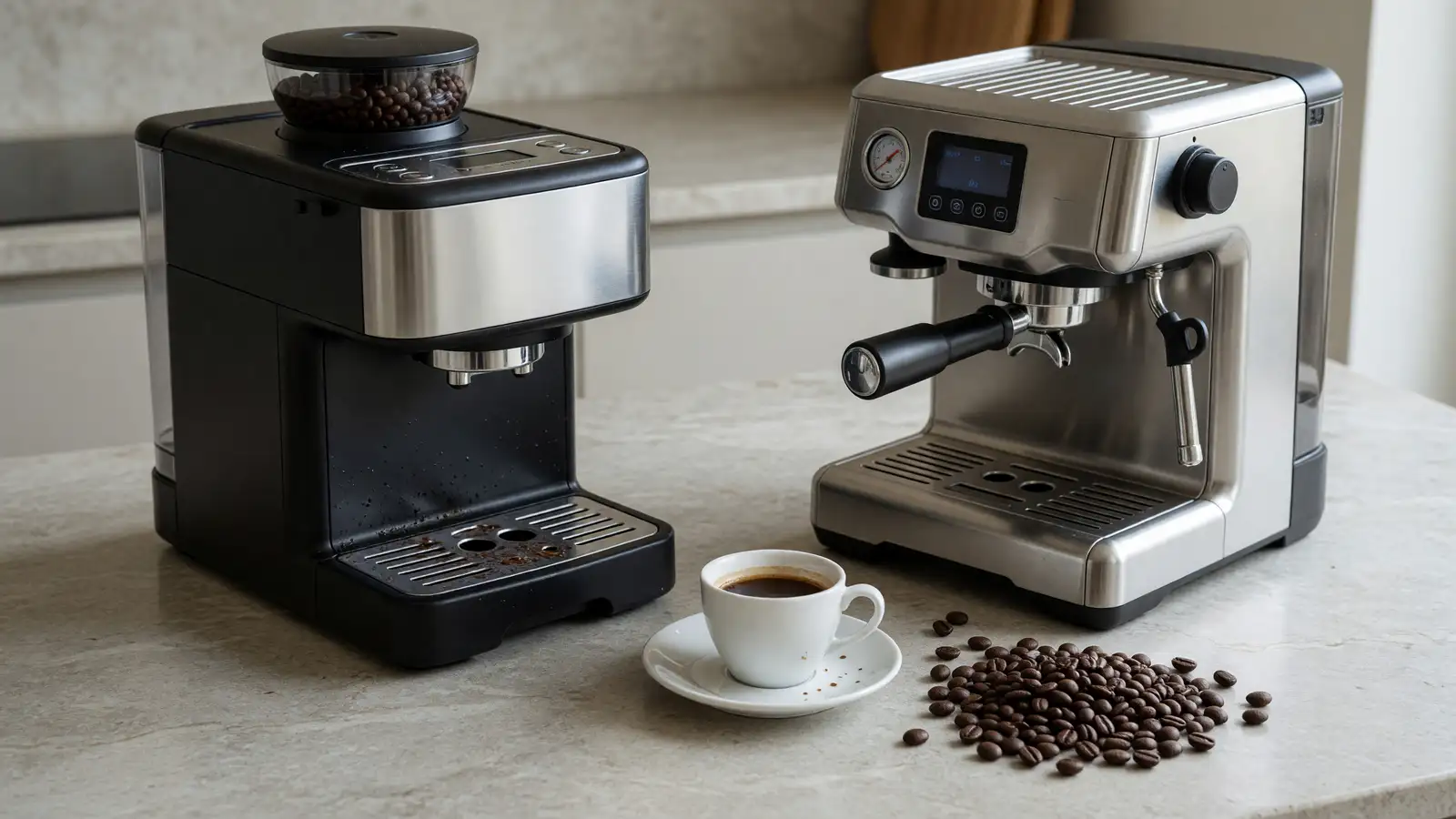
Good Housekeeping’s espresso roundup landed October 8 after the Kitchen & Cooking Lab ran more than 60 machines. Best overall: KitchenAid KF8 Fully Automatic, about $1,800 at Amazon, Walmart, and Wayfair. Best for pros: Breville Barista Pro, $850 list, $630 on the Amazon discount they printed (26 percent off), $849 at Walmart, $850 at Wayfair. One of those is a button. The other is a wand and 30 grind clicks. That is the review.
We already ran Nespresso versus Dolce Gusto as a capsule fork and Breville versus KitchenAid as stand mixers. This pair is espresso, same two brands, different job. Do not import the mixer winner.
What GH actually measured
The lab looked at espresso quality and consistency and at ease of use. The contributing writer cites six years on coffee appliances and Specialty Coffee Association coursework. Treat that as the test bench, not as a personality.
KitchenAid KF8: fully automatic, 15-BAR, 47-ounce water tank, 9.75 by 15 by 14.75 inches. GH says it earned a Kitchen Awards spot. You can customize temperature, body, and volume. Setup is easy. It was a top performer on both ease and espresso quality. The listed con is a drip tray you empty often. Switching hoppers left beans behind; a “grind and empty” cycle clears them. Best for: easy customization and lots of drink options. Skip if you hate emptying the drip tray.
Breville Barista Pro: semi-automatic with a built-in grinder. Thirty grind sizes, five temperature settings, four filter baskets (two single-wall, two double-wall). LCD that walks through grind and shot. Steam wand for milk you actually texture. GH says it heats up quickly, faster than many others they tried. Double-wall baskets help crema even with older beans or pre-ground. The listed con is that 30 grind sizes can overwhelm a beginner. Best for: fine-tuning a shot. Skip if you do not want to experiment.
Thyme & Table Barista Mini at $139 is in the same article as best value. It is not this comparison. Breville Bambino Plus is best small. Also not this comparison. The October 10 Spiral Luxe pour-over review is a $600 automatic kettle-and-bloom machine. Different drink. If you wanted pour-over, you are in the wrong aisle.
Price is the first spec
KF8: $1,800, printed three times. Barista Pro: $630 if you take the Amazon sale GH showed, otherwise about $850. Call it a 2-to-3x gap on sale and a roughly 2x gap at list. Fully automatic machines charge you for not learning a puck. That can be rational. It is not subtle.
Water capacity already hints at the chore schedule. 47 ounces on the KF8 versus the larger tanks on several semi-autos in the same roundup. Combined with a drip tray GH flagged as frequent, the expensive machine is the one you babysit in small ways all week. The cheaper machine asks you to learn a shot, then asks less often for tray theater, depending on how you steam.
Counter depth: 15 inches on the KF8, and the Barista Pro is a known deep chassis even when GH did not reprint every millimeter in the chunk we have. Measure the underside of your cabinets. A $1,800 box that does not fit under the cabinet is a floor machine. A $630 box that does not fit is also a floor machine, but you will be less angry.
Power and plumbing: both are tank machines in this writeup. No plumber. You will still descale. Automatic does not mean immortal.
The button versus the wand
KF8 is the machine you walk up to before a meeting. Drink menu, temperature, body, volume. Hopper swap if you keep two beans. “Grind and empty” when you do. Milk systems on super-autos are consistent and also a daily wipe. GH did not crown it for latte art. They crowned it for tasting good without a class.
Barista Pro is the machine that makes you late the first week and faster the fourth. Thirty grind sizes are not a beginner feature. They are the reason GH put it in “pros.” You will waste beans while you find a setting. You will also be able to change the setting when the bag changes, which a super-auto often hides behind a wheel that does less than it pretends.
The steam wand is the real fork. If you drink milk drinks and care whether the foam is paint or sauce, a wand is the tool. If you drink milk drinks and want the same cappuccino every time without a wrist, the KF8’s automatic path is the tool. Pick the drink you actually make at 7 a.m., not the drink you make in a reel.
Double-wall baskets on the Breville are a beginner on-ramp inside a pro machine. GH explicitly says they help crema with older beans or pre-ground. That undercuts the intimidation con. You can start with a double-wall basket and pre-ground, then graduate to single-wall and the 30 clicks. The KF8 does not offer that curriculum. It offers a menu.
Cleaning is the ownership cost GH already flagged
KF8: drip tray often. Hopper residual beans. Super-auto brew groups and milk paths are the long-term tax GH’s short con list only starts. Budget a weekly teardown if you steam milk daily. People who skip it buy a $1,800 paperweight that tastes like last week’s milk.
Barista Pro: wipe the wand every shot if you steam. Backflush if you want the machine to last. The LCD walkthrough does not descale for you. Heat-up speed, which GH liked, is a morning feature, not a hygiene feature.
Neither machine is the “set it on the counter and forget” fantasy. The KF8 hides more of the coffee skill and surfaces more of the plastic-parts chore. The Barista Pro surfaces the skill and keeps the chore closer to a portafilter and a wand, which a lot of people find easier to see and therefore actually do.
If you will not clean, buy neither. Use a moka pot. This site is not required to sell you a tray.
Who should take which box
Take the KF8 if two or more people in the house want different drinks and nobody wants to learn a puck, and $1,800 is not a stretch next to your rent, and you will empty the tray without a fight. GH’s “best overall” is that person. Kitchen Awards is that person. If that is not you, GH’s overall ribbon is not a command.
Take the Barista Pro if you will stand there for two minutes, if you like milk you textured, if $630 (or $850) is the number that still lets you buy beans, and if you are willing to be bad at this for a week. GH’s “best for pros” is slightly misleading. The double-wall baskets mean a careful beginner can start. “Pro” here means “will touch a grind dial.”
Take neither if you wanted the Cuisinart versus Bunn drip fight. Espresso is a different drink. A $139 Thyme & Table Mini is in the GH list if your actual need is “a small shot sometimes.” That machine’s wand, GH said, does not froth as well. Believe them.
If you already own a working grinder, the Barista Pro’s built-in grinder is redundant. You might want a Bambino-class machine instead. That is a different pair. This pair assumes you are buying one box that grinds.
A first week that does not waste a bag of beans
KF8 week one: fill the tank, run the setup GH called easy, pull the default espresso, then change only one of temperature, body, or volume per day. If you change all three at once you will not know what you liked. Empty the drip tray every night for seven days even if it looks fine, because GH already told you it fills. Use “grind and empty” before you swap beans. Write the drink name you actually order, not the longest name on the menu. If nobody in the house ordered a macchiato last month, do not start now just because the panel has one.
Barista Pro week one: start with a double-wall basket and the default LCD walkthrough. GH put those baskets in the box for a reason. Do not open all 30 grind sizes on day one. Change grind only when the shot runs in under 15 seconds or crawls past 40, and change it one click at a time. Heat-up is fast, which is GH’s favorite note; that does not mean the first milk attempt will be good. Watch a 10-minute wand video from a barista you trust, then practice on water with a drop of dish soap if you want to spare milk. Wipe the wand every time. If you skip the wipe, you will smell it on day three.
Bean budget: the KF8 will hide a bad bag behind a consistent button. The Barista Pro will show you the bag. Buy one bag you already like, not three “espresso blends” as an experiment. The $1,170 you did not spend on the KF8, at the $630 sale, is a year of decent beans. Spend some of it on beans before you spend it on a naked portafilter.
Noise: both grind. Super-autos grind inside a plastic shell. The Barista Pro’s grinder is right there. If you live with a sleeper and you brew at 5:30, the button machine is kinder only if you filled the hopper at night. Neither machine is silent. If silence is the spec, this pair is wrong.
Descaling: GH did not crown either machine for being maintenance-free. Put a calendar reminder on day 60. Tank water in a hard-water city will not wait for a warning light you ignored.
Winner
Breville Barista Pro. Same lab, same week, a third of the KF8’s street price on the discount GH printed, a wand that can make milk the way you like, and a beginner basket if the 30 clicks scare you. The KF8 is the better appliance for a specific household that wants a cafe menu from a button and will pay $1,800 plus tray duty for that menu. Most people who land on this page are not that household. They are trying not to buy a capsule system. The Barista Pro is the not-capsule machine that still teaches you what a shot is.
If GH’s overall ribbon is the only thing you trust, buy the KF8 and put a towel under the tray. You will not be wrong on taste. You will be $1,000 more committed to a button. That commitment is the product.