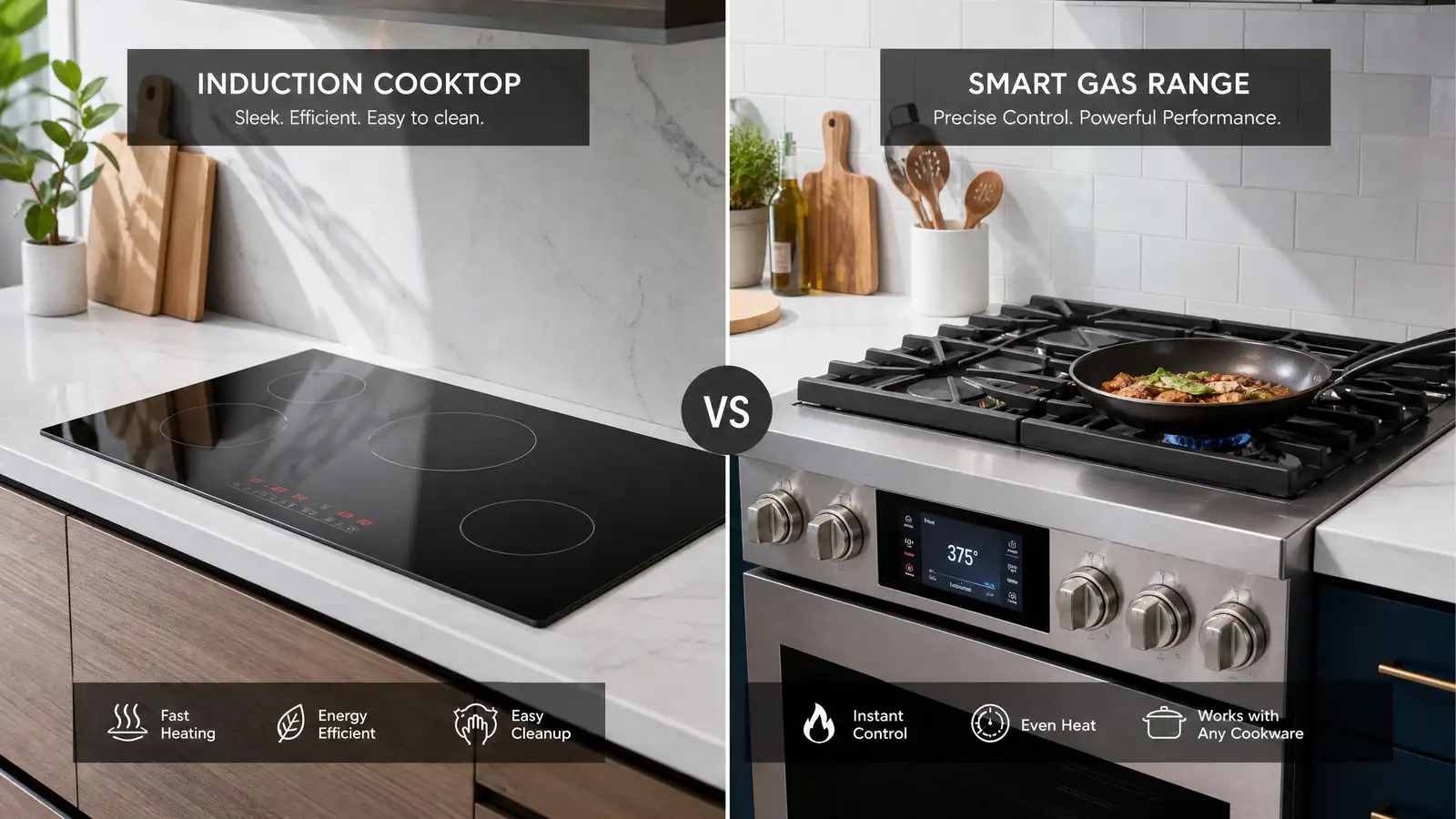
If you’ve been holding off on a kitchen upgrade because you can’t decide between induction technology and smart connectivity, you’re not alone. 2026 has brought both options to maturity, and the choice is no longer about which technology is “better” — it’s about which tradeoffs match your cooking style.
Consumer Reports recently named LG the top-rated induction cooktop brand for 2026, while GE Profile continues to push hard on smart home integration. Here’s what each option does well, where each falls short, and which one actually deserves your money.
LG Induction Cooktop: The Performance Play
Pros:
- Precise temperature control — Induction heats cookware directly through magnetic fields, giving you temperature adjustments that gas burners simply can’t match. Simmer a sauce at the lowest setting without it breaking.
- Speed — Boil water in roughly half the time of a comparable gas burner. For weekday dinners, those saved minutes compound.
- Easy cleanup — The flat glass surface means spills don’t bake onto grates. Wipe and done.
- Energy efficiency — About 85-90% of the energy goes into the cookware, compared to 40-55% for gas. Your electric bill notices.
- Consumer Reports top rating for 2026 — LG’s latest lineup scored highest across performance, reliability, and ease-of-use metrics.
Cons:
- Requires compatible cookware — Magnetic stainless steel or cast iron only. If your favorite pan is copper or aluminum, it’s time for a replacement.
- Learning curve — The responsiveness is different from gas. You’ll overshoot temperatures for the first week or two until your muscle memory adjusts.
- Power requirements — Most induction cooktops need a dedicated 240V circuit. If your kitchen doesn’t have one, expect an electrician visit.
- No visual flame — You lose the visual cue of a flame adjusting. The digital display compensates, but it’s a different experience.
GE Profile Smart Range: The Connected Kitchen Play
Pros:
- Smart home integration — Works with Alexa, Google Home, and the GE SmartHQ app. Start preheating from your phone, get notifications when your cycle is done, and access guided recipes that auto-set temperature and time.
- Convection baking — Even heat distribution for consistent results across multiple racks. Holiday baking suddenly becomes less of a juggling act.
- Air fry mode built-in — The same technology as a countertop air fryer, but integrated into your range. One less gadget on the counter.
- Fingerprint-resistant finish — The stainless steel coating actually resists smudges. A small thing that matters more than you’d expect in a busy kitchen.
- Gas or dual-fuel options — Not limited to electric. You can keep gas burners and get electric oven benefits.
Cons:
- Smart features require Wi-Fi — And when your Wi-Fi goes down (it will), some of the convenience disappears. The oven still works, but you’ve paid for features you can’t use.
- Higher price point — GE Profile ranges typically run $1,500-$2,500, compared to LG induction cooktops at $800-$1,500.
- Slower boil times — Even with high-BTU burners, gas can’t match induction’s speed. If quick weeknight cooking is your priority, this matters.
- Cleaning is harder — Grates, burner caps, and drip pans add surface area for grease and spills to accumulate on.
- Energy less efficient — Gas ranges lose significant heat to the surrounding air. You’re paying to warm your kitchen as much as your pot.
The Verdict
Choose LG induction if: You cook daily and care about speed, precision, and easy cleanup. The learning curve is real but short — most people adjust within two weeks. The energy savings over time help offset the initial investment, and Consumer Reports’ top rating for 2026 reflects real performance advantages.
Choose GE Profile if: You want a connected kitchen and value the convenience of remote preheating, smart notifications, and built-in air frying. The dual-fuel option lets you keep gas cooking while upgrading the oven. It’s the better choice for occasional cooks who prioritize convenience over raw performance.
For most households that cook regularly, LG’s induction cooktop delivers more value per dollar. The speed and precision improvements are noticeable every single day, while smart features tend to feel novel for a month and then fade into the background.