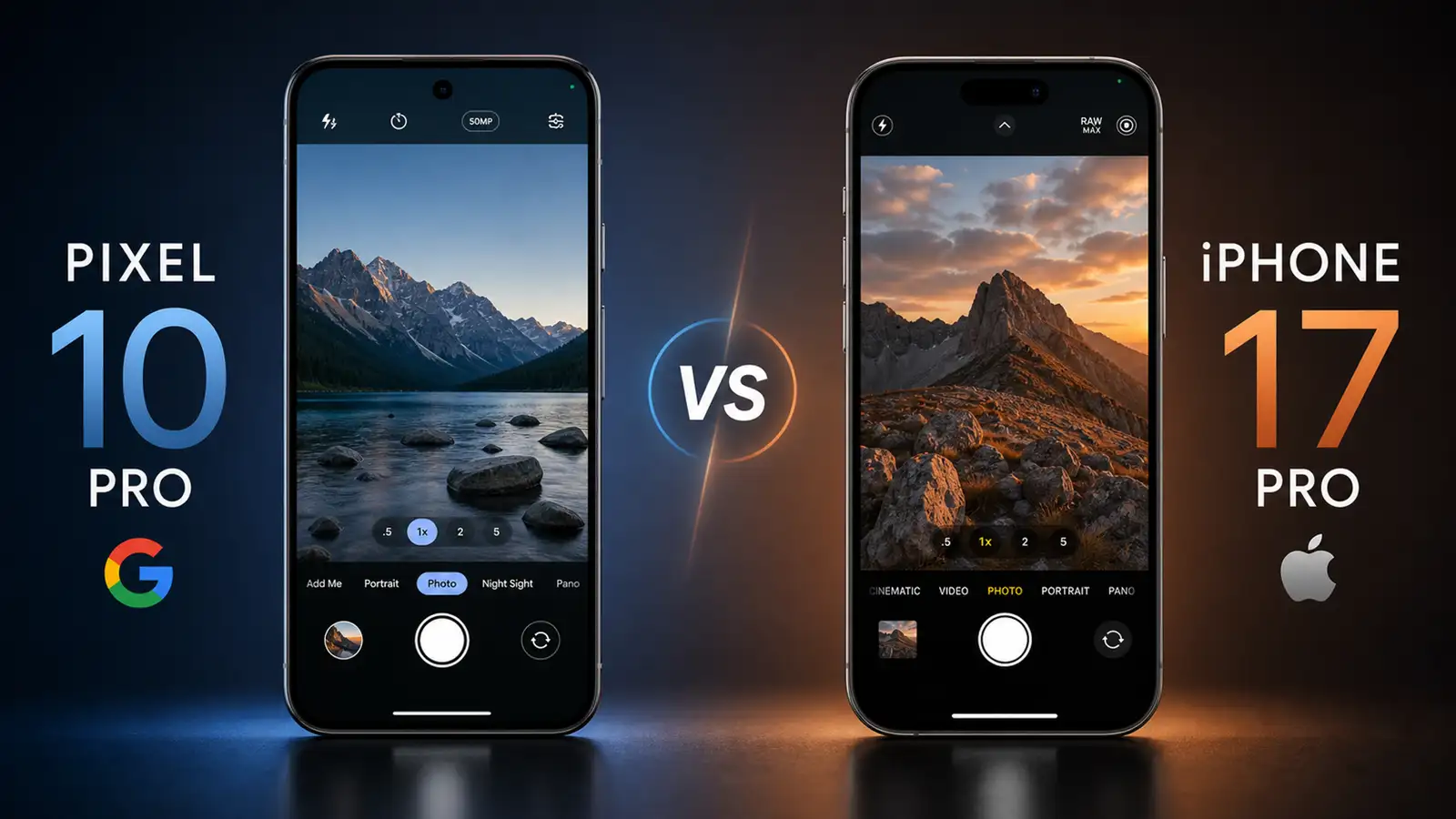
Two phones. Two ecosystems. Two very different philosophies about what a smartphone should be. The Google Pixel 10 Pro and the iPhone 17 Pro are both excellent devices that cost roughly the same — around $1,000 — and they represent the best each company can put in your pocket in 2026. But they approach the same job from opposite directions, and which one is right for you depends on what you actually value in a phone.
We spent time with both devices, comparing cameras in real-world conditions, measuring battery life across a standard workday, stress-testing the AI features each company is betting its future on, and living with each as a daily driver. Here is how they stack up.
Design and build
Both phones are glass-and-metal slabs, but the differences are immediately apparent in the hand. The Pixel 10 Pro has a matte aluminum frame with a horizontal camera bar that runs the full width of the back — a design language Google has refined over five generations. It is distinctive without being flashy. The iPhone 17 Pro uses a titanium frame with a matte glass back and the familiar triangular camera bump. It feels slightly more premium but also heavier.
The Pixel is marginally lighter at 199 grams versus the iPhone’s 206 grams, and the difference is noticeable during long one-handed use. Both have IP68 water resistance, both use USB-C (the iPhone finally caught up on that front), and both have excellent haptic engines. On pure build quality, the iPhone edges ahead — titanium is titanium — but the Pixel’s design is more interesting to look at, and the camera bar means it does not wobble when you set it flat on a table. That last detail alone is worth more than you would think.
Display
The Pixel 10 Pro has a 6.7-inch LTPO OLED with a 1-120Hz adaptive refresh rate, peaking at 2,800 nits of brightness. The iPhone 17 Pro has a 6.3-inch LTPO OLED with the same 1-120Hz range and peaks at 2,500 nits. Both are excellent. Both are sharp, color-accurate, and bright enough to read in direct sunlight.
The difference is size preference. The Pixel’s larger screen is better for reading, watching video, and multitasking. The iPhone’s smaller screen is easier to use one-handed and fits more comfortably in pockets. Neither is objectively better; it depends on your hands and your habits. If you watch a lot of Netflix on your phone, get the Pixel. If you want a phone that disappears into your pocket, get the iPhone.
Camera
This is where these two diverge most dramatically, and it is where most buying decisions will be made.
The Pixel 10 Pro uses a 50MP main sensor, a 48MP ultrawide, and a 48MP telephoto with 5x optical zoom. Google’s computational photography — the software processing that happens after you press the shutter — is still the best in the industry. Skin tones look natural. Low-light photos have detail without looking artificially brightened. The portrait mode continues to separate subjects from backgrounds more convincingly than anyone else’s. The Pixel takes photos that look like what your eye saw.
The iPhone 17 Pro uses a 48MP main, a 48MP ultrawide, and a 12MP telephoto with 3x optical zoom. Apple’s processing leans toward accuracy and consistency. Colors are true to life, maybe a touch cooler than reality. Video is where the iPhone pulls ahead — stabilization is smoother, Dolby Vision HDR recording is built in at every resolution, and the cinematic mode for rack-focus effects is genuinely useful if you shoot video with your phone.
For still photos in challenging light, the Pixel wins. For video, the iPhone wins. If you take mostly photos, buy the Pixel. If you shoot a lot of video, buy the iPhone. If you do both, the choice gets harder, but most people take far more photos than videos, which tilts the overall camera advantage toward Google.
AI features
Both companies are betting on AI as the differentiator, and the approaches could not be more different.
Google’s Gemini integration is deeply embedded in the Pixel experience and is the phone’s single strongest selling point. Gemini Live lets you have natural, flowing conversations with the assistant — you can interrupt it, change topics mid-sentence, and ask follow-up questions without starting over. Call Screen filters spam calls and transcribes unknown callers in real time before you pick up. Magic Eraser removes unwanted objects and people from photos with a tap. Best Take composites the best expressions from a burst of group photos into a single shot where everyone is smiling. Add Me lets the photographer join a group photo by compositing two shots. These features are not gimmicks — they solve specific, common problems and they work reliably, often without you having to think about them.
Apple’s Apple Intelligence suite is newer and less mature. Writing Tools can proofread and summarize text across apps, which is useful but not transformative. Image Playground generates AI images from prompts — fun for a few minutes, not something most people will use daily. Notification summaries condense long threads into digestible previews, which actually saves time if you are in a lot of group chats. But Siri, even with its AI upgrade, still misunderstands requests that Gemini handles easily. Ask Siri to “find the email where my mom sent her flight info and add it to my calendar” and it may or may not work. Ask Gemini the same thing and it does it.
The gap is not permanent. Apple is investing heavily in AI, and its approach of doing more processing on-device is better for privacy. But right now, Google is a solid year ahead, and if AI features matter to you — if you want a phone that actually acts like a smart assistant rather than a voice-activated search box — the Pixel is the clear choice.
Battery and charging
The Pixel 10 Pro has a 5,050 mAh battery that consistently lasts a full day with moderate use and often stretches into a second day with lighter use. The iPhone 17 Pro has a smaller battery — Apple does not disclose the exact capacity, but teardowns estimate around 4,400 mAh — and it reliably lasts a day but rarely more. Both support fast charging: the Pixel at 45W wired, the iPhone at 35W wired. Neither includes a charger in the box.
On battery life, the Pixel wins clearly. It is not dramatic — both phones will get you through a workday — but if you travel frequently, forget to charge overnight, or use GPS navigation heavily, the Pixel’s extra endurance matters.
Software and ecosystem
The software decision is less about the phones themselves and more about what else you own. If you have a Mac, an iPad, AirPods, or an Apple Watch, the iPhone is the obvious choice — the integration across Apple devices is still unmatched. AirDrop, Handoff, and iMessage syncing make the experience seamless in a way that Google’s ecosystem cannot replicate.
If you use Windows, Gmail, Google Photos, or any of Google’s web services as your primary tools, the Pixel integrates more naturally. Google’s version of Android is clean, updated promptly, and free of the bloatware that plagues Samsung and other Android manufacturers. The Pixel also gets feature drops every three months that add meaningful new capabilities, not just security patches.
On pure software polish, iOS is still smoother and more consistent, but the gap has narrowed to the point where most people would not notice unless they switched back and forth regularly.
Price and value
The Pixel 10 Pro starts at $999 for 128GB. The iPhone 17 Pro starts at $1,099 for 128GB. That $100 difference is not trivial, and when you factor in that Google frequently discounts the Pixel through its store while Apple almost never discounts current-generation iPhones, the effective price gap is often $150 or more.
For the money, the Pixel gives you a better camera for photos, better battery life, superior AI features, and a more interesting design. The iPhone gives you better video, tighter ecosystem integration, slightly better build materials, and the peace of mind that comes with Apple’s retail and support network.
The verdict
If you take mostly photos, value battery life, want the best AI assistant on a phone, and do not mind a larger screen, buy the Pixel 10 Pro. It does more things better for less money.
If you shoot video, own other Apple devices, prefer a smaller phone, or just want the most polished overall experience, buy the iPhone 17 Pro. It is the safer choice and the right one for anyone already inside Apple’s ecosystem.
Both are excellent phones. The gap between them is smaller than it has ever been. But on pure value — what you get for what you pay — the Pixel wins this round. Google has caught up to Apple in hardware and surpassed it in AI, and that combination makes the Pixel 10 Pro the flagship to beat in 2026.
Prices and specifications as of July 2026.