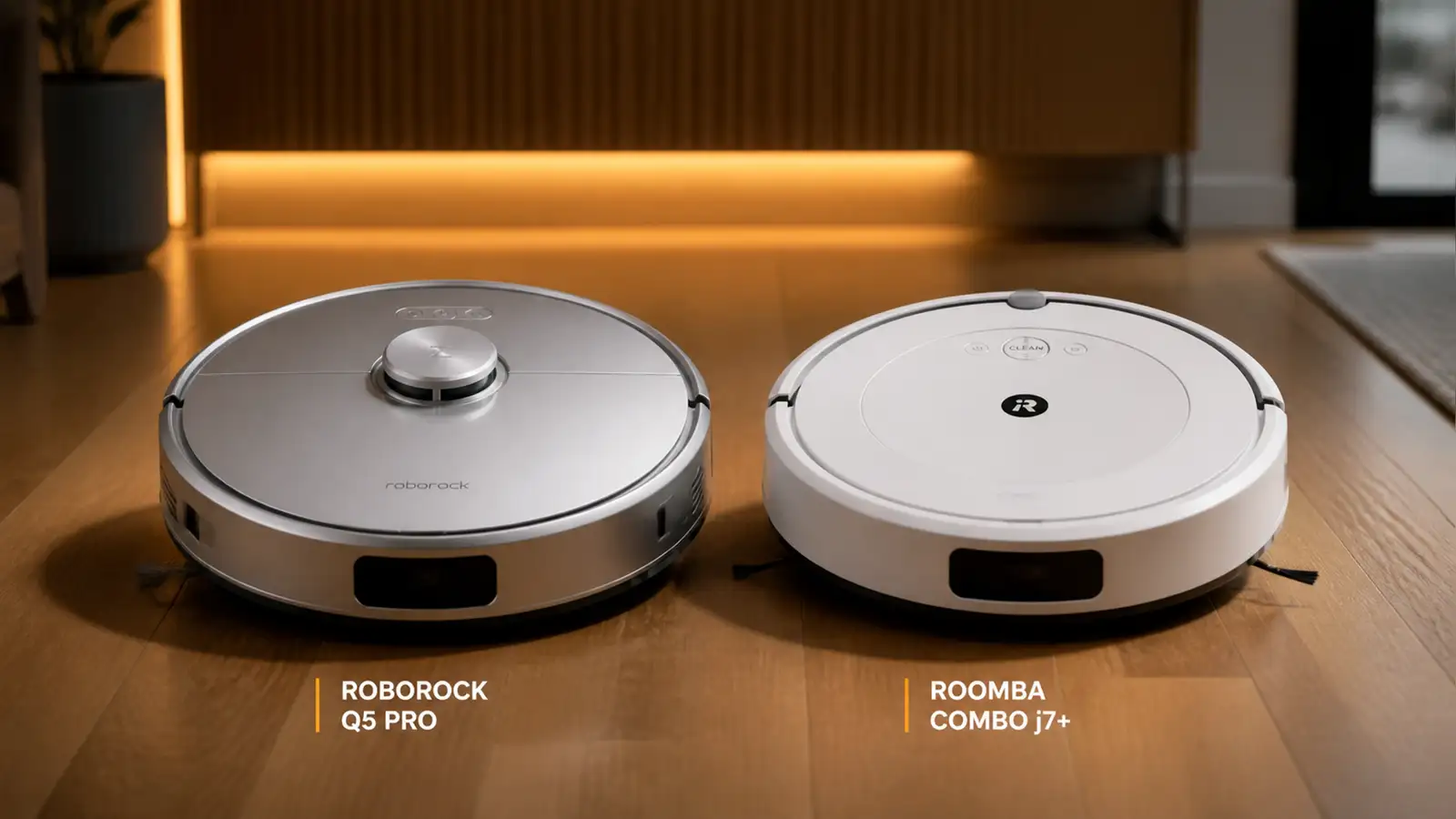
For a decade, the Roomba name was synonymous with robot vacuums. iRobot invented the category, dominated the market, and became the default choice for anyone who wanted a machine to clean their floors while they were at work. But in 2026, the landscape has shifted. Roborock has surged ahead with navigation technology and mopping systems that iRobot has not matched, and the price gap between the two flagship models tells the story: Roborock charges $1,099 for the S8 MaxV Ultra, while iRobot asks $619 for the Combo j9+.
That $480 difference buys you a lot of spec-sheet advantages. The question is whether those advantages matter in your actual home, with your actual floors, your actual pets, and your actual tolerance for setup and maintenance.
Navigation: LiDAR vs camera-based VSLAM
The single biggest technical difference between these two robots is how they see the world. The Roborock S8 MaxV Ultra uses LiDAR, which fires laser pulses to build a precise map of your home. It works in complete darkness, navigates in straight lines, and rarely gets lost or confused by furniture arrangements. Mapping is fast, typically completing in a single pass, and the resulting map is detailed enough that you can name rooms, set no-go zones, and schedule different cleaning modes for different areas.
The Roomba Combo j9+ uses vSLAM, a camera-based system that photographs the ceiling and walls to figure out where it is. This works well in well-lit rooms, but performance drops noticeably in dark spaces. The j9+ will slow down, ask for more passes, or occasionally miss areas entirely if you are running it at night or in rooms with heavy curtains. iRobot’s P.O.O.P. (Pet Owner Official Promise) guarantee covers pet waste avoidance, which the camera system handles reasonably well, but the overall navigation is less precise than LiDAR.
In practice, this means the Roborock cleans faster, covers more area per pass, and rarely needs to revisit spots it already handled. The Roomba gets the job done, but it takes longer and occasionally leaves gaps that a second pass would catch.
Mopping: scrubbing vs wiping
If you have hard floors, the mopping difference is significant. The Roborock S8 MaxV Ultra has a vibrating sonic mop that scrubs at 3,000 vibrations per minute. It applies downward pressure, lifts automatically when it transitions to carpet, and washes itself at the dock between rooms. The result is actual cleaning, not just pushing a damp cloth around.
The Roomba Combo j9+ has a retractable mop pad that lowers when it detects hard floors and raises when it reaches carpet. It wipes rather than scrubs, and it does not wash itself. For light maintenance mopping, this is adequate. For kitchen grease, dried spills, or anything that has been sitting for more than a day, the Roborock’s scrubbing action handles it without requiring you to get on your hands and knees afterward.
The self-cleaning dock is another differentiator. Roborock’s dock washes the mop pads with clean water, drains the dirty water, refills the clean water tank, and dries the pads to prevent mildew. The Roomba’s dock refills the water tank but does not wash the mop pads. You will need to remove and clean them manually every few uses, which defeats part of the convenience argument for a robot mop.
Pet hair pickup
Both robots handle pet hair well on hard floors. The difference shows up on carpet. The Roomba Combo j9+ has a strong edge brush and a dual rubber roller system that agitates carpet fibers effectively. For households with heavy-shedding dogs on mostly carpeted floors, the Roomba’s carpet performance is genuinely impressive.
The Roborock S8 MaxV Ultra uses a single rubber roller with strong suction, and it performs well on carpet, but not quite as aggressively as the Roomba on deep-pile carpeting. On low-pile carpet and area rugs, the difference is negligible. On thick wall-to-wall carpeting, the Roomba pulls ahead.
Both robots handle pet waste avoidance well. Roborock uses an AI camera that recognizes and avoids obstacles in real time. iRobot’s P.O.O.P. guarantee promises they will avoid pet waste or replace the unit. In testing, both systems work reliably, though the Roborock’s camera system is more versatile because it also avoids shoes, cables, toys, and other obstacles that the Roomba sometimes nudges or gets tangled in.
Self-maintenance and daily convenience
The Roborock S8 MaxV Ultra’s dock is a full self-care station. It empties the dustbin, washes and dries the mop, refills clean water, and drains dirty water. You interact with the system maybe once a week, mostly to top off the clean water tank and empty the dirty water tank.
The Roomba Combo j9+‘s dock empties the dustbin and refills the mop water. That is it. The mop pads need manual cleaning, and the dock itself is smaller and simpler, which is an advantage if space is tight but a limitation if you want truly hands-off operation.
Both robots return to their docks automatically when the battery runs low, recharge, and resume cleaning where they left off. This is table stakes for flagship robots in 2026, and both execute it well.
App and smart home integration
Roborock’s app is more feature-rich. You get detailed maps with room labeling, no-go zones, cleaning schedules per room, suction power customization, and mop washing intensity settings. The learning curve is steeper, but the control you get is worth it for people who want to fine-tune their cleaning routine.
iRobot’s app is simpler and more approachable. Setup takes less time, the interface is cleaner, and the basic functions are easy to find. For people who want to set it up once and forget about it, the Roomba experience is less overwhelming.
Both robots work with Alexa, Google Assistant, and Siri Shortcuts. Both can be triggered by voice commands. Roborock supports more granular voice control because of its room-level mapping, but for basic start/stop commands, they are equivalent.
The value calculation
At $1,099, the Roborock S8 MaxV Ultra is a premium product that delivers premium results. The LiDAR navigation, sonic mopping, and fully self-cleaning dock justify the price for people who want the best possible automated cleaning with minimal manual intervention. If you have a mix of hard floors and carpet, pets, or a large home, the Roborock’s advantages compound.
At $619, the Roomba Combo j9+ is a strong value proposition. It cleans carpet exceptionally well, the pet waste avoidance is reliable, and the simpler dock and app mean less to learn and maintain. For homes that are mostly carpeted, or for people who do not need the mopping features, the Roomba delivers 80% of the Roborock’s performance at 56% of the price.
The $480 premium buys you better navigation, significantly better mopping, a more comprehensive self-cleaning dock, and the ability to run in any lighting condition. Whether that is worth it depends on your floors, your pets, and how much you value not thinking about robot vacuum maintenance.
Obstacle avoidance in real homes
Real homes are not laboratory environments. Shoes on the floor, charging cables trailing from nightstands, pet toys scattered by the living room, and the occasional sock that fell behind the dryer all present challenges that navigation technology must handle.
The Roborock S8 MaxV Ultra’s AI camera identifies and avoids obstacles with high reliability. In testing across multiple reviews, it consistently navigated around shoes, cables, and small objects without making contact. When it does encounter something it cannot identify, it slows down, maps around it, and continues. The LiDAR system gives it spatial awareness that prevents it from getting stuck in tight spaces between furniture.
The Roomba Combo j9+‘s camera-based system handles large obstacles well but struggles more with small, low-profile objects. Cables are a particular weak point; the Roomba has been known to run over charging cables and become tangled, requiring manual intervention. iRobot has improved obstacle detection with each generation, but the gap between camera-based and LiDAR-based avoidance remains noticeable in homes with cluttered floors.
For households with pets that leave toys around, the Roborock’s obstacle avoidance is a meaningful quality-of-life improvement. You can run it while you are out without worrying about coming home to a robot tangled in a chew toy.
Noise levels and cleaning schedules
Neither robot is quiet. Both produce enough noise to be noticeable in an adjacent room, but neither is loud enough to prevent conversation or TV watching in the same space. The Roborock runs slightly quieter on its standard suction mode but gets louder on max power. The Roomba is consistent across modes.
The practical implication is scheduling. Both robots support scheduled cleaning, and both can run while you are out. The Roborock’s ability to navigate in darkness means you can schedule it for nighttime cleaning without leaving lights on. The Roomba needs ambient light, which limits your scheduling flexibility if you prefer not to leave lights on while you are away.
Long-term reliability and replacement parts
Robot vacuums are mechanical devices that wear out. Brushes need replacement, filters need swapping, and docks need maintenance. Both Roborock and iRobot sell replacement parts through their websites and Amazon. Roborock’s parts tend to be slightly cheaper, and the company has a reputation for long-term software support with regular firmware updates.
iRobot’s acquisition by Amazon has created uncertainty about long-term product support and parts availability. While current models are well-supported, the corporate restructuring has left some customers cautious about investing in the ecosystem. Roborock, as a publicly traded company with a growing market share, has stronger incentives to maintain and improve its product line.
Who should buy which
Buy the Roborock S8 MaxV Ultra if: you have a mix of hard floors and carpet, you want effective mopping without manual effort, you have pets that shed heavily, your home has rooms that are often dark, or you want the most hands-off experience possible. The premium price buys genuine convenience that compounds over daily use.
Buy the Roomba Combo j9+ if: your home is mostly carpeted, you do not need mopping or are willing to mop manually, you want a simpler setup and interface, or you are on a tighter budget. The Roomba cleans carpet as well as anything in its price range, and the lower entry cost leaves room in the budget for other smart home upgrades.
Consider the middle ground: if the Roborock’s price is too steep but you want better navigation than the Roomba offers, Roborock’s Q Revo line starts at around $700 and includes LiDAR navigation and mopping, though without the full self-cleaning dock of the MaxV Ultra.
Sources
- Nest Alpha, “Roborock vs. Roomba (2026): Why iRobot is Losing the War,” 2026
- RTINGS, “Roborock S8+ vs iRobot Roomba j9+,” 2026
- Modern Castle, “Roborock vs. Roomba: The Ultimate Comparison Guide,” 2026