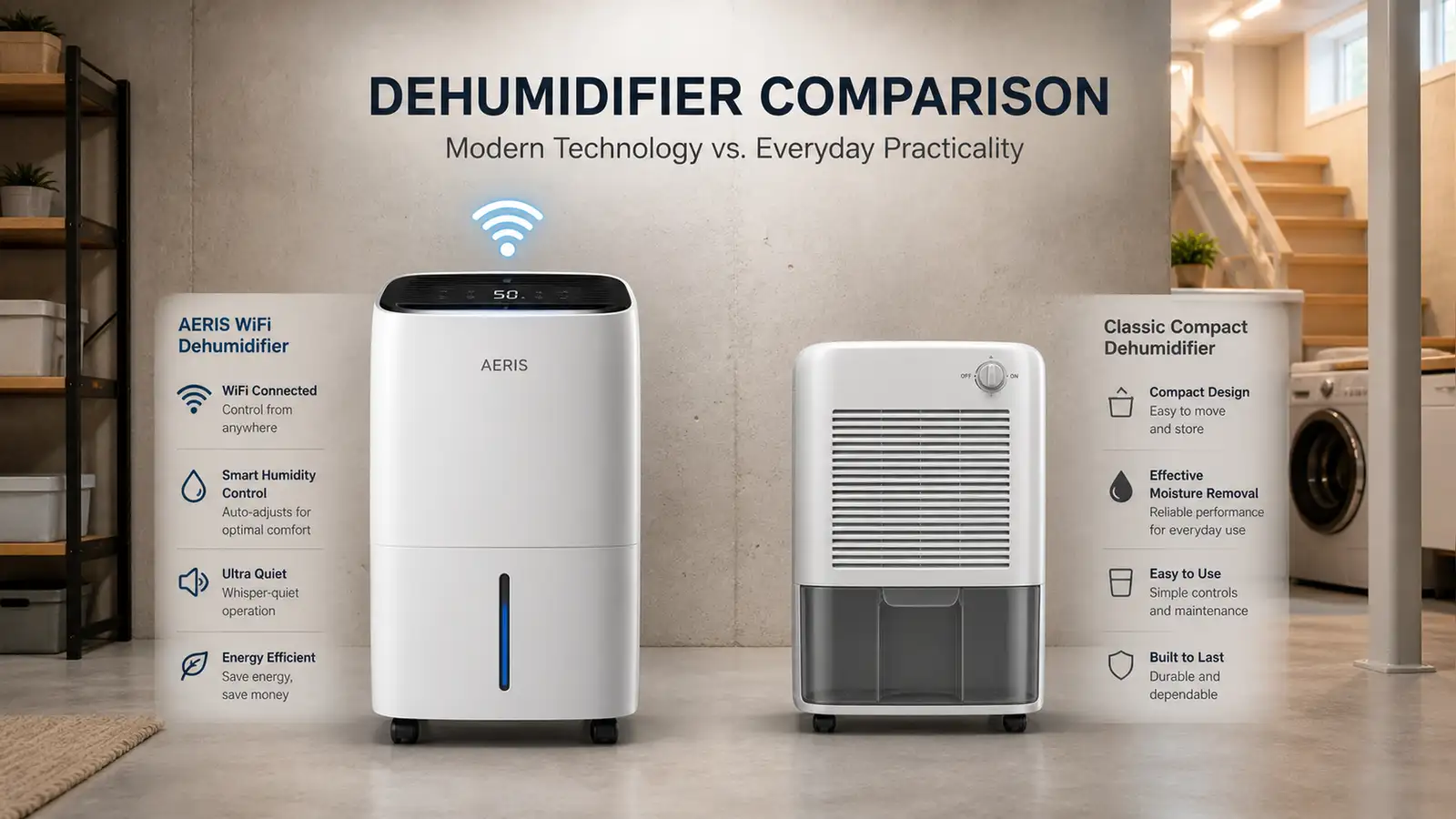
A dehumidifier is not the kind of appliance you get excited about buying. It is the kind you buy because your basement smells like a wet dog and you are tired of wiping condensation off the windows every morning. But once you decide you need one, the choice between models is more consequential than it looks — get the wrong size and you are either running it constantly without making a dent, or paying to run a machine that is overkill for your space.
Two models dominate the conversation in 2026: the TCL 50-Pint Smart Dehumidifier, which Good Housekeeping named its best overall pick after months of lab testing, and the Black+Decker 30-Pint Dehumidifier, the publication’s best value choice. They sit at different price points and target different room sizes, but for most people shopping for a dehumidifier this summer, these are the two names that keep coming up.
Capacity and Coverage: 50 Pints vs 30 Pints
The headline number on any dehumidifier is its pint capacity — how much moisture it can pull from the air in 24 hours under standard testing conditions. The TCL is rated for 50 pints per day. The Black+Decker is 30 pints. That difference translates directly into how much square footage each unit can handle.
The TCL is designed for spaces up to roughly 4,500 square feet, which covers most basements, large open-plan living areas, or whole-floor coverage in a typical home. The Black+Decker tops out around 3,000 square feet, which is fine for a single large room, a standard basement, or an apartment, but starts to struggle if you are trying to dehumidify an entire floor.
If your space is under 2,500 square feet, the Black+Decker handles it without breaking a sweat. Between 2,500 and 3,500, the Black+Decker still works but runs longer cycles. Above 3,500, the TCL’s extra capacity becomes not a luxury but a requirement — an undersized dehumidifier runs constantly without hitting your target humidity, which wastes electricity and wears out the compressor faster.
Smart Features: The WiFi Question
The TCL’s main differentiator is not the extra capacity — it is the “Smart” in the name. The unit connects to WiFi and works with Alexa and Google Assistant, which means you can check the humidity level in your basement from your phone, adjust the target humidity remotely, and set schedules. The companion app shows real-time readings, tracks runtime, and sends alerts when the water bucket is full.
Whether any of that matters depends on where the dehumidifier lives. If it is in a finished basement you use every day, the smart features are genuinely useful — you can turn the unit on before you go downstairs, check that the humidity is under control without walking down two flights of stairs, and get a phone notification when the bucket needs emptying instead of discovering it three days later when the floor is damp.
If the dehumidifier is in a crawl space or a utility room you visit twice a year, the smart features are mostly wasted. You will set the humidity target once and forget about it. In that scenario, the Black+Decker’s simple manual controls — a humidity dial and a power button — are exactly what you need and nothing you do not.
The Black+Decker is not completely analog. It has an auto-restart function that resumes operation after a power outage with your previous settings intact, which matters if you live somewhere with unreliable power. It also has a 24-hour timer, so you can set it to run during off-peak electricity hours if your utility charges time-of-use rates. But there is no app, no voice control, and no remote monitoring.
Drainage: Bucket, Hose, or Both
Both units offer the same drainage options: a built-in collection bucket you empty manually, or a continuous drain hose that lets water flow directly into a floor drain or sink. The TCL’s bucket holds slightly more water — about 1.5 gallons versus the Black+Decker’s 1.2 gallons — which means fewer trips to the sink if you are using bucket mode.
The continuous drain option is where most people should land if they have a floor drain available. Once the hose is connected, the dehumidifier runs without any intervention. Both units include the necessary hose connection, but neither includes the actual hose — you will need to pick up a standard garden hose or a dedicated dehumidifier drain hose separately.
One practical note: the TCL’s drain port is positioned slightly higher off the ground than the Black+Decker’s, which makes it friendlier for gravity-fed drainage into a sink or bucket. If you are draining into a floor-level drain, the difference does not matter.
Noise and Energy
Dehumidifiers run for hours at a time, often in spaces you are not actively using. But noise still matters, especially if the unit is near a living area or a home office. In Good Housekeeping’s testing, the TCL measured noticeably quieter than the Black+Decker on the high fan setting — not silent, but closer to the hum of a refrigerator than the drone of a window air conditioner. On low, both units are quiet enough that you forget they are running.
Energy consumption tracks with capacity. The TCL draws more power at peak operation — roughly 600 watts versus the Black+Decker’s 450 watts — but it also removes moisture faster, so the total energy used to hit a target humidity is comparable between the two. Both units carry Energy Star certification, which means they meet the EPA’s efficiency thresholds. One thing the numbers do not capture: the TCL’s smart scheduling means you can set it to run primarily during off-peak hours if your electricity plan charges different rates at different times of day. The Black+Decker has a basic 24-hour timer that can approximate the same thing, but it takes more manual setup and lacks the set-it-and-forget-it convenience of scheduling through an app.
Price and Value
The Black+Decker 30-Pint sells for around $170. The TCL 50-Pint Smart is typically $230 to $250. That $60 to $80 gap buys you 67 percent more moisture removal capacity, WiFi connectivity, a slightly larger bucket, and quieter operation on high. For a basement over 3,000 square feet, that is an easy call — the Black+Decker cannot do the job, so the comparison is moot.
For a smaller space, the math shifts. If your basement is 2,000 square feet and you do not care about checking humidity from your phone, the Black+Decker does everything you need at a lower price. It is a straightforward, effective dehumidifier with no software to update, no WiFi to configure, and no app permissions to manage. For people who want an appliance that just works and never asks for a firmware update, that simplicity is a feature, not a shortcoming.
Which One Should You Buy?
Get the TCL 50-Pint Smart if your space is over 3,000 square feet, if you want remote monitoring and smart home integration, or if noise on the high setting is a concern. The extra capacity gives you headroom, and the smart features are well-implemented rather than gimmicky.
Get the Black+Decker 30-Pint if your space is under 2,500 square feet, if the dehumidifier lives in a utility area you rarely visit, or if you want to spend less and avoid adding another app to your phone. It is a capable dehumidifier that performs exactly as advertised, and it does so without any of the complexity that comes with WiFi-enabled appliances.
If your space is between 2,500 and 3,500 square feet, the decision comes down to climate. In a humid region or a basement that stays damp year-round, spring for the TCL — the extra capacity means shorter run cycles and less strain on the compressor. In a drier climate where the dehumidifier runs seasonally, the Black+Decker is adequate and the savings stay in your pocket.
Maintenance and Longevity
Both dehumidifiers require the same basic maintenance: cleaning or replacing the air filter every few months, and occasionally wiping down the water bucket to prevent mold growth. The TCL has a washable filter that slides out from the back, and the app sends a reminder when it is due for cleaning. The Black+Decker also uses a washable filter but relies on you to remember — there is an indicator light on the control panel, but no push notification.
Build quality between the two is comparable. Both use plastic housings with integrated handles and caster wheels for moving between rooms. The TCL is slightly heavier — around 40 pounds versus the Black+Decker’s 33 pounds — but the difference is negligible when both are on wheels. Neither unit feels premium, but neither feels flimsy either. These are functional appliances, not design objects. You will not be showing them off to guests, but you will not be embarrassed if someone sees one in the corner of the basement either.
Warranty coverage is one area where the Black+Decker pulls ahead. It comes with a two-year limited warranty compared to the TCL’s one year. For an appliance that runs for hundreds of hours in damp conditions, that extra year of coverage is meaningful, especially at the lower price point. If long-term reliability is a priority and your space does not demand the TCL’s extra capacity, the Black+Decker’s warranty is a point in its favor.
The Verdict
The TCL 50-Pint Smart Dehumidifier is the better dehumidifier in almost every measurable way: more capacity, quieter operation, smart features that are actually useful rather than bolted-on gimmicks. It earns its status as Good Housekeeping’s best overall pick. If you can afford the extra $60 to $80 and your space justifies the capacity, it is the right choice.
The Black+Decker 30-Pint wins on value, simplicity, and warranty. It is not trying to be smart or impressive. It is trying to pull moisture out of the air reliably for years, and it does that job well. For smaller spaces and for people who want to plug something in and never think about it again, it is the better fit — and the lower price and longer warranty make it feel like the smarter financial decision even when the TCL is technically the better machine.