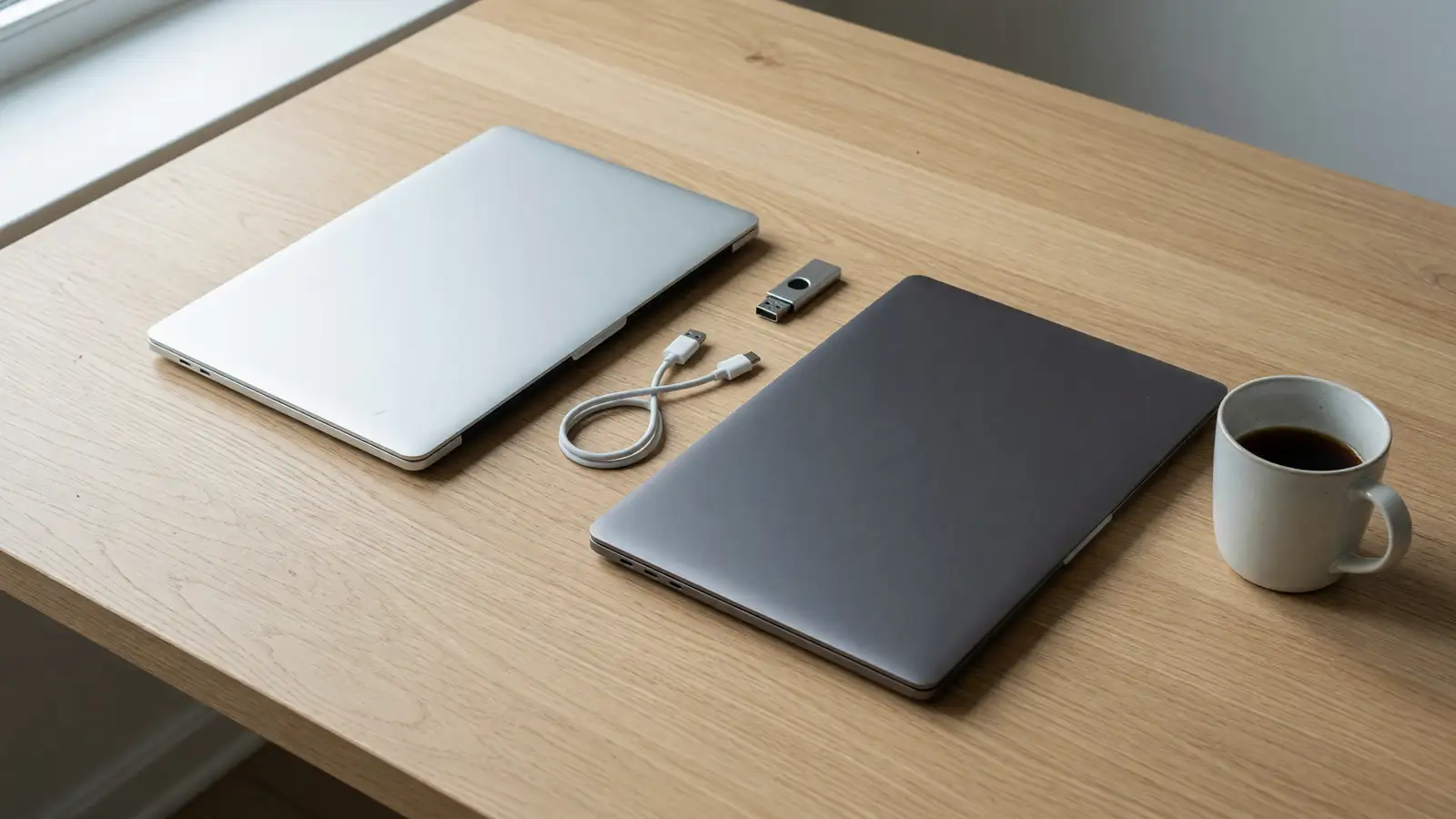
Mark Hachman’s PCWorld review on September 30 calls the Acer Swift Air 14 a $699 MacBook challenger and then prints the asterisk in the spec table: 8GB of LPDDR5X. Mashable’s MacBook-alternatives roundup a day earlier had not finished testing the Air 14 and still filed it as a promising Neo rival. We already ran Neo versus the M5 Air. This is the Windows machine PCWorld put on the same Geekbench chart.
Both stickers sit at $699 if you believe Acer’s Best Buy listing and the Neo story from last week. One of them has USB-A and a 70-watt-hour pack that lasted 19.5 hours in Foundry’s video rundown. One of them won single-core by 39 percent in the same PCWorld file. You are buying a bottleneck on purpose. Pick which bottleneck you can live with.
$699 versus $699 is not a spec
PCWorld’s as-tested machine is SFA14-I31-58V8, model family SFA14-I3, $699.99 at Acer and Best Buy. Intel Core 5 320. 8GB LPDDR5X, expandable to 16GB. Intel Graphics. NPU at 16 TOPS. 14-inch 1920×1200 TFT, 30–120 Hz, not touch. 512GB PCIe Gen 4. 1080p webcam. Wi-Fi 6e, Bluetooth 5.3. 12.4 × 8.8 × 0.51 inches. 2.62 pounds. Aluminum, little flex in the keyboard deck.
Neo’s exact CPU string is not in this week’s PCWorld extract. What is in it: Geekbench 6 multicore 8,996 versus the Swift Air’s 7,647, a 16 percent gap. Single-core 3,574 versus 2,397, a 39 percent gap. Hachman treats that single-core hole as the “menus will lag a bit” warning. Believe him if you live in Chrome with 40 tabs and a slideshow. Ignore him if you live in Docs and a streaming window.
Acer’s chief executive, in the same review, expects PC prices up 5 to 20 percent in the fourth quarter of 2026. That is not a coupon. That is a reason the $699 tag might not wait. Neo’s tag will move on Apple’s calendar, not Acer’s. Do not screenshot either price as a 2027 MSRP.
Mashable’s tested Acer in that roundup is a different SKU: Swift Edge 14 AI at $1,499.99 with 32GB and 1TB and a 2.8K OLED touch panel, 48 percent slower than the latest MacBook Air in single-core and 33 percent slower in multi-core. Do not paste Edge numbers onto the Air 14. The Air 14 is the $699 Intel stick with 8GB. The Edge is the expensive OLED. Zenbook S14 versus M4 Air is another family. Stay on the chart Hachman printed.
19.5 hours is the Windows argument
Foundry’s standard video rundown: about 19.5 hours on the Swift Air 14. Procyon Office loop: 11 hours 14 minutes. Hachman left the panel at a fixed 120 Hz for those runs and notes you might do better with the dynamic refresh. 70 watt-hours is the pack. Typical 14-inch Windows machines, in his setup graph, sit nearer three pounds; this one is 2.62.
I do not have PCWorld’s Neo minutes in the same video rundown. I will not borrow Mashable’s Chromebook number and subtract. Mashable did say the Chromebook Plus Spin 514 lasted 18 hours 11 minutes and beat the Neo by three and a half hours in that test. Different lab, different loop. Use it only as a reminder that Neo is not automatically the endurance king. Our Neo versus M5 Air headline already treated 16 hours as the thing Neo is not.
If your day is a lecture hall and a train, 19.5 hours of video is theater, but 11 hours of Office is the workday plus a delay. 8GB will eat that advantage if Windows starts paging. Hachman calls 8GB a grievous error in 2025 and more forgivable in a shortage year. Expandable to 16GB is the sentence that keeps the machine in the conversation. Confirm whether your unit is soldered-plus-slot or a service part before you believe “expandable.” PCWorld printed the word. A Best Buy clerk is not a schematic.
Cinebench 2024 refused to run on 8GB. That is a review finding, not a footnote. He dropped to R23 and got 7,274, under the Aspire Go’s 8,530 and well under the Swift Go 16 with Ryzen AI 400 at 11,967. You are not buying a render box. You are buying a thin Intel 14-inch that can open the lid for a full workday.
Handbrake: 1,901 seconds on the Air 14 versus 2,053 on an IdeaPad Slim 3i. The Air 14 wins that pairing. It does not win a pairing PCWorld did not print against Neo. Stop there.
Ports and the panel are why the Air 14 exists
Two Thunderbolt 4 USB-C ports, a USB-A port, a 3.5 mm jack. No Wi-Fi 7. The display fully reclines even though it is not a touch panel, which Hachman flags as odd. 1920×1200 is 16:10, not OLED, not 2.8K. Mashable’s Zenbook A14, in the same alternatives piece, has HDMI plus two USB-C plus USB-A plus a jack, and weighs 2.4 pounds. The Air 14 is 2.62. You are not buying the lightest 14-inch. You are buying a $699 one with a full-size USB-A.
Neo, as a Mac, is the usual two-port life unless Apple changed the SKU after our last look. I am not reprinting a port count I did not re-extract this week. I am reprinting the Air 14’s table. If you still carry a USB-A microphone, that jack and that A port are the review.
Hachman liked the display enough to put “good display” in the pros next to battery and price. 30–120 Hz on TFT is the mechanism. It is not the Edge’s OLED. If you grade color for a living, this is the wrong Acer. If you write and ride trains, 120 Hz is candy and 19.5 hours is the feature.
The NPU rating is 16 TOPS. That is a Copilot+ conversation I am not going to inflate. 16 TOPS is not the 40-plus club. Treat Windows Studio Effects as a maybe. Treat the Core 5 320 as an office chip. Dell 16S versus Swift 16 AI is the larger haptic-pad fight. This Air 14 is smaller and poorer in RAM.
Construction, webcam, and the parts PCWorld bothered to touch
Hachman bought a $699 machine expecting cut corners. The aluminum did not flex in a way that bothered him, keyboard tray or hinge. 2.62 pounds is under his “typical 14-inch is about three pounds” line. 0.51 inches thick. 12.4 by 8.8 inches on the footprint. That is a bag laptop. It is not a 16-inch OLED slab like the Dell 16S pairing.
Webcam is 1080p with Windows Hello. Fine for class. Not a reason to buy. Biometrics on the camera means you are not getting a fingerprint reader in the spec table he printed. If you want a reader, you are in a different SKU.
Storage is 512GB PCIe Gen 4. Replaceable in theory on many Acers, not promised here. I will not write a how-to for a screw I did not see. 512GB is the floor for a Windows 14-inch in 2026 if you keep local video. Neo’s SSD story is Apple’s. If you already live in iCloud, 512 feels different than if you live in Steam.
The reclining, non-touch panel is the oddball. Tent modes without touch are a hinge flex for a feature the glass does not offer. Use it as a stand for a train table if you want. Do not buy the Air 14 because it folds flat. Buy it because the battery ran 19.5 hours with the panel locked at 120 Hz, which is the pessimistic refresh setting in his note.
PCMark 10, in the same review, is the office-and-calls suite he still trusts, and he says it does not support Windows on Arm. That is why it is an Air 14 number and not a Neo number in his file. Cross-platform comparison in that article is Geekbench 6. Stay on Geekbench when you argue Neo. Stay on Procyon and video rundown when you argue endurance. Mixing Mashable’s Chromebook 18-hour-11-minute loop with Foundry’s 19.5 is how people invent a fake winner.
Mashable’s Zenbook A14 at 2.4 pounds, 0.3 lighter than the Air they measured, with an OLED and HDMI, is the machine you look at if $699 is not the constraint and you still want Windows ports. It is not this comparison. The Air 14’s job is to be the Windows Neo at the Neo’s money, with 8GB hanging off the side of the spec sheet.
RAM expansion is the unresolved mechanical question. PCWorld says 8GB LPDDR5X, expandable to 16GB. LPDDR plus expandable often means a second slot or a higher SKU, not a stick you buy at a mall. Before you treat 16GB as a plan, read Acer’s service PDF for SFA14-I3. If the PDF is silent, assume 8GB is the life of the machine. Then the Cinebench 2024 refusal is not a benchmark quirk. It is the product.
Who should take the 39 percent loss
Take the Swift Air 14 if you need Windows, USB-A, and a battery that PCWorld actually timed past 19 hours of video. Take it if $699 has to be the out-the-door number this week and you can live in 8GB until you confirm the 16GB path. Take it if Cinebench 2024 is not a program you run, because it will not launch.
Take the Neo if single-core snappiness is the whole laptop to you. 39 percent in Geekbench 6 is not a rounding error. Hachman said menus and app switching will feel it. Take the Neo if your peripherals are already USB-C and you do not want Intel’s driver week. Take the Neo if you already decided Apple’s keyboard is the input device.
Do not take the Swift Edge 14 AI numbers and call them a win for the Air 14. Do not take Mashable’s “we have not tested it” as a score. Do not take Acer CEO price-hike talk as a reason to buy a machine whose RAM you hate. A 5 to 20 percent Q4 bump on a machine you will resent is still a bump on a mistake.
Winner on this page is the Swift Air 14, on the boring axes PCWorld measured: endurance, weight under 2.7 pounds, price parity with Neo, and ports a student kit still uses. Neo keeps the CPU. If your work is the CPU, you are not the buyer this $699 Windows SKU is for. If your work is the charger brick you keep forgetting, 11 hours 14 minutes of Procyon is the spec that paid for the asterisk.