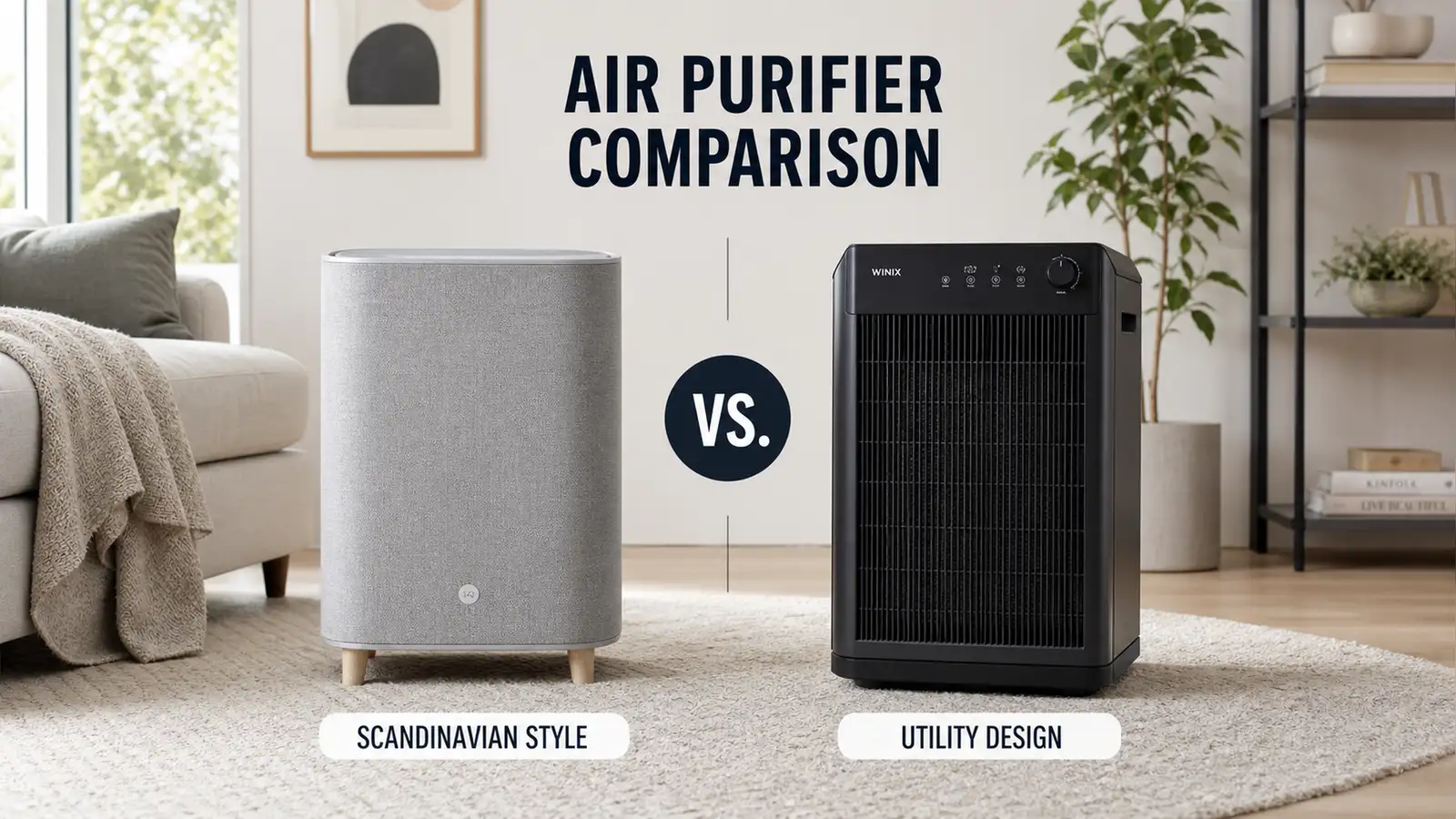
Wildfire smoke, pollen seasons that keep getting longer, and the general realization that indoor air is often worse than outdoor air have made air purifiers a standard appliance rather than a niche purchase. Consumer Reports published its 2026 air purifier rankings on July 22, and two models dominated the mid-size room category: the Blueair Blue Pure 311i+ Max and the Coway Airmega AP-1512HH. Both are highly rated, both have loyal followings, and both clean air effectively. But they prioritize different things, and the right choice depends on what you value more — quiet operation and portability, or filtration depth and long-term durability.
The basics: what you’re buying
The Blueair Blue Pure 311i+ Max is the newer of the two, a Swedish-designed unit that weighs 8 pounds and covers rooms up to about 432 square feet. It uses a combination of HEPA filtration and an electrostatic charge to capture particles down to 0.1 microns — pollen, pet dander, dust, smoke, and even some viruses. It has four fan speeds, a built-in dirt sensor that adjusts the fan automatically when air quality drops, and an indicator light that tells you when to change or clean the filter. Annual maintenance runs about $135, which covers replacement filters and energy costs.
The Coway Airmega AP-1512HH is a Korean-designed workhorse that has been at or near the top of air purifier rankings for years. It covers about 361 square feet with a four-stage filtration system: a pre-filter for large particles, an activated carbon filter for odors, a True HEPA filter for fine particles, and an ionizer that can be turned off independently. It has three fan speeds plus an eco mode that shuts off the fan when no pollution is detected for 30 minutes. It weighs about 12 pounds. Annual filter and energy costs come in around $130 to $150 depending on usage.
Both units are designed for medium to large rooms — bedrooms, living rooms, home offices. Neither is sized for open-plan spaces above 500 square feet. If you need whole-house coverage, you’ll want something larger or multiple units.
Performance: what the tests say
Consumer Reports tested both models for their ability to remove dust, pollen, and smoke at both high and low speeds. The Blueair 311i+ Max scored especially well on its high setting, where it was “terrific” at clearing all three particle types. On low, it delivered “near top-level results” while staying quiet enough to run overnight in a bedroom. The CADR (Clean Air Delivery Rate) numbers bear this out: the Blueair moves air fast when it needs to and pulls back gracefully when it doesn’t.
The Coway Airmega AP-1512HH performed similarly on particle removal but with a different profile. Where the Blueair does its best work on high, the Coway maintains more consistent performance across speed settings — you get roughly the same filtration quality on medium as on high, just slower. The trade-off is that the Coway is audibly louder on its highest setting — not disruptive in a living room during the day, but noticeable in a quiet bedroom. On eco mode, it’s nearly silent, but eco mode only activates when the air is already clean, so it’s not a solution for overnight filtration in polluted conditions.
For wildfire smoke specifically — a use case that’s become increasingly relevant across North America as fire seasons lengthen — both units performed well in CR’s smoke clearance tests. But there’s an important distinction in how they handle it. The QZ.com roundup of Consumer Reports data noted that Coway’s dedicated activated carbon filter gives it a measurable edge on odor and VOC (volatile organic compound) removal. Smoke isn’t just particulate matter; it’s also gas-phase pollutants that HEPA filters alone can’t catch. The Blueair’s electrostatic approach is faster at capturing the visible particulate matter — the stuff that makes the air look hazy — but less effective on the gaseous compounds that give smoke its smell and that can cause longer-term respiratory irritation.
If you’re buying an air purifier primarily for allergies — pollen, dust mites, pet dander — both units perform similarly well, and you can choose based on noise and aesthetics. If wildfire smoke is the reason you’re shopping, the Coway’s carbon filter is a meaningful advantage that outweighs most of the Blueair’s usability wins.
Noise and livability
This is where the two units diverge most clearly. The Blueair 311i+ Max is designed to disappear into a room. On its lowest setting, it’s quiet enough that you can sleep next to it without noticing any mechanical hum. The fabric pre-filter comes in multiple colors — gray, blue, pink — which sounds trivial on a spec sheet but actually matters when the device is going to occupy visible space in your home for years. An air purifier is a permanent fixture, not something you stash in a closet, and the Blueair looks more like a piece of Scandinavian-designed electronics than a utility appliance.
The Coway is more utilitarian and unapologetic about it. It’s a black or white box with a prominent front grille and a control panel on top. It does its job efficiently and doesn’t try to be decorative. On its higher settings, you’ll hear it — a steady fan noise that’s noticeable but not unpleasant. In a living room during the day, this is perfectly fine. In a bedroom at night, you’ll probably want to run it on low or rely on eco mode, which means you’re trading some filtration coverage for silence.
Weight matters if you plan to move the unit between rooms, which is a common use pattern — bedroom at night, living room during the day. At 8 pounds, the Blueair is genuinely easy to carry one-handed from room to room. At 12 pounds, the Coway is still portable but noticeably heavier, and the boxy shape makes it slightly more awkward to grip. Neither is a hassle to relocate occasionally, but if you plan to move it daily, the Blueair’s 4-pound advantage adds up.
Maintenance and running costs
Both units use replaceable filters that need to be changed every 6 to 12 months depending on usage and air quality. The Blueair’s annual maintenance runs about $135. The Coway runs $130 to $150 — close enough that cost isn’t a meaningful differentiator.
The Coway has one maintenance advantage: its pre-filter is washable and captures large particles like hair and dust before they reach the HEPA filter, extending the life of the more expensive filter. The Blueair’s fabric pre-filter is also washable, but the main filter replacement schedule is similar.
Both brands scored well on Consumer Reports’ reliability surveys. Coway owners reported slightly higher satisfaction rates, but Blueair was also well above average.
Features and controls
The Blueair 311i+ Max has a clear edge on smart features. Its auto mode uses a built-in particle sensor to adjust fan speed in real time — the fan ramps up when it detects cooking smoke or outdoor pollution and drops back down when the air clears. The filter replacement indicator is built into the unit rather than relying on a timer. There’s also a companion app for remote control and air quality monitoring, though the unit works perfectly well without it.
The Coway’s standout feature is its ionizer, which generates negative ions to help particles clump together and fall out of the air. Ionizers are controversial — they can produce trace amounts of ozone — but Coway’s can be turned off independently from the main fan, which is the right design choice. The eco mode is genuinely useful: it shuts off the fan when the air is clean and restarts when it detects pollution, saving energy and filter life during stretches when the air quality doesn’t change much.
Which one should you buy?
Pick the Blueair Blue Pure 311i+ Max if you want a unit that fades into the background: quiet enough for a bedroom, light enough to move between rooms, and attractive enough that you won’t mind looking at it every day. It’s the better choice for apartments, bedrooms, and home offices where noise and aesthetics matter. The auto mode with the built-in particle sensor means you can essentially set it and forget it — the unit ramps up when your partner burns toast and settles back down when the air clears. If you’re not dealing with smoke or strong odors, the Blueair’s performance advantage in the metrics that matter most (dust, pollen, pet dander) combined with its livability make it the pick for most people.
Pick the Coway Airmega AP-1512HH if you want maximum filtration depth and don’t mind a slightly louder, more utilitarian appliance. Its activated carbon filter makes it the better pick for households with cooking odors, smokers, or proximity to wildfire smoke. The washable pre-filter and eco mode also make it slightly cheaper to run over the long term, though the difference is marginal — maybe $15 to $20 a year at most. If you’re someone who wants to see exactly what the filter is catching, the Coway’s accessible front grille and visible pre-filter let you check at a glance, where the Blueair’s fabric wrap hides the filter entirely.
One factor that doesn’t get discussed enough: filter availability. Both Blueair and Coway sell replacement filters directly and through Amazon, but Coway’s longer market presence means third-party compatible filters are more widely available and often cheaper. If you plan to keep the unit for five-plus years, the Coway’s filter ecosystem gives you more options down the road.
If you’re in a region affected by wildfire smoke — which, as of summer 2026, covers a growing portion of North America — the Coway’s carbon filter is worth the trade-off in noise and aesthetics. If you’re dealing with typical indoor pollutants like dust, pollen, and pet dander in a space where you want the purifier to be heard and not seen, the Blueair is the more livable choice. In either case, both units do what they’re supposed to do: clean the air. The difference is in how they go about it, and which approach fits your home.
Sources: