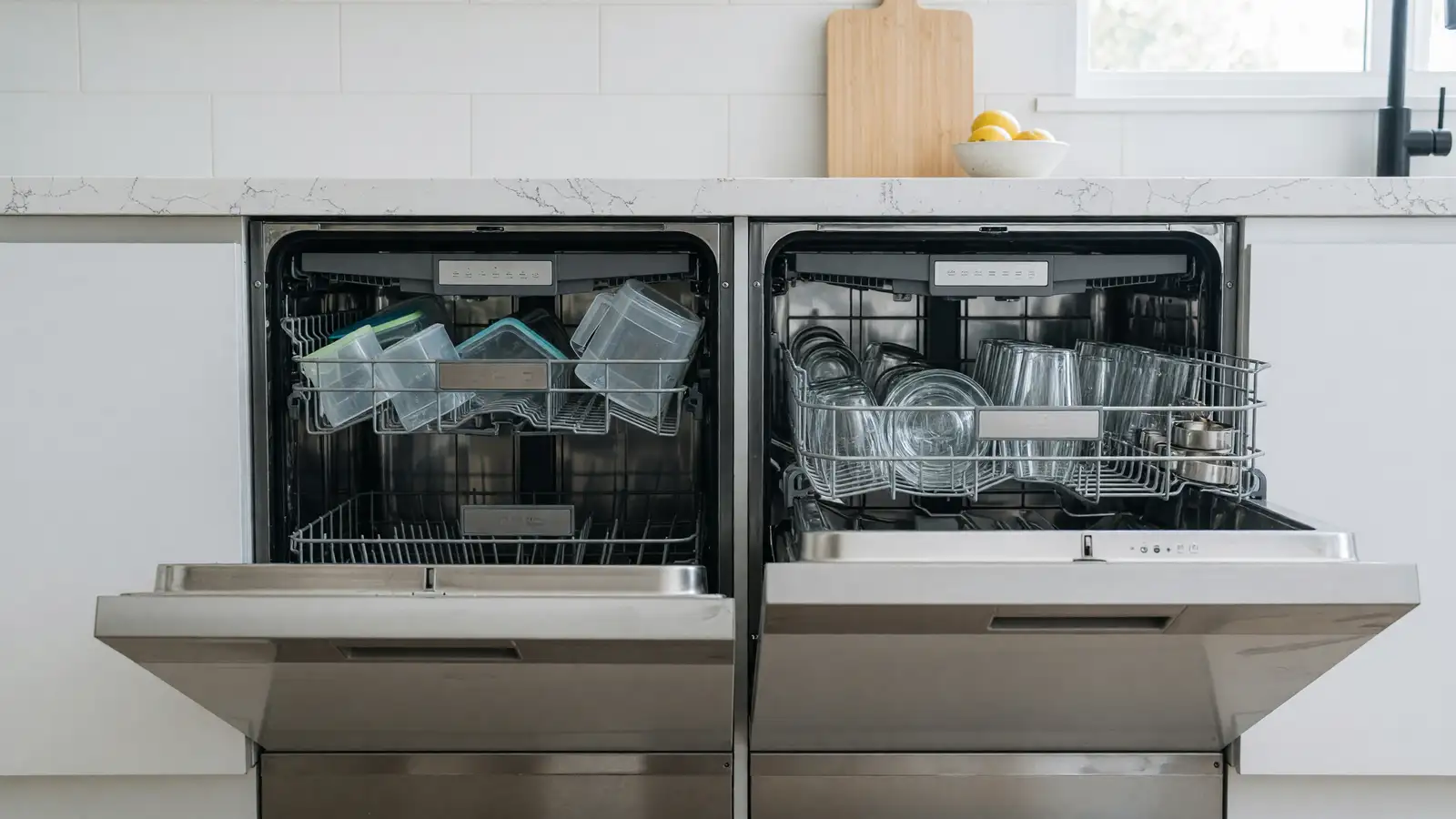
Quartz, Colleen Cabili, updated October 15, ran Consumer Reports’ member reliability through four machines. Bosch, Midea, Miele, and Thermador sit at the top of the brand list. Bosch and Miele are the pair that land highest on reliability and owner satisfaction at the same time. The Miele that carries those scores into a built-in box is the G7196SCVISF: overall 78, $2,399. That is a CR score and a street price. It is not a service rate.
Yale Appliance is the service-rate page. Twelve-month repair: Miele 5.6 percent, down from 10.1. Bosch 7.8 percent, down from 9.5. Miele is 2.2 points less likely to need a visit in year one, in that shop’s data. Dishwashers, Yale notes, wait behind refrigerators and ranges when a technician has to choose. Reliability is not a vibe. It is who shows up last.
Consumer Reports’ 2026 lab roundup puts each machine through about 30 hours of trials. Standouts include Bosch, LG, and Miele. The related reliability page cites survey data from more than 66,000 owners. We already ran KitchenAid against Breville on the counter and a Breville oven against a Cuisinart. This week the object is under the counter.
5.6 versus 7.8 is the year-one tax
Yale’s table is local repair reality, not CR’s predicted reliability. Both brands improved versus last year. Miele’s drop from 10.1 to 5.6 is the bigger swing. Bosch was already the quiet reliable one in a lot of kitchens; 7.8 percent is still a small shop number, and it is not 5.6. If you live where dishwasher techs book out, 2.2 points is a calendar.
CR’s brand list, in Quartz, puts Bosch and Miele together at the top of both reliability and satisfaction. Thermador tracks Bosch because Bosch builds it. The Star Sapphire DWHD661EFP is $2,499 with an overall 79, strong wash and strong dry. That machine is the expensive Bosch in a Thermador badge. It is not this comparison’s second product, but it tells you the 79 sits $100 above the Miele 78. Overall scores at this altitude are a coin. Service rates are not.
Midea’s MDT24P7CST is Quartz’s spoiler: sub-$1,000, same reliability and satisfaction measures as the premium names. If your budget is the Midea, stop reading the $2,399 paragraph as destiny. This piece is for people already in the Bosch 800 / Miele G 7000 neighborhood. The Midea exists so you do not pretend that neighborhood is the only way to buy a reliable tub.
Price bands overlap. Features do not.
Yale’s street ranges are the useful grid.
Bosch 500 with AutoAir: $899 to $1,149, promo floor around $849. Miele G 5056: $1,099 to $1,299, promo around $1,049. Bosch has auto-open. Miele’s racks feel more fitted, in Yale’s phrasing. This is not the 800 fight. It is the warning that a “Bosch vs Miele” headline without a series number is a lie.
Bosch 800 with CrystalDry: $1,299 to $1,599, promo around $1,199. Miele G 5256: $1,299 to $1,499, promo around $1,249. Yale’s example 800 is the SHX78CM5N at $1,549. Example Miele at the next step: G 5266 SCVi SFP at $1,899. CrystalDry is the 800’s jump. AutoDos is Miele’s.
Bosch Benchmark with CrystalDry, 38 dB: $1,599 to $1,999, promo around $1,499. Example SHX9PCM5N at $1,799. Miele G 7156 AutoDos: $1,699 to $2,199, promo around $1,599. Example G 7186 SCVi SFP at $2,199. Quartz’s G7196SCVISF at $2,399 sits on top of that last band.
If you are choosing 800 versus G7196, you are not choosing $1,549 versus $2,399 as if those were the only two stickers in the category. You are choosing zeolite drying plus zone control versus Miele’s wash coverage, racks, and AutoDos, and you are paying hundreds for the last step. Yale says Bosch 800 is the nightly technology jump (plastics, PowerControl). Miele 5256 refines coverage. G7196 is the reliability-and-satisfaction SKU Quartz picked, not Yale’s value pick. Keep the SKUs straight.
CrystalDry is the plastic. AutoDos is the detergent.
Bosch CrystalDry uses zeolite to absorb moisture and emit heat. Yale: it raises temperatures and dries plastics best. If your rack is lunch containers and lids, this is the feature you can feel at 7 a.m. Quartz’s note on the G7196SCVISF is the other side. Buyers who want dishes dry straight out of the machine will find stronger performers elsewhere. Miele won reliability. It did not, in that write-up, win drying.
AutoDos is Miele’s counter. Detergent dosing as a system, not a tab you forget. Yale pairs AutoDos with flexible racks and, on the G 7156 class, “dosing intelligence.” If you already rinse like a maniac and only run full loads, AutoDos is a convenience. If your household is three different people dumping plates, dosing is the feature that keeps the tub from becoming a science project.
PowerControl on Bosch 800 and Benchmark is zone control for mixed loads: china and a baked pan on the same rack, in Yale’s use case. Miele’s 3D cutlery tray and rack geometry show up for stemware. Those are not the same night. A house that packs hotel-style stemware is a Miele house. A house that packs leftover containers is a CrystalDry house. The 5.6 percent does not dry a lid.
Noise: Benchmark down to 38 dB. Bosch 500 is the quiet-and-value line at or under 44 dB in Yale’s quick take. If the machine sits on a wall shared with a bedroom, 38 dB is the spec to verify on the sticker, not in a blog. G7196’s noise is not in our extract. Do not invent it. Ask the spec sheet.
CR’s 30 hours are not Yale’s truck
Consumer Reports’ lab is soil, cycles, and drying under a protocol. About 30 hours per dishwasher. Pang-Chieh Ho’s 2026 roundup is the public-facing “best and worst” page. It will not give you Yale’s 12-month service percentage. It will tell you whether the machine cleaned the casserole. Those are different failures. A quiet Bosch that leaves a lid wet is a CrystalDry conversation. A Miele that needs a pump in month eight is a 5.6 versus 7.8 conversation.
Quartz’s G7196SCVISF at 78 and $2,399 is the expensive efficiency-and-dependability pick, with drying as the concession. Thermador at 79 and $2,499 is the Bosch family member that did not concede drying. If drying is the whole review, Thermador and Bosch 800/Benchmark are the fork, and G7196 is the wrong headline. If a truck roll is the whole review, G7196’s brand rate is the number Quartz wants you to buy.
Sixty-six thousand owners, on CR’s reliability page, is the survey, not the lab. Predicted reliability is a reputation. Yale’s percentages are invoices. If you can get Yale’s service in your market, weight Yale. If you cannot, CR’s brand list is the thing you can actually use. Do not average 5.6 and 78. They do not share a unit.
Yale’s quick takeaways are blunt enough to steal as a shopping note. Best overall washer with least fuss: Miele G 7156, or G 5256 to save, AutoDos plus coverage. Best plastics dryer: Bosch 800 or Benchmark with CrystalDry. Quiet and value: Bosch 500 at or under 44 dB. Stemware: Miele. Mixed china and pans: Bosch 800/Benchmark PowerControl. G7196 is Quartz’s reliability SKU, not Yale’s “least fuss” SKU. If you wanted least fuss, you are in the 7156 paragraph.
Who the 800 is for
The Bosch 800 at $1,549 as tested in Yale’s example is the machine if plastics matter, if you want PowerControl, and if you do not want to spend G7196 money. CrystalDry is the reason to stop at 800 instead of 500. AutoAir on the 500 is a door trick. It is not zeolite.
You accept a higher year-one service rate than Miele in Yale’s shop. 7.8 percent is still low. You also accept that Thermador exists at $2,499 if you wanted Bosch drying with a different badge and a 79. Most people should not pay that delta for three points of overall score.
Parts and techs: Bosch has more of both in most U.S. suburbs. Yale’s “local repair service can matter more than small reliability differences” is the sentence that should sit under every decimal. A 2.2-point gap is real and small. A two-week wait is real and large.
Who the G7196 is for
The Miele G7196SCVISF at $2,399 is the machine if you want the brand that Quartz says wins reliability and satisfaction together, and you can live with drying that is not the class leader. AutoDos and rack geometry are the nightly reasons, not the 78. The 78 is how CR felt about the whole box.
You pay hundreds over an 800. You may pay hundreds over a G 5256 or G 7156 that Yale would rather sell you on value. If the G7196 is the one on the CR list your spouse screenshot, fine. Match the SKU. G 7186 at $2,199 in Yale’s example is not the G7196. Suffixes matter. SCVi SFP is a fully integrated door. Do not order a box that does not match the cabinet plan.
Winner here is Miele G7196 on the metric this week actually moved: year-one service in Yale’s table plus Quartz’s dual win on reliability and satisfaction. Bosch 800 wins the lid. If your household is lids, ignore the winner line and buy the 800. If your household is “do not call a tech,” the 5.6 percent is the product.
Promo floors in Yale’s table are holiday dips, not everyday tags. Bosch 500 around $849. Miele 5056 around $1,049. Bosch 800 around $1,199. Miele 5256 around $1,249. Benchmark around $1,499. Miele 7156 around $1,599. If a screenshot of $2,399 is your only number, you skipped the weeks when the 800 is the buy. Wait for the dip if plastics are the feature. Do not wait for a dip on a G7196 if the reason you are there is the 5.6 percent. Reliability is not a rebate.
LG appears in CR’s lab standouts and not in Quartz’s four-machine reliability shortlist. Do not drag LG into this head-to-head without a SKU. The 2026 lab page is allowed to like Bosch, LG, and Miele at once. This article is not a three-way. Midea’s sub-$1,000 box is the only third name that earned a paragraph, because Quartz used it to puncture the idea that reliability requires a $2,399 door.
Cabinet plan: a 24-inch integrated door is not a portable. Measure the opening. SCVi SFP on Miele is the fully integrated path in Yale’s examples. Bosch top-control boxes in the 800 and Benchmark lines are the ones in the street-price table. If your kitchen is already cut for a Bosch 500, the G7196 is a fantasy until the cabinet changes. Buy the 800 that fits. Put the 5.6 percent on the next remodel.
We ran air purifiers as a 4x price question. Dishwashers have the same shape. The premium is not louder marketing. It is a truck that comes later, or a lid that dries. Pick which failure you are paying not to have.