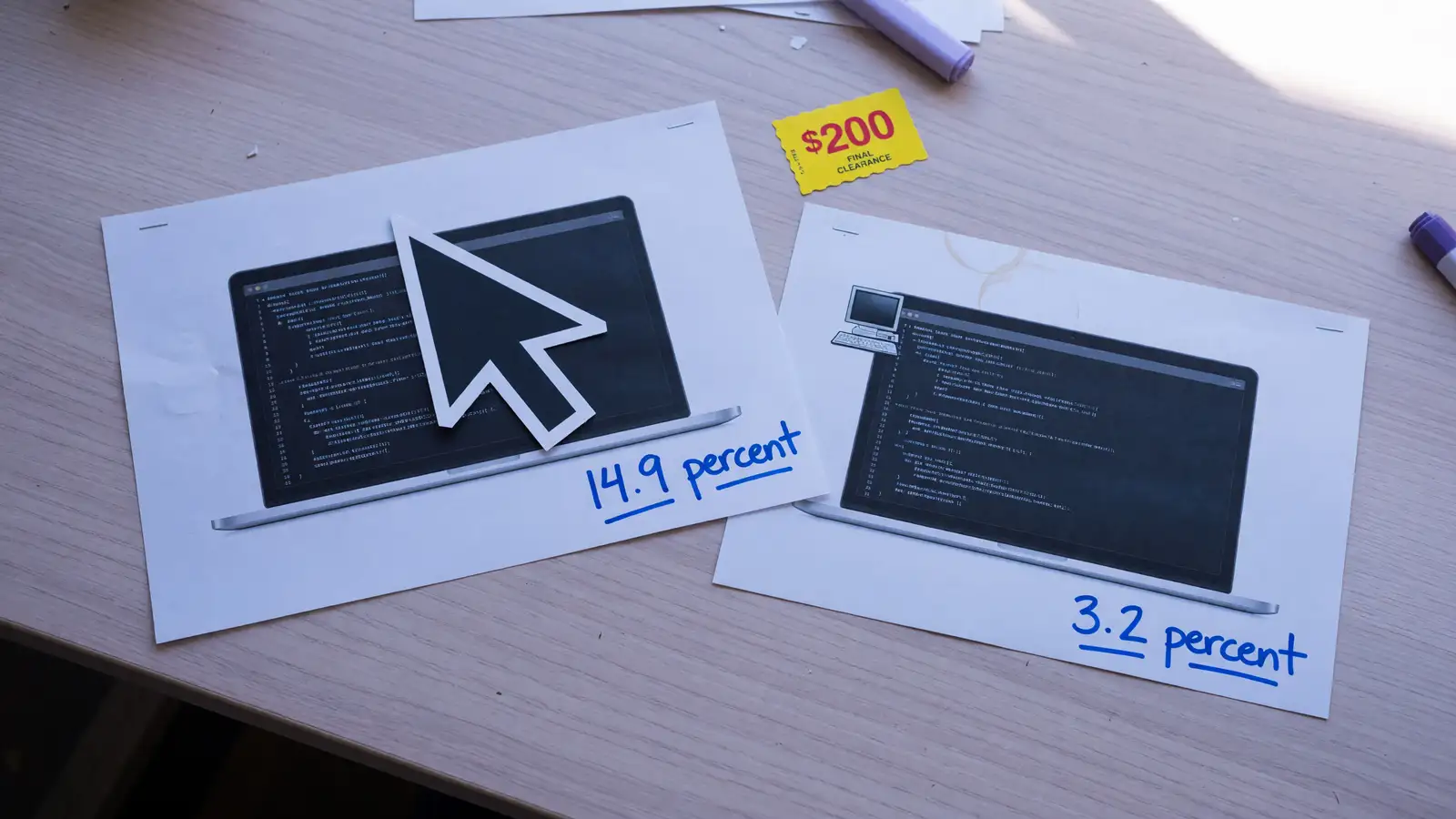
Stack Overflow published the 2026 Developer Survey on October 6: 30,903 valid responses from 169 countries. Visual Studio Magazine’s writeup of the IDE table is the number that matters for this pairing. Among 13,193 people who answered the development-environment question, Cursor is sixth at 14.9 percent. Windsurf is 3.2 percent. Cognition rebranded that editor to Devin Desktop on June 2. The survey still says Windsurf. Usage still did not follow the rename on this survey.
We already ran GitHub Copilot vs Cursor as the extension versus the fork, and Cursor vs Claude Code as the GUI versus the terminal. This week is two downloaded apps that both want to replace VS Code. Copilot stays in the room because Tech Insider’s October 4 three-way priced the $190 gap as Cursor Ultra at $200 against Copilot Pro at $10. Devin’s reported Max is also $200. Ultra versus Max is not a price fight. 14.9 versus 3.2 is the usage fight.
What you install is an editor, not a model
Cursor is Anysphere’s VS Code fork. Inline edits, chat, autocomplete, Composer, and, as of September 10, Projects with coordinator agents that can hand work to subagents and run on Anysphere’s cloud. First launch will import VS Code settings and keybindings. That import is the migration product.
Devin Desktop is Cognition’s rebuild of Windsurf, the editor it absorbed. Tech Insider’s timeline: SWE-1.5 on October 30, 2025, with a Cerebras partnership and a reported 950 tokens per second; SWE-1.7 on July 8, 2026, trained from a Kimi K2.7 base; desktop rebrand June 2, 2026; Cascade retired July 1 in favor of Devin Local. SWE-2 sits behind the current desktop. The model names are Cognition’s. They are not a reason to switch editors if you have never opened Windsurf.
Setup is not the same. Cursor is download, log in, open a folder. Devin Desktop, in Tech Insider’s first-ten-minutes section, usually wants GitHub or GitLab connected through Devin Cloud first so Desktop, CLI, and Review inherit the same repo permissions. Unattended backlog work is a Cloud configuration, not a desktop click. If you wanted an IDE, you just bought a platform with four surfaces.
VS Code plus Copilot remains two pieces. The editor has been free since 2015. Copilot is the paid extension. PR approval landed September 1. VS Code’s September 16 release pushed Agent Host, Dev Container-based agent runs, Codex support, and default automations. If the team already standardized on VS Code, that path does not ask anyone to move settings. This comparison is for people who already decided the extension is not enough.
Yahoo Finance, via Tech Insider, put Anysphere in talks around a $50 billion valuation and an xAI option to acquire at $60 billion. Cognition closed a Series D of more than $1 billion in May 2026 at $26 billion. Those are cap tables. They do not compile. They do tell you Copilot is a Microsoft line item and the other two are still startups with cloud runs on their own infrastructure.
The $200 seat is the same shape. The $40 seat is not
Cursor’s public grid: Hobby $0, Pro $20, Pro+ $60, Ultra $200, Teams Standard $40 per user per month, Teams Premium $120. Devin, as reported in the same roundup and checked against Cognition’s FAQ for the team formula: Free with a light quota, Pro about $20, Max about $200, team $80 per month plus $40 per full seat, with that seat usable across Cloud, Desktop, CLI, and Review. Copilot: Free, Pro $10, Pro+ $39, Business $19, Enterprise $39.
The $190 headline is Ultra versus Copilot Pro. It is not Cursor versus Devin. Both of those will sell you a $200 individual ceiling. At team price, Copilot Business undercuts Cursor Teams Standard by $21 a seat, and Devin’s $80+$40 formula is a different object: a platform fee plus a seat that is supposed to cover four surfaces. If three of those surfaces are Cloud runs you do not want, you are paying for a backlog robot you did not ask for.
Cursor Projects means the coordinator can run off your laptop. That is convenient. It is also code leaving the machine. Devin Cloud is the same sentence with a different vendor. Devin Local exists because some work has to stay on the notebook. Copilot Business and Enterprise inherit GitHub’s existing SSO, audit logs, and org policy, which is why regulated shops still start there even when the agent features feel bolted on.
None of the three publishes a real total cost once agent tokens overrun the included credits. Budget the overrun before you sign the seat. A $20 Pro that becomes Ultra in week two is a $200 product with a $20 onboarding.
A month of tasks is not a survey. Both still help
Vinod Chugani at KDnuggets spent October’s first week telling a month-long test: legacy refactor, greenfield API, debugging he would rather forget. Cursor’s Composer and Agent modes handled a Django model rename across views, serializers, tests, and migrations without dropping the thread. On vague, large-repo jobs, Agent mode made locally correct edits that were globally inconsistent, including files he had not named. Pro is about $20, with extra billing when agent sessions get heavy. His line: worth it for substantial refactoring; harder to justify if you only wanted inline suggestions.
Copilot, in the same piece, still wins latency on inline completions and the GitHub-shaped context: repos, pull requests, issues. Ask, Plan, and Agent inside Copilot Chat work on bounded tasks and feel less cohesive than Cursor or Windsurf. $10 is the cheapest paid seat. Enterprise policy is the reason a bank stays. If autonomous multi-step coding is the primary need, he says tools built around that from the start have an edge.
He files Windsurf / Devin Desktop as the one that wants to run as long as you let it. That matches Cognition’s Cloud-first backlog pitch. It does not match a developer who wants to watch inline diffs in Composer 2.5. Cursor 3.11 Side Chats let you run a second agent thread without dumping the first. That is a GUI for a person who is still in the file. Devin’s unattended run is a GUI for a person who left.
Chugani’s sample is one person. Stack Overflow’s IDE table is 13,193 people who can pick more than one tool. Those percentages are usage in the respondent group, not exclusive market share. Cursor at 14.9 percent is already a minority next to VS Code at 70.9 percent. Windsurf at 3.2 percent is a rounding error in a lot of orgs. Admired scores, which ask existing users if they want to keep the tool, put VS Code at 55.7 percent and Cursor at 33 percent. Desired usage still leads with VS Code at 40.6 percent. The disruptors have not displaced the default editor. They have split a slice of people who will install a second one.
Among people who already use AI, Stack Overflow says 66 percent live in coding agents and 63 percent in chatbots. Agents of choice: Claude Code 66 percent, GitHub Copilot 59 percent. 73 percent of AI coding-assistant users are daily. Those agent percentages are not IDE share. Claude Code is a terminal. Copilot rides VS Code. Cursor’s 14.9 percent is the fork. Devin is not in that agent-of-choice sentence. If your team already standardized on Claude Code, the September Copilot-versus-Claude survey flip is still the pairing. Do not buy Devin Desktop to solve a terminal habit.
Who should take which download
Take Cursor if you will leave VS Code, you want Composer diffs on a multi-file rename, and you will review every extra file Agent mode touches. Pay Pro at $20 until the usage email arrives. Do not start on Ultra because a roundup mentioned $200. Turn Projects off until security has read Anysphere’s data policy. Import the keybindings on night one or you will spend a week fighting chords.
Take Devin Desktop if the job is an unattended backlog and you already accepted Cognition’s Cloud permission model. Connect GitHub first, then install the desktop, then decide whether Local or Cloud is allowed on this repo. The $80+$40 seat only makes sense if more than one surface is in use. If you just wanted Cascade-as-it-was, that brand retired on July 1. You are buying Devin Local inside a renamed app, plus a model family (SWE-2) you cannot get as an extension.
Stay on VS Code plus Copilot if the org already owns GitHub Enterprise policy. $10 Pro is the trial. Agent Host on the September 16 VS Code is the feature to turn on before you shop forks. PR approval on September 1 is a GitHub permission, not an editor skin.
One more filter: who sees the agent. Cursor Teams can tie a Project to a Slack channel so the channel gets status without opening the IDE. That is useful and also a leak if the channel is wider than the repo. Devin’s shared $40 seat is meant so Cloud people and Desktop people draw from one pool. Copilot Business tells admins which repositories the extension touched. If you cannot answer “who is allowed to watch the run,” you are not ready for coordinator agents, regardless of which fork you downloaded.
The Cerebras 950 tok/s number on SWE-1.5 is a 2025 inference story. It is not SWE-2’s published score in the October 4 roundup. Do not shop Devin Desktop because a year-old tokens-per-second chart looked like a benchmark win. Composer 2.5’s parallel diffs are the Cursor number you can see without a press kit.
Winner is Cursor for this pairing. The survey already picked it over Windsurf by a wide margin, the onboarding is one app without a Cloud-first detour, and KDnuggets’ refactor example is the job most people mean when they say they want an AI editor. Devin Desktop is the other $200 logo. It is a platform. It is not the editor the 14.9 percent already opened.
If you cannot review diffs, neither download is safe. An agent that opens its own PR is Copilot’s September 1 feature and Devin Review’s product. That is a process decision. It is not a reason to switch IDEs on a Friday.