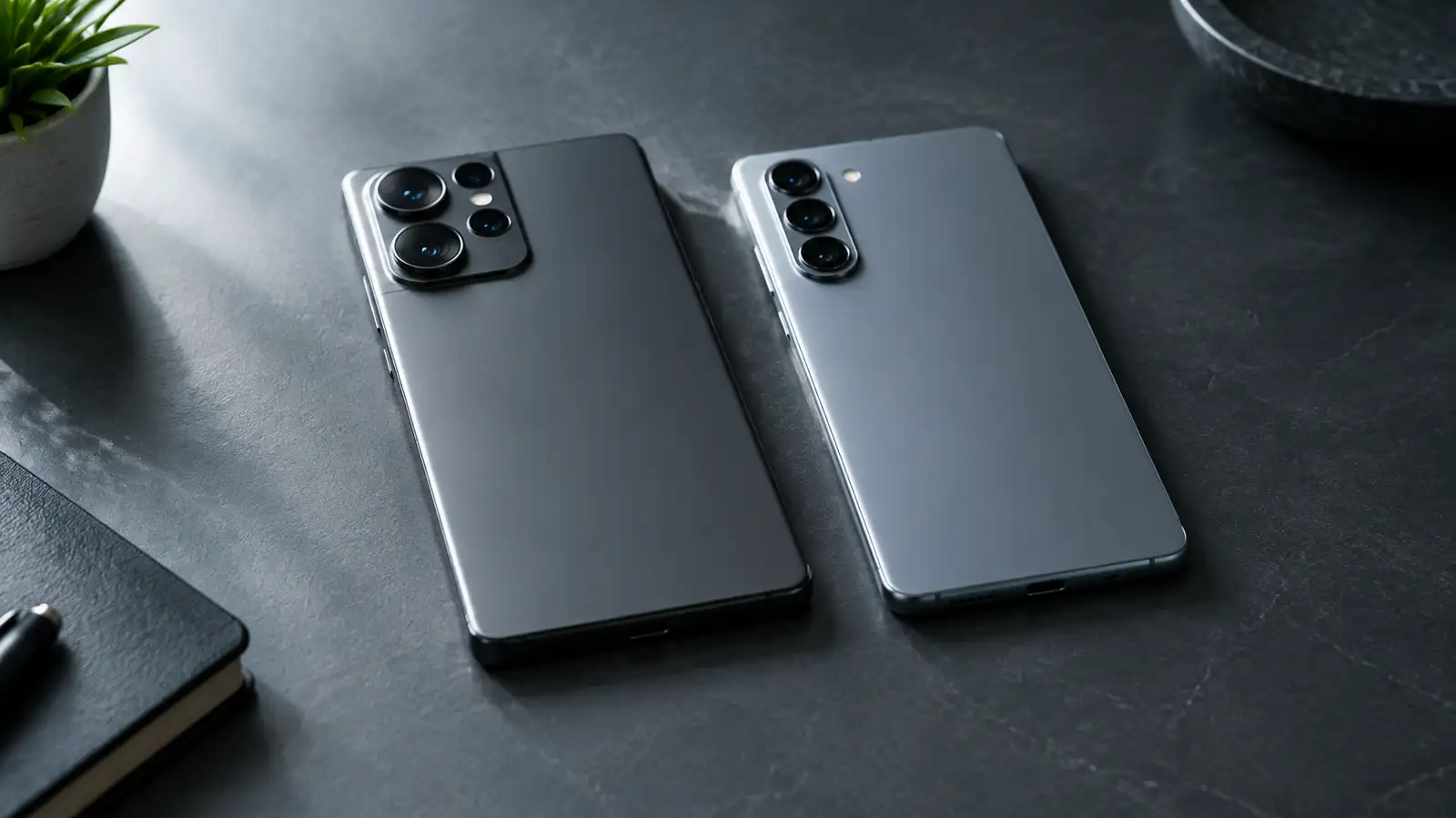
The arrival of the Motorola Signature 27 vs Samsung Galaxy S26 Ultra rivalry introduces a direct challenge to the top tier of Android hardware. For several generations, Samsung treated the Ultra line as an unchallenged baseline for buyers spending well over a thousand dollars. The Galaxy S26 Ultra pairs a large display, an embedded digital stylus, multi-window desktop software, and a quad-sensor camera array. Motorola entered this exact segment on November 5, 2026, unveiling the Motorola Signature 27 at a starting price of $1,599. Instead of delivering an incremental update, Motorola prioritized high-capacity silicon-carbon battery chemistry, specialized Tandem OLED panel hardware, and high-wattage charging.
Choosing between these two smartphones depends on which hardware priorities align with your daily routines. Motorola configured the Signature 27 with an extreme hardware profile: a dual-stack Tandem OLED panel capable of reaching 12,000 nits peak brightness, an audio system co-engineered with Bang & Olufsen, and a 7,000 mAh silicon-carbon power cell. Samsung built the Galaxy S26 Ultra around office productivity, optical reflection reduction, the built-in S Pen, and a camera layout offering two distinct optical zoom distances. Both manufacturers promise seven years of software support, yet each phone serves a very different type of user.
Motorola Signature 27 vs Samsung Galaxy S26 Ultra: Core specifications
The specification table below compares the dimensions, silicon, battery configurations, display technologies, and camera hardware across both flagship phones using verified technical documentation:
| Hardware Metric | Motorola Signature 27 | Samsung Galaxy S26 Ultra |
|---|---|---|
| Starting Retail Price | $1,599.99 USD (12GB + 512GB) | $1,299.00 USD (12GB + 256GB) / $1,419.00 USD (12GB + 512GB) |
| Display Size and Panel | 6.8-inch Extreme AMOLED Duo (Tandem OLED) | 6.9-inch Dynamic LTPO AMOLED 2X |
| Screen Resolution | 2772 x 1272 pixels (1.5K, ~446 PPI) | 3120 x 1440 pixels (QHD+, ~505 PPI) |
| Refresh Rate | 1 Hz to 120 Hz LTPO | 1 Hz to 120 Hz LTPO |
| Peak Panel Brightness | 12,000 nits (small HDR highlights) | 2,600 nits |
| Surface Protection | Corning Gorilla Glass Ceramic 3 | Corning Gorilla Armor 2 (Anti-reflective) |
| Display Privacy Layer | Software-level permission controls | Hardware-level switchable Privacy Display filter |
| Processor Silicon | Qualcomm Snapdragon 8 Elite Extreme Gen 6 | Qualcomm Snapdragon 8 Elite Gen 5 for Galaxy |
| Available US Configurations | 12GB LPDDR5X + 512GB UFS 4.1 (Single US SKU) | 12GB/256GB, 12GB/512GB, 16GB/1TB UFS 4.0 |
| Primary Rear Camera | 50MP Sony LYTIA L910 (f/1.6, OIS, LOFIC) | 200MP wide (f/1.4, OIS, Multi-directional PDAF) |
| Dedicated Telephoto Optics | 200MP Periscope (3x optical, 100x hybrid zoom) | 50MP Periscope (5x optical) + 10MP (3x optical) |
| Ultra-Wide Camera | 50MP (122-degree FOV, autofocus macro) | 50MP (f/1.9 aperture, Dual Pixel PDAF) |
| Motion Capture Sensor | Dedicated Event-Based Vision (EVS) sensor | Laser autofocus and multi-spectrum color sensor |
| Front Camera | 50MP wide with autofocus | 12MP Dual Pixel with autofocus |
| Battery Capacity | 7,000 mAh typical (6,790 mAh rated) Silicon-Carbon | 5,000 mAh Lithium-Ion |
| Wired Charging Speed | 90W TurboPower (~12 hours use from 12 min charge) | 60W wired fast charging |
| Wireless Charging Speed | Up to 50W (Motorola charger) / ~15W (standard Qi, no Qi2) | Up to 15W/25W wireless charging |
| Audio Engineering | Stereo speakers co-engineered by Bang & Olufsen | Stereo speakers tuned by AKG with Dolby Atmos |
| Integrated Stylus | None supported | Built-in S Pen with 4,096 pressure levels |
| Operating System | Android 17 with Hello UI | Android 16 with One UI 8.x |
| Software Lifecycle | 7 years OS upgrades + 7 years security updates | 7 years OS upgrades + 7 years security updates |
| Ingress Certification | IP68 and IP69 certified | IP68 certified |
| Physical Dimensions | 162.01 x 77.04 x 7.99 mm | ~163.6 x 78.1 x 7.9 mm |
| Device Weight | 227 grams | 214 grams |
Display engineering: Tandem OLED luminance versus Gorilla Armor 2 anti-reflective glass
The display panels on these two phones resolve outdoor visibility problems through opposing engineering choices. As detailed in Motorola Mobility’s official launch release, the Motorola Signature 27 carries a 6.8-inch “Extreme AMOLED Duo” display built on Tandem OLED architecture. By stacking two distinct organic light-emitting layers atop one another, the panel distributes electrical current across dual emitters. This configuration enables a peak brightness rating of 12,000 nits in small HDR windows while maintaining panel efficiency and extending organic material lifespan. When viewing videos under intense midday sunshine, the Signature 27 powers through harsh environmental light through sheer luminous output.
Samsung relies on an optical solution rather than chasing peak nit numbers. According to Samsung Newsroom’s official Galaxy S26 announcement, the Galaxy S26 Ultra pairs a 6.9-inch Dynamic LTPO AMOLED 2X panel with Corning Gorilla Armor 2 glass. The display reaches a peak brightness of 2,600 nits, which is lower than Motorola’s ceiling, but the Gorilla Armor 2 surface incorporates an optical coating that absorbs approximately 75 percent of incoming reflections. When reading documents inside bright office spaces, working near cafe windows, or sitting under direct studio lighting, the Galaxy S26 Ultra delivers exceptional readability because the glass prevents overhead lamps and facial reflections from washing out the panel.
Resolution numbers also favor Samsung for fine desktop-style layouts. The Galaxy S26 Ultra outputs a QHD+ resolution of 3120 x 1440 pixels at roughly 505 pixels per inch. High-density spreadsheets, small fonts in PDF blueprints, and complex web pages appear cleanly rendered without jagged character curves. The Signature 27 operates at a 1.5K resolution of 2772 x 1272 pixels, producing approximately 446 pixels per inch. The screen renders streaming media and gaming interfaces with crisp clarity, though close-up reading reveals slightly softer edge boundaries than Samsung’s sharper grid.
Samsung also includes a dedicated hardware Privacy Display filter on the Galaxy S26 Ultra. Users can activate this mode from the quick settings panel to narrow the horizontal light dispersion of the subpixels. Commuters seated on commuter trains or business executives handling sensitive communications at airport terminals can view their screen straight-on while passengers seated immediately to their left or right observe a darkened surface. Motorola provides standard software privacy toggles and permission dashboards, but offers no physical optical filter to obscure side angles.
Silicon performance, thermal architecture, and battery endurance
Processing hardware and battery configurations show significant generational shifts between the two devices. The Motorola Signature 27 runs Qualcomm’s Snapdragon 8 Elite Extreme Gen 6 platform, built on a 2-nanometer fabrication process. As highlighted in Ars Technica’s detailed hardware analysis, Motorola paired this chip with an internal “ArcticMesh” cooling setup that uses diamond-infused thermal interface material and a multi-channel vapor chamber to pull heat away from the silicon package.
Samsung equips the Galaxy S26 Ultra with Qualcomm’s Snapdragon 8 Elite Gen 5 for Galaxy, manufactured on a 3-nanometer node with elevated primary core clock speeds. Everyday responsiveness across social feeds, browser tabs, video streaming, and split-screen multitasking feels immediate on both smartphones. Under sustained heavy computation, such as continuous high-framerate 3D rendering or exporting long 4K video timelines, Motorola’s 2-nanometer architecture and diamond thermal paste allow the processor to maintain peak clock rates with minimal thermal throttling.
Configuration options differ substantially between markets. In the United States, Motorola sells the Signature 27 exclusively in a single tier featuring 12GB of LPDDR5X RAM alongside 512GB of UFS 4.1 storage. The software includes a 12GB RAM Boost virtual memory option, but buyers seeking an internal 1TB configuration cannot purchase one in the US market. Samsung provides broader commercial variety, letting customers select 12GB of RAM with 256GB or 512GB of storage, or step up to 16GB of RAM with a 1TB storage drive for intensive local file storage.
Battery capacity is where Motorola establishes a measurable physical advantage. The Signature 27 packs a 7,000 mAh typical capacity (6,790 mAh rated) silicon-carbon battery into a chassis measuring 7.99 mm thick and weighing 227 grams. Silicon-carbon anode chemistry stores more milliamp-hours within each cubic millimeter compared to traditional lithium-ion compositions. Heavy users running continuous satellite navigation, high-brightness screen settings, mobile hotspot tethering, and 5G data connections can expect up to two full days of typical operation between outlet visits.
The Galaxy S26 Ultra uses a traditional 5,000 mAh lithium-ion cell in a 7.9 mm body weighing 214 grams. Samsung’s software power management and adaptive display refresh keep the phone running reliably through a standard 16-hour workday, though demanding power users often find the battery hovering between 15 and 20 percent by late evening.
Replenishment speeds further separate the two flagships. As noted in 9to5Google’s technical overview, the Signature 27 supports 90W TurboPower wired charging, allowing users to gain roughly 12 hours of usable battery reserve from a 12-minute charge. Its wireless charging supports speeds up to 50W when placed on Motorola’s proprietary charging stand; standard third-party wireless pads charge at approximately 15W, and the device does not include Qi2 magnetic alignment rings. Samsung provides 60W wired fast charging on the Galaxy S26 Ultra, which recharges the battery to around 75 percent in 30 minutes, alongside standard Qi wireless charging and reverse Wireless PowerShare.
Readers tracking how Samsung’s battery stamina measures up against competing multi-lens phones can read our Samsung Galaxy S26 Ultra vs iPhone 18 Pro Max head-to-head analysis.
Camera architectures: Highlight preservation versus dedicated optical zoom
Camera engineering choices show two different approaches to mobile photography. Motorola designed the Signature 27 to master dynamic range and freeze rapid physical movement. Samsung built the Galaxy S26 Ultra around sensor resolution and optical magnification versatility.
Motorola centers the rear camera module on a 50MP Sony LYTIA L910 primary sensor equipped with Lateral Overflow Integration Capacitor (LOFIC) technology. Conventional image sensors frequently blow out bright light sources because individual pixel wells saturate before the exposure finishes. LOFIC circuitry drains excess electrical charge into an overflow capacitor before the photodiode clips. Nighttime city streets filled with neon signs, car headlamps, and backlit stage performances retain saturated colors and clear sign lettering without the artificial HDR haloing common in multi-exposure post-processing.
Motorola also placed a dedicated Event-Based Vision (EVS) sensor on the camera island. Rather than recording standard video frames at fixed intervals, this neuromorphic sensor monitors continuous fluctuations in light intensity across individual pixels in microseconds. When tracking running pets, active children, or fast sports plays, the EVS sensor detects motion trajectories instantly and triggers zero-shutter-lag exposures, minimizing motion blur.
Where Samsung retains a clear advantage is in long-range zoom flexibility. The Galaxy S26 Ultra includes a 200MP main camera with a wide f/1.4 aperture, supported by two dedicated telephoto lenses: a 10MP 3x optical camera and a 50MP 5x periscope optical camera. Having two native optical focal lengths allows the camera system to adapt to varying subject distances. The 3x optical lens delivers natural perspective for portraits and tabletop photography, while the 5x periscope lens captures crisp architectural details and wildlife without digital cropping artifacts.
Motorola approaches zoom with a single 200MP periscope lens locked at 3x optical magnification, relying on high sensor resolution and AI algorithms to crop into frames for 10x and 30x captures. While the Signature 27 captures clear 3x portraits, Samsung’s 5x optical telephoto resolves sharper surface textures, cleaner subject outlines, and more convincing background separation at focal lengths beyond 120mm.
Mobile photographers evaluating multi-camera flagship setups can reference our Pixel 11 Pro vs Galaxy S26 Ultra camera and software comparison.
Software systems, S Pen productivity, and operating freedom
Operating systems and workflow features present stark contrasts between structured corporate productivity and lightweight software personalization.
The Galaxy S26 Ultra remains the only mainstream flagship with an integrated digital stylus. The siloed S Pen provides 4,096 levels of pressure sensitivity, tilt recognition, and Bluetooth remote controls. Users can jot down handwritten notes on the dark lock screen without unlocking the device, sign digital contracts, sketch visual concepts, and precisely select cells inside large spreadsheets. Samsung DeX expands this utility by transforming the smartphone into a desktop environment when connected to an external monitor via USB-C or wireless Miracast. With mouse and keyboard support, resizable application windows, and desktop file management, the phone functions effectively as a lightweight workstation.
Samsung’s One UI software includes the Galaxy AI tool suite, which handles live voice call translation, formatting assistance in Samsung Notes, audio recording transcriptions, and generative photo adjustments.
Motorola ships the Signature 27 with Android 17 and its Hello UI skin. Hello UI keeps the uncluttered interface of stock Android while incorporating familiar physical gestures, such as double-chopping the handset to toggle the LED flashlight and twisting the wrist twice to open the camera.
The software package on the Signature 27 also incorporates Google’s Gemini Intelligence suite at the operating system level. Key additions include Gboard Rambler, which strips filler words and refines punctuation during continuous voice dictation, Create My Widget, which builds interactive home-screen widgets from simple written prompts, and real-time ASL Sign-to-Text translation via the front-facing 50MP camera.
For technical users focused on privacy, the Signature 27 provides rare open platform support. Motorola worked directly with open-source communities to verify out-of-the-box compatibility with GrapheneOS. Owners can unlock the bootloader and install the privacy-hardened operating system without losing hardware camera tuning or breaking device security attestations.
Both manufacturers guarantee seven years of major Android version upgrades and seven years of regular security updates, keeping either device current into late 2033.
Readers curious about how Samsung balances productivity tools against competing ecosystems can read our iPhone 18 Pro vs Galaxy S26 Ultra flagship breakdown.
Acoustic design, chassis engineering, and durability standards
Industrial design and multimedia components reflect distinct manufacturing priorities on both devices. Motorola designed the Signature 27 as a luxury hardware statement. The back panel is available in Coal Smoke, which features a tactile technical weave texture, and Capulet Olive. The chassis measures 162.01 x 77.04 x 7.99 mm and weighs 227 grams, utilizing an aircraft-grade aluminum frame and Corning Gorilla Glass Ceramic 3 to guard the front panel against drops onto hard surfaces.
The acoustic design on the Signature 27 stands out among modern flagships. Motorola partnered with Danish luxury audio firm Bang & Olufsen to tune the acoustic chambers and stereo speaker grilles. The speakers produce full mid-range clarity, clean vocal separation, and audible lower-frequency presence. Watching films or listening to podcasts while moving around a room delivers greater sound volume and clarity than typical smartphone speakers produce.
Motorola also secured both IP68 and IP69 certifications for the Signature 27. While IP68 verifies submersion in fresh water up to 1.5 meters for 30 minutes, IP69 verifies resistance to close-range, high-pressure, and high-temperature water jet sprays. This provides reliable protection against high-pressure faucet washing and torrential downpours.
Samsung builds the Galaxy S26 Ultra with an Armor Aluminum frame and Corning Gorilla Armor 2 glass, measuring 163.6 x 78.1 x 7.9 mm and weighing 214 grams. The slightly rounded frame corners improve hand ergonomics compared to earlier square-edged Ultra designs. Its stereo speakers are tuned by AKG with Dolby Atmos support, delivering crisp dialogue and balanced highs, though they produce less acoustic body than Motorola’s Bang & Olufsen configuration.
Retail rollout schedules are worth noting. Motorola opens pre-orders for the Signature 27 on November 19, 2026, with general retail availability starting November 26, 2026. Limited launch promotions include a bundled Moto Watch Ultra and one year of MotoCare warranty coverage.
Buying recommendation: Who wins for which buyer
Evaluating the purchase decision requires balancing pricing differences against functional workflows. The Motorola Signature 27 carries an MSRP of $1,599.99 for a single 12GB RAM and 512GB storage configuration. The Samsung Galaxy S26 Ultra starts at $1,299.00 for 256GB of storage and $1,419.00 for the matching 512GB capacity, resulting in a $180 difference at equivalent storage levels.
Choose the Motorola Signature 27 if:
- Battery endurance is your highest hardware priority. The 7,000 mAh silicon-carbon cell delivers genuine multi-day battery stamina that easily outperforms the Galaxy S26 Ultra under demanding workloads.
- Rapid charging turnaround is essential. 90W TurboPower wired charging restores hours of battery capacity in twelve minutes.
- Outdoor screen visibility in direct sunlight matters most. The 12,000-nit Tandem OLED display cuts through harsh sun with sheer panel luminance.
- You photograph fast-moving subjects. The combination of LOFIC highlight suppression and the neuromorphic Event-Based Vision sensor eliminates blown-out lights and freezes rapid motion without shutter delay.
- You value open platform freedom or plan to install GrapheneOS for strict data privacy.
Choose the Samsung Galaxy S26 Ultra if:
- Stylus input and handwriting are central to your daily routine. The integrated S Pen remains unmatched for signing documents, sketching, and navigating detailed files.
- You work under reflective indoor lighting or near bright windows. Corning Gorilla Armor 2 glass absorbs ambient reflections, providing superior optical comfort without requiring high panel brightness.
- Screen privacy in crowded spaces is necessary. The hardware-based Privacy Display filter blocks side angles with a single toggle.
- Extended telephoto photography is a regular requirement. Dedicated 3x and 5x optical telephoto lenses deliver superior optical detail and cleaner portraits beyond 100mm.
- Desktop computing via Samsung DeX, broad enterprise IT management, and carrier trade-in incentives fit your purchasing strategy.
Both devices stand at the front of flagship Android engineering in late 2026. The Motorola Signature 27 delivers unmatched battery capacity, exceptional panel brightness, and open software flexibility. The Samsung Galaxy S26 Ultra remains the premier tool for stylus productivity, desktop workflows, and versatile multi-lens telephoto photography.