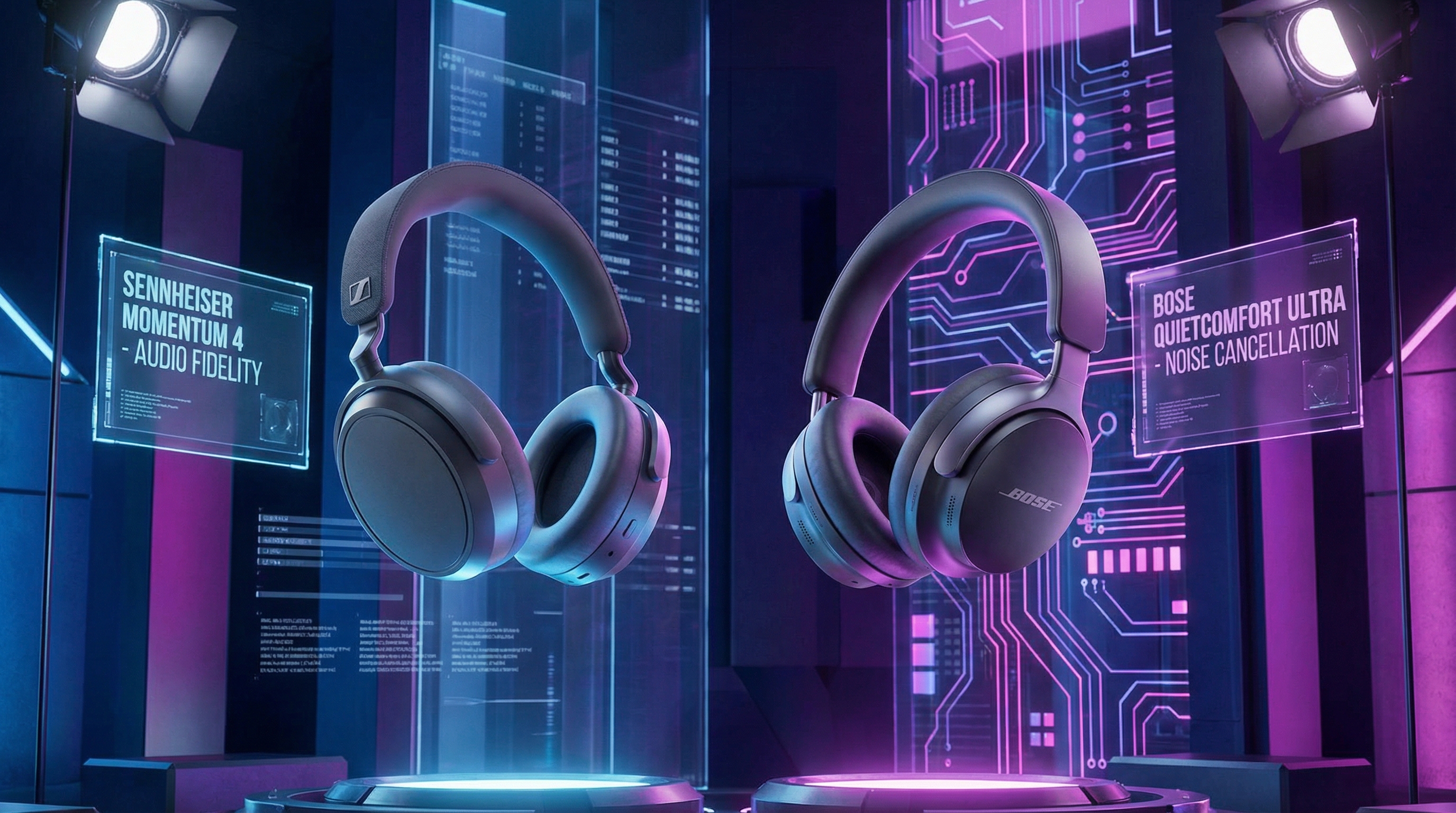
The premium headphone market has always been a battleground between different philosophies. Sennheiser built its reputation on sound quality that audiophiles respect, while Bose became synonymous with comfort and noise cancellation that just works. The Momentum 4 represents Sennheiser’s most complete wireless headphone to date, finally matching competitors on battery life and features while maintaining its sonic edge. The Bose QuietComfort Ultra is the company’s flagship attempt to prove it can compete on sound quality without sacrificing the comfort that made the brand famous. I spent six weeks with both headphones across flights, commutes, and long listening sessions to see which philosophy wins in 2025.
Design and Comfort
The Momentum 4 is a departure from Sennheiser’s previous design language. Gone are the retro-inspired metal sliders and fabric headband of the Momentum 3. The new design is more modern and streamlined, with a synthetic leather headband and plastic construction that feels lighter but less premium in the hand. The ear cups are deep and spacious, with memory foam cushions wrapped in synthetic leather. They sit around your ears rather than on them, which is essential for long-term comfort.
Bose knows comfort better than anyone, and the QuietComfort Ultra proves it. The ear cushions are impossibly soft, with a protein leather covering that feels gentle against skin. The clamping force is perfectly calibrated. tight enough to maintain a good seal for noise cancellation, but light enough that you forget you are wearing them after twenty minutes. The headband padding distributes weight evenly, and the overall fit accommodates a wide range of head sizes without adjustment anxiety.
Build Comparison
| Specification | Sennheiser Momentum 4 | Bose QC Ultra |
|---|---|---|
| Weight | 293g | 250g |
| Foldable | Yes (hinged) | Yes (flat) |
| Carrying Case | Hard shell | Hard shell |
| Water Resistance | No | No |
| Headband Material | Synthetic leather | Cushioned synthetic |
| Ear Cushion | Synthetic leather | Protein leather |
The weight difference is noticeable. The Momentum 4 feels heavier on your head, though the difference is not uncomfortable. Bose wins on portability with its flat-folding design that packs smaller in a bag. Both come with hard-shell cases that protect well but take up similar space. Neither headphone has official water resistance ratings, which is disappointing at this price point.
Sound Quality
This is where Sennheiser flexes its audio engineering heritage. The Momentum 4 sounds exceptional. The tuning is balanced and refined, with a slight warmth that makes music engaging without coloring it artificially. Bass response is tight and controlled, extending deep without bleeding into the midrange. Mids are clear and present, giving vocals and instruments proper weight and texture. Treble is detailed and airy, with excellent extension that reveals subtle details in well-recorded tracks.
Sennheiser supports aptX Adaptive, aptX, AAC, and SBC codecs. On Android devices with aptX Adaptive support, the sound quality is noticeably better than standard Bluetooth, with lower latency and higher bitrate transmission. The Momentum 4 also includes a parametric EQ in the app, allowing precise tuning across multiple frequency bands. For listeners who care about sound customization, this level of control is rare in wireless headphones.
The QuietComfort Ultra represents Bose’s most serious attempt at audiophile-grade sound. It sounds notably better than previous QuietComfort models, with richer tonality and better detail retrieval. The low end is deep and satisfying, mids are smooth, and highs are clear without harshness. Bose’s Immersive Audio mode adds spatial processing that widens the soundstage on compatible tracks. It is not a gimmick. the effect enhances certain genres, particularly orchestral and electronic music.
Comparing them directly reveals clear differences. The Momentum 4 has superior technical performance. Instrument separation is better, dynamic range is wider, and detail retrieval is more precise. The QC Ultra sounds warmer and more forgiving, which makes poorly recorded tracks more listenable but sacrifices some accuracy. For critical listening, the Sennheiser wins. For casual enjoyment, the Bose is more quickly pleasing.
Codec support gives Sennheiser an edge. The QC Ultra supports aptX Adaptive and AAC, which is good but not exceptional. The Momentum 4’s broader codec support means better compatibility with high-quality wireless audio sources.
Noise Cancellation
Bose built its reputation on noise cancellation, and the QuietComfort Ultra delivers the best ANC the company has ever produced. Low-frequency noise. airplane engines, train rumble, HVAC systems. is virtually eliminated. Mid-frequency sounds like conversation and keyboard typing are reduced to faint whispers. High-frequency noise is softened but not completely removed, which is typical of all ANC implementations. The cancellation feels natural and transparent, without the ear-pressure sensation that some aggressive ANC systems produce.
The Momentum 4’s noise cancellation is very good but not quite at Bose’s level. Sennheiser uses adaptive ANC that adjusts to your environment, and it handles low-frequency noise effectively. On flights and trains, the difference between the two headphones is small enough that most people would not notice. In office environments with mixed-frequency noise, the Bose has a slight edge in overall quietness.
Where Sennheiser catches up is in transparency mode. The Momentum 4’s Transparent Hearing mode sounds exceptionally natural, with clear passthrough that makes conversations easy without removing the headphones. Bose’s Aware mode is also excellent, but the Sennheiser has slightly better clarity and less digital processing artifacts.
Both headphones offer adjustable ANC levels through their apps. Bose provides a simpler interface with preset modes, while Sennheiser gives more granular control over cancellation intensity. For most users, Bose’s approach is more intuitive. For those who want precise control, Sennheiser delivers.
Battery Life
This is where the Momentum 4 dominates. Sennheiser claims 60 hours of playback with ANC enabled, and in my testing, the headphones consistently delivered 55 to 58 hours. This is battery life that eliminates charging anxiety for even the longest trips. I used these headphones for two weeks of daily commuting and work listening before needing to charge them.
The QuietComfort Ultra offers around 22 to 24 hours with ANC, which is respectable but nowhere near the Momentum 4’s endurance. With Immersive Audio enabled, battery life drops further to around 18 hours. For most people, this is still enough for several days of use, but the difference is significant if you travel frequently or dislike charging routines.
Both headphones charge via USB-C. The Momentum 4 takes about two hours for a full charge, while the QC Ultra charges slightly faster at around 90 minutes. Quick charging is available on both. 15 minutes gives you approximately 4 hours on the Momentum 4 and 2.5 hours on the QC Ultra.
Connectivity and App Experience
The Momentum 4 uses Bluetooth 5.2 with multipoint support for connecting to two devices simultaneously. The Smart Control app is comprehensive, offering parametric EQ, sound mode customization, ANC adjustment, and firmware updates. The interface is clean and logical, though it can feel overwhelming if you just want simple controls. Multipoint switching worked reliably in my testing, with smooth handoffs between laptop and phone.
Bose’s QuietComfort Ultra also supports Bluetooth 5.3 multipoint connection. The Bose Music app is simpler and more streamlined, focusing on essential controls without overwhelming users with options. EQ is limited to preset modes and a basic adjustable curve. You can toggle Immersive Audio, adjust ANC levels, and manage connections. The app prioritizes ease of use over depth of customization.
Both headphones support voice assistants. Sennheiser works with Google Assistant, Alexa, and Siri through your phone. Bose offers the same assistant support. Neither has a meaningful advantage here.
For call quality, both headphones perform well. The Momentum 4 uses four microphones with beamforming and wind noise reduction. The QC Ultra uses a similar microphone array with AI-based noise suppression. In side-by-side tests, call recipients reported clear audio from both headphones in quiet and moderately noisy environments. Both struggled equally in very windy conditions.
The Verdict
The Sennheiser Momentum 4 wins this comparison for anyone who prioritizes sound quality and battery life. The audio performance is simply better. more detailed, more accurate, and more engaging for critical listening. The 60-hour battery life is a game-changer that eliminates charging anxiety. The app offers deep customization for listeners who want control over their sound signature.
The Bose QuietComfort Ultra remains the better choice for comfort-focused users and those who prioritize noise cancellation above all else. It is lighter, more comfortable for all-day wear, and delivers slightly better ANC performance. The Immersive Audio feature adds genuine value for certain music genres. If you spend long hours in noisy environments and want the most comfortable headphones available, the Bose is the smarter pick.
For most listeners, the Momentum 4’s combination of superior sound quality and exceptional battery life makes it the more compelling package. You sacrifice a bit of comfort and a small margin of ANC performance, but you gain audio quality that justifies the premium price and battery life that redefines what wireless headphones can deliver.