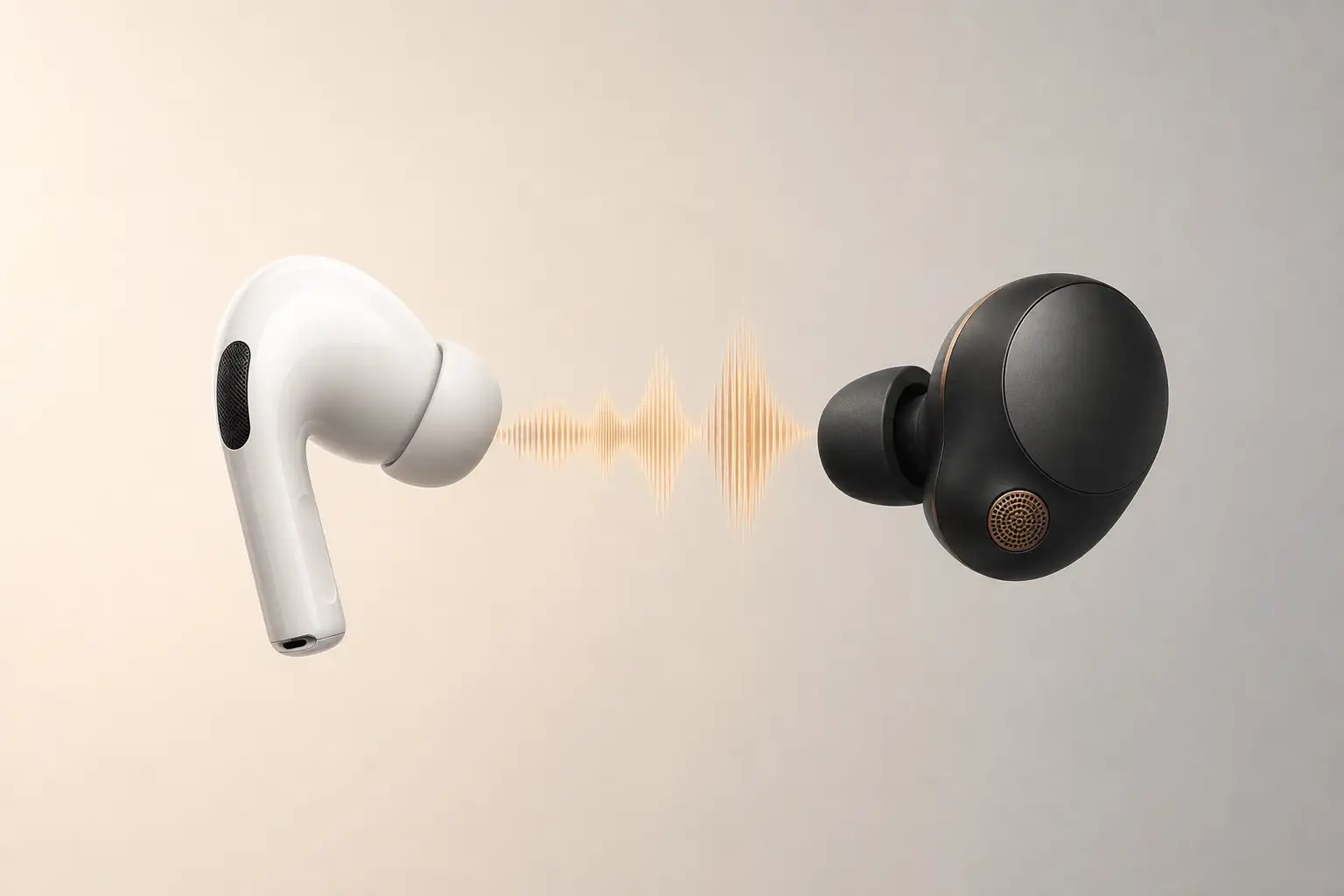
AirPods Pro 3 are sitting at $179 right now — the lowest we’ve seen — and Sony’s WF-1000XM6 just got a firmware update that finally fixes some of the connection quirks people complained about at launch. If you’ve been waiting for a sign to pick up new earbuds, this week might be it.
I spent the last two weeks switching between these two pairs on my commute, during calls, and while listening to everything from podcasts to jazz. Here’s what actually matters when you’re trying to decide.
Sound Quality
Sony’s WF-1000XM6 uses updated 8.4 mm drivers with a wider frequency range than the previous generation. The bass hits harder without muddying the mids, and the treble detail is noticeably sharper — you’ll hear cymbal decay and string resonance that the AirPods Pro 3 tends to smooth over. Apple’s custom driver is still very good, especially for pop and vocal-heavy tracks, but it’s tuned for pleasant rather than precise.
Sony also supports LDAC, which means if your phone can transmit high-bitrate Bluetooth, you’re getting closer to lossless quality than the AAC-only AirPods Pro 3. For most people on Spotify or Apple Music, the gap won’t jump out at you. If you’ve got a local library of FLAC files or use a hi-res streaming tier, Sony wins.
Noise Cancellation
Both sets use adaptive ANC that adjusts to your environment in real time. Sony’s is the more aggressive of the two — it cuts more low-frequency rumble on planes and trains. The AirPods Pro 3 takes a lighter approach, which actually works better in offices and coffee shops because it doesn’t create that “underwater” pressure feeling some people get with heavy ANC.
Sony’s transparency mode is a step behind Apple’s. When I switched to Sony’s transparency, voices sounded slightly processed and there was a faint hiss in quiet rooms. Apple’s is the closest to “not wearing earbuds” of any product I’ve tested.
Call Quality
The AirPods Pro 3 has a noticeable edge here. Apple’s voice isolation algorithm picks up your voice cleanly even in windy conditions, and the “Hey Siri” wake word works reliably from across a room. Sony’s call quality is solid but the microphones pick up more background noise, and the person on the other end asked me to repeat myself a couple of times during a call on a busy street.
Battery Life
Sony wins on paper — about 12 hours from the buds alone with ANC off, 8 hours with it on. The AirPods Pro 3 manages roughly 6 hours with ANC on, 7 without. Both cases give you an extra two full charges. Apple’s MagSafe and Qi2 wireless charging is more convenient if you’ve got a compatible pad, while Sony still uses USB-C on the case.
Ecosystem Lock-In
This is the real deciding factor for most people.
If you’re deep in Apple’s ecosystem — iPhone, Mac, Apple Watch — the AirPods Pro 3 will auto-switch between devices, show you a battery widget, and give you spatial audio with head tracking. None of that works with Android.
Sony’s earbuds pair with everything, and the Sony Headphones Connect app on both iOS and Android lets you tweak EQ, ANC levels, and button controls. The trade-off is you lose the seamless handoff between devices that Apple users take for granted.
Price
At the current $179 deal, the AirPods Pro 3 undercuts the Sony WF-1000XM6 by about $80. Even at full retail ($249 vs $329), Apple’s are the more affordable option.
Verdict
Pick the AirPods Pro 3 if: you use an iPhone, you care about call quality, and you want the smoothest possible experience with zero fiddling. The $179 deal makes them the better value right now.
Pick the Sony WF-1000XM6 if: you want the best sound quality available in wireless earbuds, you need Android compatibility, or you fly frequently and want maximum noise cancellation. The extra cost buys you better drivers, LDAC support, and longer battery life.
Both are excellent. The “right” one is mostly about which phone is in your pocket.