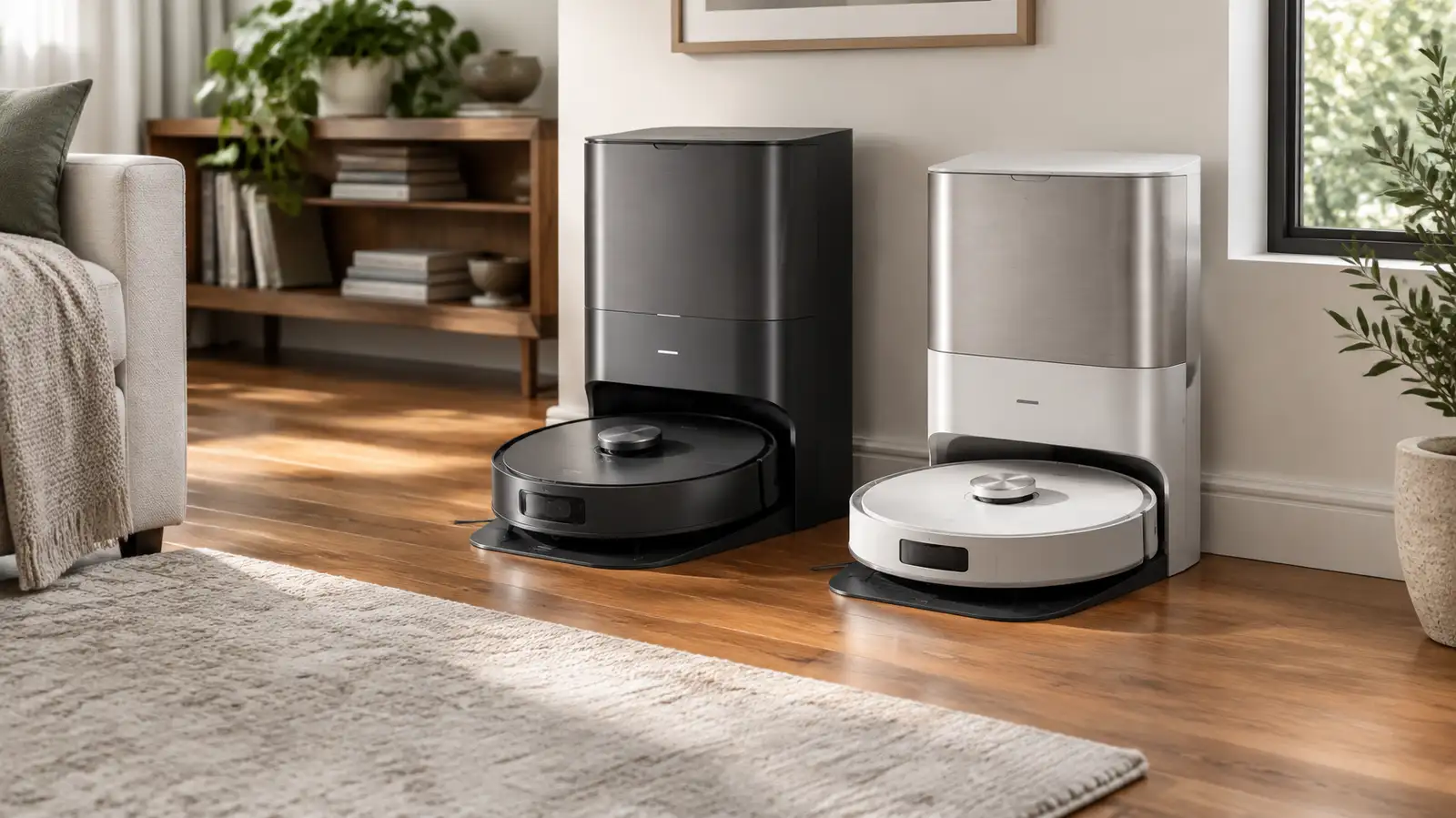
The arrival of the eufy Omni S2 Pro vs Roomba Max 875 matchup marks a significant shift in premium automated floor care. For several product cycles, the automated cleaning category relied on twin spinning round mop pads that dragged across hard floors. While those rotating discs handle light surface dust, they struggle with sticky kitchen syrups, greasy residues, and fine allergens embedded inside floor pores. On November 2, 2026, Anker unveiled the eufy Robot Vacuum Omni S2 Pro at a suggested retail price of $1,699.99, engineering the machine around hospital-grade hygiene, an underbody germicidal ultraviolet light, electrolyzed water generation, and a high-powered 40,000 Pa suction motor. That launch places eufy in direct competition with iRobot’s flagship Roomba Max 875 Combo, a $1,199 system built around heavy physical agitation, a 6.0-centimeter roller spinning at 300 RPM, ultrasonic heated mist, and active hair-cutting blades.
Choosing between these two premium systems comes down to which household hazards dominate your living spaces. The eufy Omni S2 Pro targets microscopic biological threats. By pairing six 275-nanometer UV-C light-emitting diodes with an inline electrolyzer that transforms tap water into an antimicrobial wash, eufy built a machine for households managing severe dust mite sensitivities, pet dander, or crawling infants. The Roomba Max 875 Combo targets visible kitchen messes and mechanical obstacles. iRobot equips its flagship with a 60-degree Celsius ThermaMist ultrasonic emitter to dissolve hardened grease before its heavy 18-Newton scrubbing roller arrives, alongside pneumatic front-wheel lifters that clear tall interior room thresholds. Both appliances eliminate manual mop washing, yet their engineering choices serve distinct home environments.
eufy Omni S2 Pro vs Roomba Max 875: Core specifications
The comparison table below outlines the retail pricing, suction ratings, mopping technologies, heating elements, sanitization methods, and maintenance systems across both flagship systems using verified technical documentation:
| Hardware Metric | eufy Robot Vacuum Omni S2 Pro | iRobot Roomba Max 875 Combo |
|---|---|---|
| Starting Retail Price | $1,699.99 USD | $1,199.00 USD (with AutoWash Dock) |
| Official Market Status | Announced November 2, 2026 | Released late 2026 flagship rollout |
| Maximum Vacuum Suction | 40,000 Pa AeroTurbo motor | 35,000 Pa SealForce (20 L/s airflow) |
| Mopping Mechanism | HydroJet 3.0 active roller mop | PowerSpin Max 6.0 cm diameter roller mop |
| Roller Rotation Speed | Continuous high-speed wash cycle | 300 RPM |
| Downward Scrubbing Pressure | Real-time internal scraper contact | 18 Newtons (~1.8 kg downward force) |
| Active Liquid Pre-treatment | Inline electrolyzed water generation | ThermaMist 60°C ultrasonic heated spray |
| Disinfection Hardware | Underbody UV-C system (6 LEDs, 275nm) | High-temperature thermal contact |
| Health Certification | AAFA & ASL Asthma & Allergy Friendly | Sealed allergen filtration system |
| Main Brush Hair Management | Detangling comb teeth and roller fins | 66 active motorized cutting blades |
| Carpet Protection System | Ultrasonic detection with chassis lift | DriLift (14.5 mm lift + mechanical shield) |
| Maximum Threshold Clearance | Up to 22 mm standard clearance | Up to 35 mm (pneumatic wheel lifters) |
| Dock Wash Temperature | 212°F (100°C) steam and hot water | 80°C hot water roller wash |
| Dock Drying Method | Heated air convection drying | 55°C warm air circulation drying |
| Dust Collection Capacity | Sealed dust bag in station | Enclosed allergen bag (up to 90 days) |
| Smart Home Standard | Matter native, Google Home, Alexa, Apple | iRobot OS, Alexa, Google Assistant |
Roller mopping dynamics: HydroJet 3.0 self-cleaning versus ThermaMist heated spray
The primary technical battle between the eufy Omni S2 Pro and the Roomba Max 875 unfolds across how their motorized cylindrical rollers contact flooring. Standard disc mops rotate flat microfiber pads against tile or wood, which inevitably spreads dirty liquid across clean sections once the pad becomes saturated. Both of these machines abandon flat pads in favor of full-width rolling cylinders that continuously refresh their contact surfaces, yet each brand solves stain removal through different chemical and mechanical principles.
As outlined in The Verge’s coverage of the eufy Omni S2 Pro launch, the Omni S2 Pro relies on the HydroJet 3.0 active roller-mop module. While navigating across rooms, the machine feeds fresh 131-degree Fahrenheit water onto the roller while internal squeegees scrape contaminated moisture directly into a wastewater collection channel. What sets the S2 Pro apart from earlier machines like the Dreame X60 Max Ultra vs Eufy Omni S2 comparison is its dual-action disinfection array. An integrated electrolytic cell applies an electrical current to minerals present in municipal tap water, generating hypochlorous acid and hydroxyl radicals. At the same time, six downward-facing UV-C light-emitting diodes operating at a peak germicidal wavelength of 275 nanometers bathe the floor in ultraviolet energy. This combination neutralizes up to 99.99 percent of bacteria, viruses, and fungal spores without requiring synthetic chemical detergents that leave sticky film residues on hardwood finishes.
iRobot takes a mechanical and thermal approach on the Roomba Max 875 Combo. According to iRobot’s official Roomba Max specifications, the company engineered the PowerSpin Max roller system around an oversized 6.0-centimeter diameter scrubbing cylinder. The roller spins at 300 RPM while applying 18 Newtons of continuous downward force against hard surfaces, equivalent to placing a 1.8-kilogram weight directly over the scrub contact patch. To break down sticky messes, the Roomba does not simply dispense room-temperature water. It uses an ultrasonic ThermaMist nozzle that shoots a continuous 60-degree Celsius heated fog onto the floor immediately ahead of the roller. When the machine encounters dried barbecue sauce, maple syrup, or muddy paw prints, the hot vapor softens the sugars and oils before the spinning roller makes contact.
For homeowners dealing with sticky food spills around dining areas, iRobot’s combination of thermal mist and 18 Newtons of force removes thick residues in fewer passes than eufy’s lighter roller contact. However, for households where barefoot walking and infant crawling make chemical-free surface sanitation paramount, eufy’s 275-nanometer UV-C exposure and electrolyzed water leave floors microbiologically cleaner.
Suction architecture and carpet management: 40,000 Pa versus SealForce skirt
Vacuuming performance across both machines demonstrates how motor ratings interact with mechanical housing design. Raw suction figures have escalated dramatically across the robot vacuum sector, but lifting deep grit from carpet backing requires maintaining sealed airflow to draw air directly through dense pile.
The eufy Omni S2 Pro has an AeroTurbo suction motor capable of generating 40,000 Pascals of static vacuum pressure. This rating represents an enormous reserve of suction designed specifically to extract dense pet hair, fine sand, and micro-allergens from high-pile carpets and grout lines. Anker coupled this suction unit with full-system sealed filtration, earning an official Asthma & Allergy Friendly certification from the Asthma and Allergy Foundation of America and Allergy Standards Limited. The certification requires rigorous laboratory verification that the vacuum captures microscopic allergens without venting particulate back into the ambient room air during high-power operation or dock evacuation. When the S2 Pro transitions from tile onto an area rug, ultrasonic sensors detect the fiber density change, shut off liquid dispensing, and lift the roller mop assembly to avoid wetting carpet edges.
iRobot approaches carpet cleaning through airflow management and physical perimeter seals. The Roomba Max 875 Combo delivers 35,000 Pascals of suction, but pairs that motor with a motorized SealForce chassis skirt. When the Roomba moves over carpet, the skirt automatically drops down to form an airtight boundary against the pile, concentrating airflow to a volume of 20 liters per second. This air velocity pulls sand, grit, and buried dander upward through the dual rubber brush rollers without requiring the motor to strain against open air leaks.
Carpet protection during mixed mopping runs also highlights an ingenious design in the Roomba Max 875. In earlier generations, as seen in our breakdown of the Roborock S8 MaxV Ultra vs Roomba Combo j9+, mops lifted only a few millimeters, which frequently resulted in wet edges brushing against plush shag carpets. The Roomba Max 875 Combo introduces the DriLift system. When approaching rugs, the machine lifts its roller mop 14.5 millimeters and simultaneously slides a mechanical moisture shield underneath the cylinder. This physical barrier ensures that even if the robot navigates across plush wool rugs, damp microfiber never touches carpet fibers. For homes with expensive textiles or varied floor coverings, iRobot’s mechanical shield provides superior peace of mind.
Hair management and obstacle navigation: Cutting blades versus matrix vision
Pet owners and multi-resident households frequently find robot vacuums halted by tangled hair wrapped tightly around roller bearings. Cleaning these tangles manually with razor blades remains one of the least pleasant aspects of robot ownership.
iRobot tackles hair management directly with an active mechanical cutting system built into the Roomba Max 875 Combo. The primary brush assembly houses 66 motorized cutting blades positioned along internal channels. As the roller rotates during standard cleaning cycles, these blades oscillate to slice through wrapped pet fur and long human hair before fibers can bind into the motor axles. The chopped strands pass directly into the suction stream and enter the dust collection chamber. iRobot supplements this main brush with an eccentric spiral side brush designed to sweep edge debris inward without wrapping stray threads around its central hub. In households with shedding dogs or long-haired family members, this motorized blade layout eliminates the routine chore of snipping hair off the roller.
The eufy Omni S2 Pro handles hair through passive fin geometries and high-velocity suction. The roller uses curved rubber blades and integrated comb teeth inside the brush chamber that guide hair strands straight toward the central suction intake. While this configuration resists moderate shedding, very long hair can still wrap around the outer axle bearings over weeks of continuous operation, requiring occasional manual extraction.
Navigation hardware also reflects contrasting design philosophies. The eufy Omni S2 Pro utilizes a structured-light matrix sensor paired with an RGB camera and an AI vision processor. The system identifies small floor hazards including smartphone charging cables, socks, pet waste, and small toys, calculating diversion routes without bumping into furniture legs. The Roomba Max 875 Combo pairs ClearView Pro LiDAR with PrecisionVision AI. iRobot’s software recognizes more than 300 household objects and 20 specific floor stain categories. When the Roomba identifies a wet spill, it can adjust its cleaning sequence, scrubbing the liquid first or avoiding it until dry vacuuming concludes, similar to the advanced spatial routing observed in the iRobot Roomba Max 705 vs ECOVACS DEEBOT X12 OmniCyclone evaluation.
Dock automation, maintenance costs, and ecosystem connectivity
The base stations bundled with these two vacuums function as complete sanitation hubs, handling waste extraction, fluid replenishment, and roller washing. However, their internal washing temperatures and smart home protocols diverge significantly.
The eufy All-in-One Dock introduces a thermal washing cycle that heats incoming water to 212 degrees Fahrenheit (100 degrees Celsius), producing boiling liquid and steam inside the wash basin. After completing a cleaning mission, the S2 Pro docks, and the station floods the roller with boiling water to dissolve congealed oils and eliminate bacterial colonies. Following the wash cycle, the station circulates heated air through the roller compartment until the microfiber material dries completely. This high-temperature cycle prevents the damp, sour odor that often develops in base stations that rely on lukewarm water. In addition, eufy built native Matter protocol support into the S2 Pro. Users can integrate the robot directly into Apple Home, Google Home, Samsung SmartThings, or Amazon Alexa ecosystems without relying on proprietary cloud bridges or third-party home automation plugins.
The iRobot AutoWash Dock washes its roller using 80-degree Celsius hot water, followed by a 55-degree Celsius warm air circulation drying phase. While 80 degrees Celsius is lower than eufy’s boiling point, it remains hot enough to break down grease and kitchen residues effectively. The AutoWash Dock has a 4.0-liter clean water reservoir and a 3.5-liter dirty water tank, along with an automatic cleaning solution metering dispenser that adds the exact ratio of floor cleaner to each wash cycle. iRobot houses extracted debris in an enclosed allergen bag capable of holding up to 90 days of dust, keeping pet hair and dander sealed away from the room. Smart home control operates through iRobot OS, supporting Alexa and Google Assistant voice commands, though it lacks native Matter integration for Apple Home setups.
Maintenance expenses over a three-year ownership horizon reveal minor trade-offs. The Roomba Max 875 requires replacement allergen bags, official cleaning solution cartridges, and eventual replacement of its 66-blade brush unit. The eufy Omni S2 Pro uses standard tap water with its internal electrolyzer, eliminating recurring chemical detergent purchases, though replacement dust bags and eventual UV-C component inspections represent standard upkeep.
Practical purchasing guide for homes with pets, allergies, or mixed flooring
Our editorial analysis of the hardware specifications, cleaning mechanics, and daily maintenance profiles points to clear recommendations for different domestic settings:
The eufy Omni S2 Pro represents the premier option for households where indoor air purity and surface hygiene take precedence over everything else. If your home includes crawling toddlers, family members diagnosed with asthma, or indoor pets that track outside pollen across hardwood floors, the S2 Pro justifies its $1,699.99 investment. Its clinical Asthma & Allergy Friendly certification, 40,000 Pa suction velocity, underbody 275-nanometer UV-C lamps, and chemical-free electrolyzed water provide a level of biological cleanliness that no mechanical scrubbing brush can match on its own. For households whose home automation runs on Apple Home via the Matter protocol, eufy offers unified setup and automation routines.
The iRobot Roomba Max 875 Combo is the better tool for busy family homes dominated by heavy foot traffic, kitchen messes, thick rugs, and tall doorways. At $1,199.00, it delivers a massive $500 price advantage over the eufy while providing unmatched physical scrubbing power. The combination of a 6.0-centimeter roller spinning at 300 RPM, 18 Newtons of downward pressure, and a 60-degree Celsius ThermaMist pre-treatment dissolves dried syrup and sauce far more aggressively than eufy’s lighter roller contact. In addition, its 66-blade haircutting roller ends the frustration of clearing bound pet fur, its DriLift mechanical shield guarantees dry rugs, and its pneumatic wheel lifters clear room transitions up to 35 millimeters that stop other robots in their tracks.
If your daily priority is biological sanitization and seamless Matter automation, buy the eufy Omni S2 Pro. If your daily priority is conquering stubborn kitchen grease, heavy pet hair shedding, and varied flooring transitions at a significantly lower purchase price, the Roomba Max 875 Combo delivers the stronger all-around package.