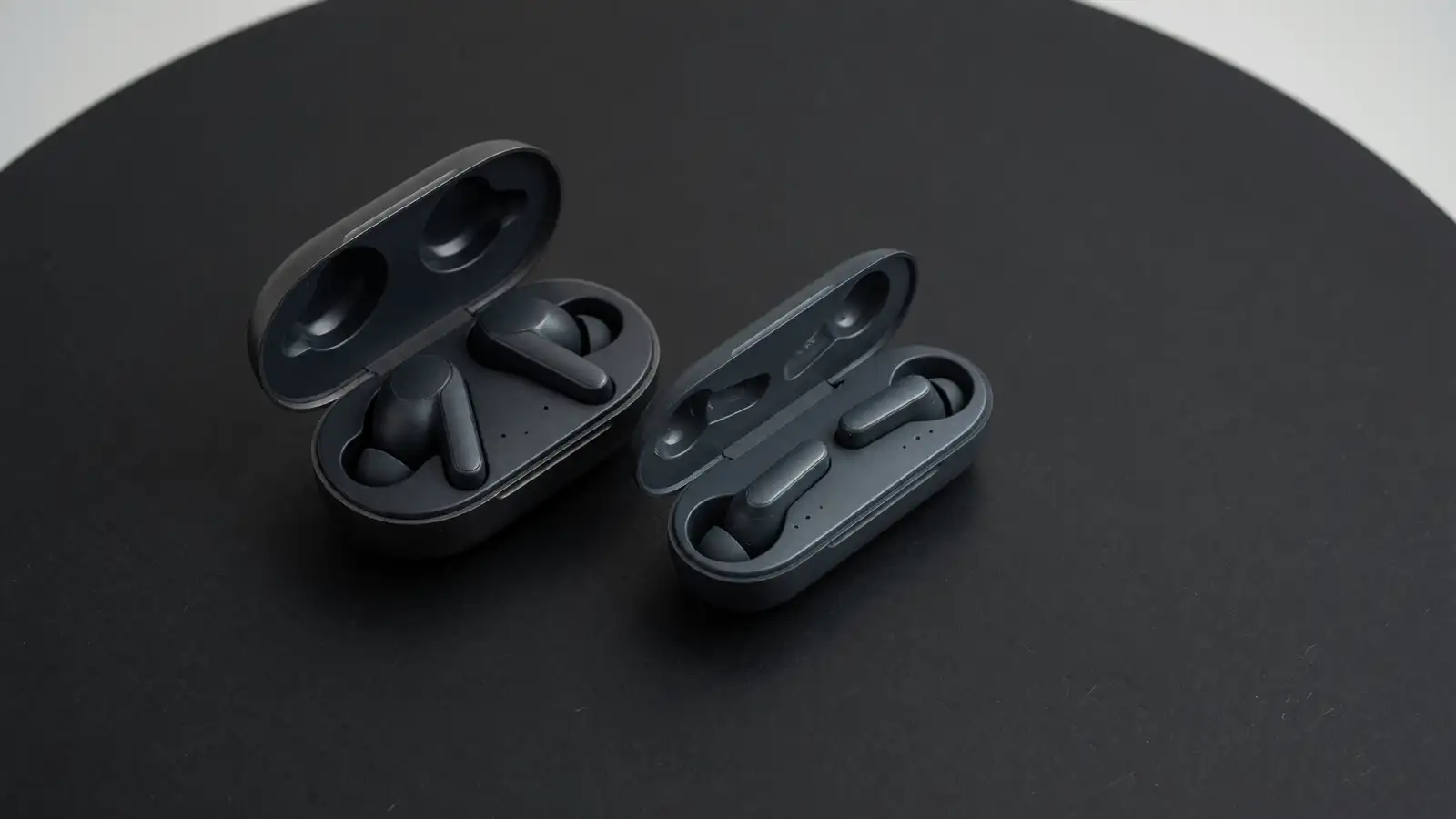
Momentum True Wireless 5 vs Sony WF-1000XM6: The Loser Lasts Longer
Sony wins the scorecard. That is not a controversial sentence.
On September 10, SoundGuys published a head-to-head that gives the WF-1000XM6 better stock tuning, a longer standardized battery run, and stronger noise canceling. The author would still buy the Sennheiser MOMENTUM True Wireless 5, because you can put a new cell in the buds and the case with a small screwdriver. Sony’s cells are sealed. When they die, the product dies.
We already ran the over-ear Momentum 5 against the WH-1000XM6. Same argument, bigger batteries. Earbuds live in pockets and charge every day. The cells are smaller. The replacement question arrives sooner.
Specs that are in the write-ups
| MOMENTUM True Wireless 5 | WF-1000XM6 | |
|---|---|---|
| SoundGuys battery test | 6 hours 17 minutes | 9 hours 41 minutes |
| Rated, ANC on (Major HiFi) | ~6 hours | ~8 hours |
| Rated, ANC off (Major HiFi) | up to 12 hours | not the lede |
| Case total (Major HiFi) | up to 40 hours | ~24 hours |
| Quick charge | 8 minutes → ~1 hour | not compared here |
| Charging | USB-C and Qi | USB-C (case) |
| IP | IP54 | IPX4 |
| Bluetooth | 6.0 | 5.3 |
| Hi-res codec | aptX Lossless | LDAC |
| Broadcast | later firmware, per SG | Auracast now |
| EQ | 8-band | 10-band |
| Driver (Major HiFi) | 7mm TrueResponse, 5Hz–21kHz | refined dynamic, QN3e processor |
| Batteries | replaceable, buds and case | sealed |
Pascal ratings are not a thing in earbuds, but brochure hours are. Believe the SoundGuys stopwatch more than the box. Sony still wins the stopwatch.
Sound: Sony is the pair you do not EQ
SoundGuys’ stock take is blunt. Sony’s bass is a little heavy, the midrange is even, the treble does not lurch. There is a narrow mid dip on the XM6 that looks worse on a chart than it sounds, and it goes away with ANC off. If you put them in and press play, that is the friendlier curve.
Sennheiser’s bass-through-mids are in good shape. The trouble is up high: not enough around 3kHz, where voices and lead instruments sit, and too much around 6kHz. “S,” “sh,” and “z” can go shrill. On a lot of tracks you will not care. On a mix with loud, forward vocals, you will, and then you cannot stop hearing it.
The fix is the 6kHz band in Smart Control Plus. It is an eight-band graphic EQ, not parametric, so you are moving a chunk of spectrum rather than a spike. Most people never open that screen. That is why Sony wins the out-of-box round.
Major HiFi’s comparison spends more time on the hardware: four microphones per Sennheiser bud, beamforming, a voice accelerometer, AI voice isolation, automatic wind suppression. Sony’s pitch is the QN3e processor and a larger housing than the XM5 to hold more microphones. Fit: Major HiFi says the XM6 can feel looser; the TW5 is slimmer and more stable. Fit is personal. If you already bounced off the XM5’s foam tips, do not assume the XM6 solved you.
Calls, from SoundGuys: both are fine in ideal, office, and street clips. Neither is a reason to pick a side.
ANC and the chart that oversells the gap
Sony cancels more. SoundGuys says the chart looks decisive. Their ears say the gap is smaller where the noise you hate actually lives: voices, cabin drone, room noise. Sony’s lead is in the very low and very high frequencies. With a good seal, the difference narrows. Both are enough for a commute, an office, or a flight. Call it a win on points.
If you buy earbuds for airplanes as a personality, buy the Sony. If you buy them for a bus and a gym, both clear the bar, and you should spend the rest of the money on tips that seal.
IP ratings are closer than the numbers look. SoundGuys: both handle water the same way; Sennheiser also claims dust. Codec is a phone question. aptX Lossless and LDAC are two ways to push more audio over Bluetooth. Auracast is Sony’s real extra: airports, gyms, theaters that broadcast. Sennheiser told SoundGuys it would arrive later in firmware. Believe firmware when it ships.
Battery is a year-one number and a year-three problem
SoundGuys’ standardized test: Sony 9:41, Sennheiser 6:17. Major HiFi’s rated figures rhyme with that once ANC is on, and then they diverge on the case. Sennheiser’s case is the endurance play: 40 hours total, 8 minutes for an hour. Sony’s case is 24 hours in that write-up.
For a workday, both still have charge left unless you listen six hours straight without the case. SoundGuys says most people will never hit the gap in year one.
Year two and three are the point of the article. Tiny cells, daily charging, pockets. When the runtime halves, Sony’s answer is a new pair. Sennheiser’s answer is a screwdriver and a spare cell, in the buds and in the case. A $300 product with a three-year hard stop is $100 a year. A $300 product you can keep alive is $300.
They made this argument for the Momentum 5 over-ears. It is worse in a bud. EU rules in 2027 are going to make replaceable cells less of a hobbyist feature. SoundGuys calls the TW5 a head start rather than a gimmick. The only other buds they name with the same idea are Fairphone Fairbuds, which do not keep up here on sound or features.
If you already own XM5 buds and they are still healthy, this comparison is not a reason to churn. If you are replacing a dead sealed pair for the second time, stop pretending the scorecard is only about 3kHz.
Who this is for
Buy the Sony WF-1000XM6 if you want the safer product: friendlier tuning, longer measured runtime, stronger ANC, Auracast today, and you can probably find them discounted. That is also the pair next to AirPods Pro 3 in our earlier Sony-buds piece. Android users who live in LDAC will feel at home.
Buy the MOMENTUM True Wireless 5 if you will open an EQ, you care about a replaceable cell, you want Bluetooth 6.0 and a dust rating, and you would rather win the decade than the chart. SoundGuys’ author is in this camp. So is this page’s winner field.
Do not buy either if you need a $100 commute bud. These are $300 objects. The repair argument only pays if you keep them long enough for the first cell to die.
A word on the companion apps, because that is where both companies hide the product after you pay. SoundGuys says both apps let you remap controls, adjust sound, and crawl through toggles. That is table stakes at this price. What differs is the EQ you actually need. Sony’s 10-band is there if you want it, but their stock curve asks less of you. Sennheiser’s 8-band is closer to mandatory if you are sensitive to that 6kHz shelf. If you refuse to install a vendor app, Sony is the less annoying sealed box.
Wind is a Sennheiser talking point in the Major HiFi write-up: automatic suppression on the TW5. If your commute is a bike or a platform, that matters more than Auracast at an airport you visit twice a year. If your life is terminals and open offices, Sony’s isolation lead plus Auracast is the grown-up feature list.
Do not treat Bluetooth 6.0 as a reason by itself. It is a future-proofing line on a spec sheet. Codec support on the phone you own this year decides whether aptX Lossless or LDAC does anything. Check that before you buy a story about “hi-res wireless.”
Replacement parts are the unsexy SKU. Sennheiser winning the decade only happens if the cells are actually for sale in three years, at a price that is not another $300. SoundGuys is betting the EU timeline forces that market into existence. If you are outside that market, ask Sennheiser’s support whether they will sell you the part before you pick a winner on principle.
Warranty and retail extras are missing from both write-ups, so do not invent them. If your country has a two-year hardware warranty that already covers battery failure, Sony’s sealed cell is less of a trap than SoundGuys’ US-centric “buy another pair” story. If your warranty is one year and the shop shrugs at batteries, Sennheiser’s screwdriver is the product.
Travel: Qi on the Sennheiser case is a real daily convenience if your nightstand already has a pad. Eight minutes for an hour is the airport feature. Sony’s longer single-charge run is the long-haul feature. Pick the failure mode you actually hit.
If you already like Sony’s app ecosystem and wear an XM5 over-ear at the desk, the XM6 buds will feel like the same company. That is worth something. Switching to Sennheiser for a cell you might replace in 2029 is a values purchase. SoundGuys made that purchase on the page. This comparison agrees, with the caveat that values purchases only pay if you follow through.
Foam tips versus silicone is still the unglamorous half of ANC. Major HiFi flags Sony’s foam as a seal problem for some ears. If your last XM5 never isolated, try silicone on the XM6 before you decide Sony “lost ANC” on your head. Sennheiser’s slimmer shell will not save a bad tip either. Take the pair back if the first week is pain. Fit is not a character test.
Street prices are not in these two pieces. Independent measurements beyond SoundGuys’ battery and listening notes are not in Major HiFi as a full lab dump. If you need RTINGS-style isolation charts before you spend, wait. If you have already decided you are in the $300 class and you hate e-waste, the Sennheiser is the one that has an answer after the warranty.