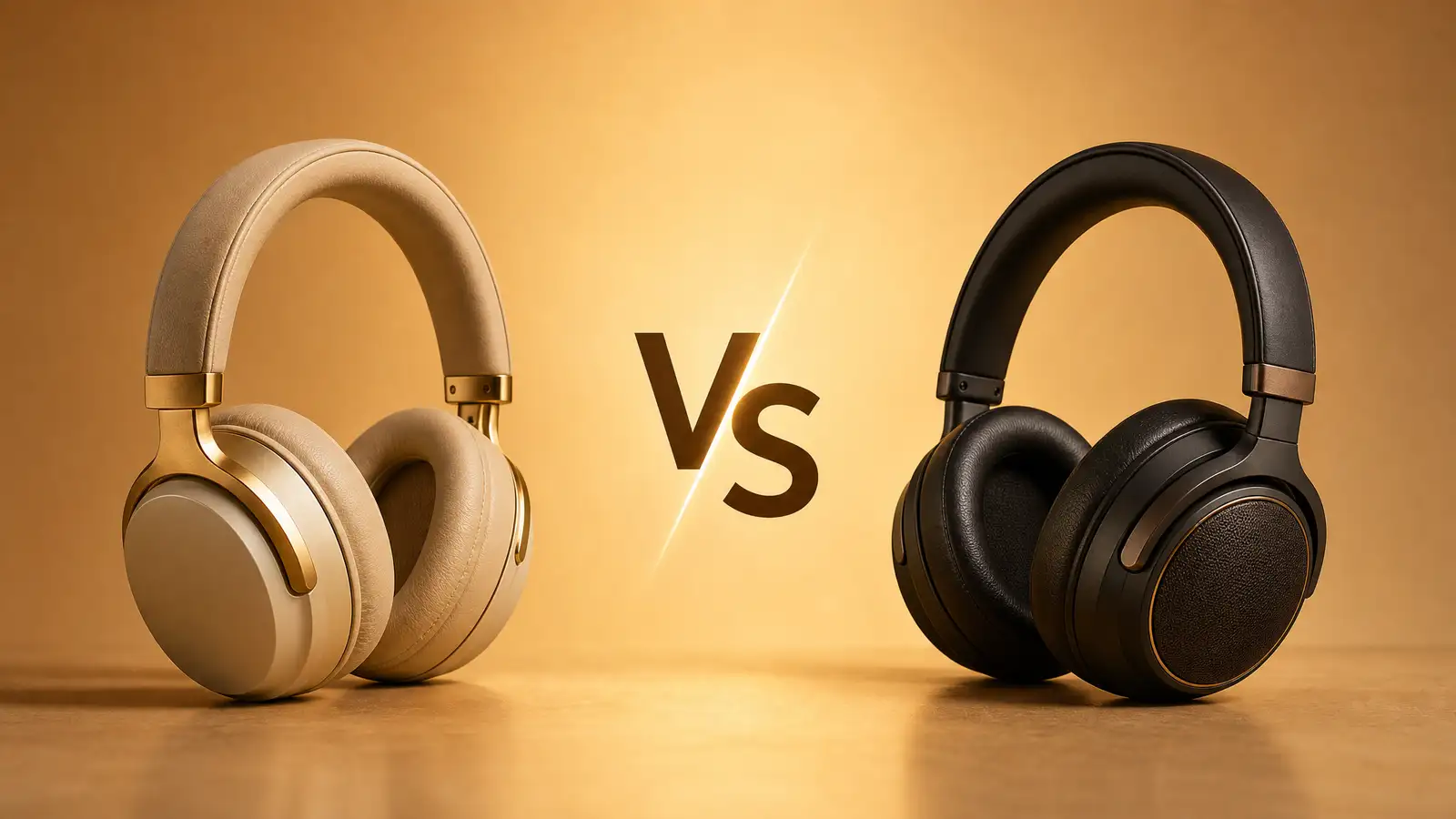
Sony and Apple have been circling each other in the premium headphone space for years, but 2026 is the first year both flagship over-ears feel like genuine peers. The Sony WH-1000XM6 refines a formula that has dominated “best headphones” lists since the XM3 era. The AirPods Max 2, arriving five and a half years after the original, finally gets the H2 chip and ANC upgrades that bring it level with Sony’s best. We bought both pairs and lived with them for two weeks. Here is what $400 versus $550 actually gets you.
Design and Comfort
Sony stuck with the design language it introduced on the XM5: a streamlined, minimalist shell with a slim headband and synthetic leather pads. The XM6 weighs roughly 250 grams and folds flat into a compact hard case. The plastic build does not feel cheap, but it does not feel $400 either. What it does feel is weightless. We wore these for six-hour flights without fatigue, and the clamp force is light enough that glasses wearers will not feel pinched after an hour.
The AirPods Max 2 takes the opposite approach. At 385 grams, it is the heaviest pair of wireless headphones we have ever tested. Apple used the same aluminum ear cups, stainless steel frame, and mesh canopy headband as the original. The build quality is leagues ahead of Sony: these feel like serious hardware, not consumer plastic. But the weight catches up. After two hours, we noticed the headband pressing into the crown. After four, we wanted to take them off.
Apple still refuses to add a power button. The Max 2 enters an ultra-low-power state when placed in the included Smart Case, which remains a flimsy silicone flap that protects nothing and looks absurd. Sony’s hard case is practical and protective. If you travel with headphones, this matters more than you might think.
| Specification | Sony WH-1000XM6 | AirPods Max 2 |
|---|---|---|
| Weight | 250g | 385g |
| Foldable | Yes (flat) | No |
| Case | Hard shell | Smart Case (minimal) |
| Connectivity | USB-C + 3.5mm | USB-C only |
| Water Resistance | No | No |
Noise Cancellation
For years, Sony held an uncontested lead in ANC. The AirPods Max 2 closes the gap entirely. Both headphones now sit at the top of the noise-cancelling hierarchy, and picking a winner depends on which type of noise you face.
The XM6 uses Sony’s new QN3 processor and a 12-microphone array with an Adaptive NC Optimizer that adjusts in real time based on your environment, air pressure, and even whether you are wearing glasses. On a transatlantic flight, it silenced the low-frequency drone of jet engines to near-inaudibility. In a busy coffee shop, it reduced conversation to a distant murmur. The ANC feels surgical: precise and thorough across the full frequency range.
The AirPods Max 2, powered by the H2 chip, matches Sony on low-frequency cancellation and actually edges ahead on mid-frequency noise. Office chatter and keyboard clatter came through slightly quieter on the Max 2 than on the XM6. The difference is not dramatic, but it is measurable. Apple’s implementation also produces less of the ear-pressure sensation that aggressive ANC systems sometimes cause, which makes the Max 2 more comfortable for extended ANC use despite its weight.
Transparency mode is excellent on both. Sony’s sounds marginally more natural, but Apple’s is perfectly usable. If ANC is your top buying criterion, you cannot go wrong with either. If you work in open-plan offices, the Max 2 has a fractional advantage on voice-range noise. If you fly frequently, the two are inseparable.
Sound Quality
This is where the comparison gets interesting because the two headphones reflect fundamentally different audio philosophies.
The Sony WH-1000XM6 was tuned in collaboration with mastering engineers, and it shows. Out of the box, the sound is balanced, detailed, and controlled. Bass extends deep without muddying the midrange. Vocals have presence and weight. The treble is crisp without edging into harshness at higher volumes. Sony supports LDAC, aptX Adaptive, AAC, and SBC, so Android users get near-lossless wireless audio. The Sony Headphones Connect app includes a comprehensive EQ with multiple bands, allowing you to shape the sound to your preference. We dialed in a slight bass boost and left everything else flat, and the XM6 delivered the kind of engaging, wide-soundstage performance that makes you rediscover tracks you have heard a hundred times.
The AirPods Max 2 sounds slightly better out of the box. Apple’s tuning is warmer, richer, and more immediately pleasing. The H2 chip drives computational audio features that widen the soundstage and add depth to spatial audio tracks. Personalized Spatial Audio with dynamic head tracking is genuinely impressive: it places instruments in three-dimensional space and holds them there as you turn your head. Watching a Dolby Atmos film mix on the Max 2 feels like sitting in a theater.
The catch: Apple provides no user EQ. None. You listen the way Apple decided you should, and if you do not like the tuning, your only option is the system-wide EQ buried in iOS settings. Sony’s parametric EQ gives you control. Apple gives you a take-it-or-leave-it experience.
For critical listening, we preferred the Sony XM6 once EQ was applied. For casual enjoyment and spatial audio content, the AirPods Max 2 is more fun. Codec quality on Android narrows significantly on the Max 2, which only supports AAC and SBC. iPhone users get the best of both headphones. Android users lose nearly all of the Max 2’s advanced audio features.
Battery Life and Charging
Sony claims 30 hours with ANC enabled and 40 hours with it off. In our testing, the XM6 consistently hit 28 to 31 hours with ANC on. A quick charge gives you three hours of playback from a three-minute charge via USB-C. This is enough to eliminate range anxiety on any realistic trip.
The AirPods Max 2 delivers around 20 hours with ANC and spatial audio active. That number drops closer to 18 hours if you use head-tracked spatial audio heavily. In 2026, 20 hours is acceptable but not impressive at this price point. The original Max also managed 20 hours. Apple added a USB-C port (replacing Lightning), which is welcome, but there is still no 3.5mm jack for wired listening. Sony includes a 3.5mm port, making the XM6 usable with in-flight entertainment systems without a dongle.
When the battery runs out, the Max 2 needs the Smart Case to enter sleep mode, and if you forget the case, the headphones drain slowly in your bag. The XM6 has a physical power button that works instantly. This difference encapsulates a lot about the design gap between these two products.
Connectivity and Ecosystem
Bluetooth multipoint works on both. The XM6 connects to two devices simultaneously and switches between them using Sony’s app or on-ear controls. We paired it with an iPhone and a Windows laptop, and the handoff was reliable.
The AirPods Max 2’s ecosystem integration is where Apple pulls ahead decisively for iPhone and Mac owners. iCloud pairing means you set up the headphones once and they appear on every Apple device signed into your account. Switching from iPhone to MacBook to iPad is instant and automatic. You pick up a call on your phone and the headphones route audio back to music when you hang up. This seamlessness is genuinely useful and impossible to replicate on non-Apple headphones.
For Android and Windows users, the Max 2 behaves like a standard Bluetooth headphone, and you lose spatial audio, automatic switching, and most of the smart features. Sony’s companion app works equally well on iOS and Android, and LDAC gives Android users a tangible audio quality advantage on the XM6 that the Max 2 simply cannot match.
Call quality is strong on both. The XM6 uses 12 microphones with AI-driven voice pickup that isolates your voice even in noisy environments. The Max 2 uses the H2 chip for computational voice isolation. Call recipients told us both sounded clear, with the XM6 doing slightly better at suppressing background wind noise during outdoor calls.
Price and Value
The Sony WH-1000XM6 launched at $399 and can regularly be found for $349 to $379. The AirPods Max 2 starts at $529, with some color options reaching $549. That is a $150 to $170 gap, and for most people, the XM6 delivers more of what matters: lighter weight, longer battery life, better portability, broader codec support, and ANC that is practically equivalent.
The extra $150 on the Max 2 buys you premium materials, slightly better out-of-box sound, and seamless Apple integration. If you own multiple Apple devices and value build quality over weight, the premium is defensible. If you use Windows or Android alongside Apple products, or if you travel frequently, the XM6 is the clearly smarter purchase.
Final Verdict
We tested these headphones in the same environments, on the same flights, with the same playlists. The Sony WH-1000XM6 does more things well for less money. It is lighter, lasts nearly twice as long on a charge, folds into a protective case, works brilliantly across all platforms, and sounds excellent once you spend five minutes in the EQ settings. At $399, it is the best all-around ANC headphone you can buy in 2026.
The Apple AirPods Max 2 is a luxury product that excels within its lane. The aluminum build is beautiful, the H2-powered ANC now matches Sony, and the Apple ecosystem integration is frictionless in a way that genuinely improves daily use. But the weight, the 20-hour battery ceiling, and the $529 starting price limit its appeal to a narrower audience. If you live entirely inside Apple’s ecosystem and want the best-looking, best-sounding (out of the box) headphones on the market, the Max 2 delivers. For everyone else, the XM6 remains the smarter choice.