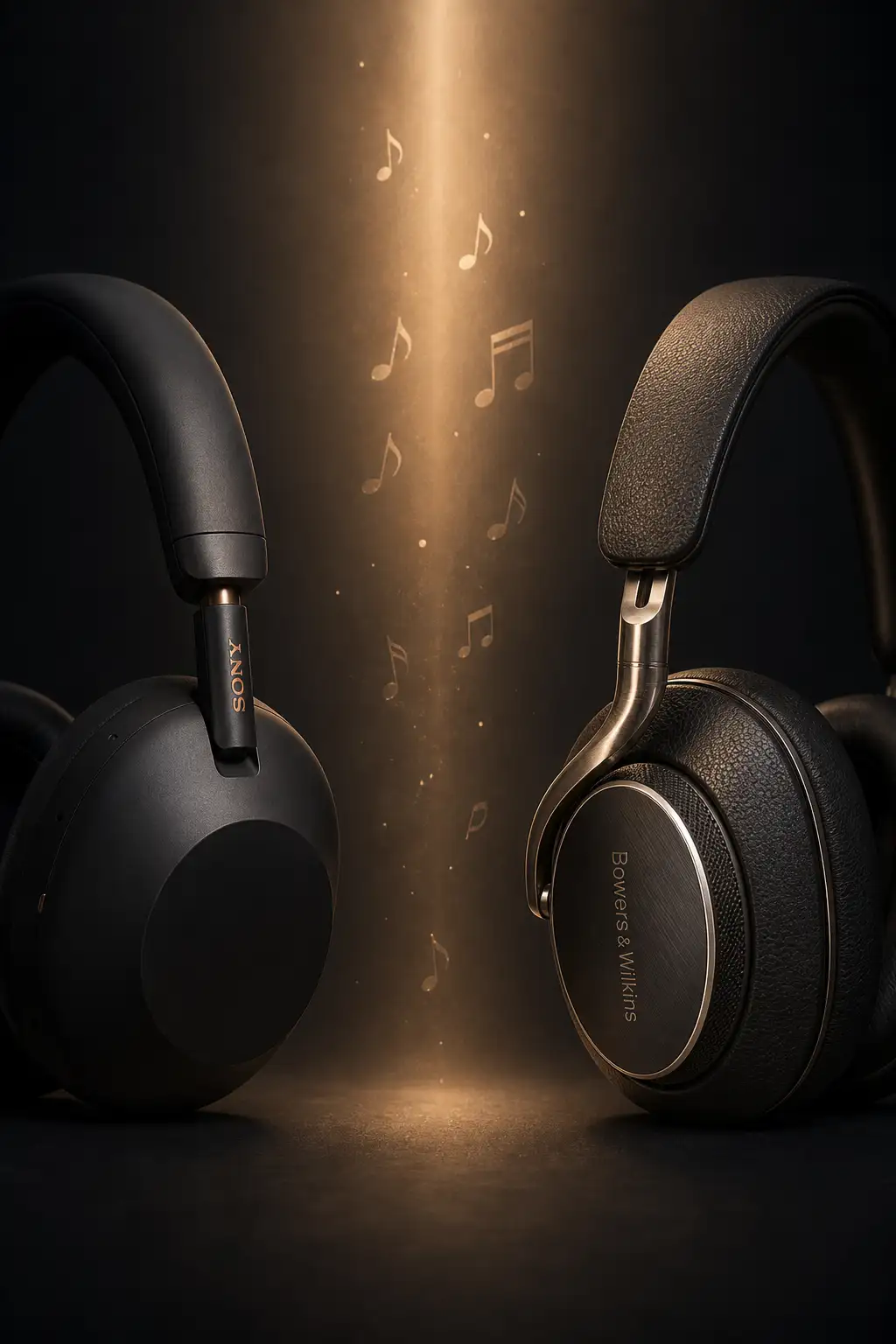
Two over-ear headphones at the $400 price point, two very different value propositions. The Sony WH-1000XM6 is the headphone you buy for best-in-class noise cancellation and a feature set that covers every use case. The Bowers & Wilkins Px8 is the headphone you buy because it looks and feels like a luxury product and sounds like one too.
Both are excellent. Which one belongs on your head depends on what you value more: utility or experience.
Build and Design
The Bowers & Wilkins Px8 is the best-built wireless headphone on the market. The earcups are machined aluminum, the headband is wrapped in Nappa leather, and the memory foam cushions are covered in soft leather that breathes better than synthetic alternatives. The attention to detail — the way the hinges glide, the metallic finish on the controls — makes the Sony look and feel like a plastic toy by comparison.
The Sony WH-1000XM6 is not poorly built. The design is lighter and more practical. The plastic construction keeps weight down to 250 grams versus the Px8’s 320 grams. The XM6 folds flat and comes with a compact carrying case. The Px8 folds flat but does not collapse as compactly, and the included case is larger.
If you care about materials and the way things feel in your hands, the Px8 is in a different league. If you prioritize weight and portability, the XM6 is the more practical choice.
Sound Quality
Sony’s XM6 refines the house sound Sony has been iterating on for years: slightly warm, detailed, and energetic. The 30mm drivers have been retuned with a more controlled bass response than the XM5. Mids are clear without being forward. The soundstage is wider than previous Sony flagships, though still more intimate than open-back headphones.
The Bowers & Wilkins Px8 sounds like a high-end wired headphone that happens to have Bluetooth. The 40mm carbon cone drivers deliver bass that is deep, controlled, and textured — you hear the resonance of an upright bass string, not just a thump. The mids are lush and present. Treble is extended without being harsh. The soundstage is wider and more three-dimensional than the Sony. The Px8 does not try to impress you with bass quantity. It impresses with texture, separation, and tonal accuracy.
For critical listening, the Px8 is clearly better. For podcasts, YouTube, and everyday listening, the XM6 is more than good enough — and actually more forgiving of poorly recorded content.
Noise Cancellation
Sony wins here, and it is not close. The XM6’s ANC is the benchmark that all other headphones are measured against. Dual processors sample ambient noise 800 times per second across eight microphones. Low-frequency rumble is eliminated. Midrange noise — office chatter, TV in the next room — is reduced to a faint whisper. The adaptive ANC adjusts automatically based on your activity and environment.
The Px8’s ANC is adequate for an office or coffee shop but struggles on flights and in loud environments. Low-frequency cancellation is decent, but midrange noise passes through more noticeably than on the Sony. The ANC is not bad — it is just not a reason to buy the Px8. You buy the Px8 for sound and build, and the ANC is a bonus.
If noise cancellation is your top priority, get the Sony. No contest.
Comfort
Despite the weight difference, comfort is surprisingly close. The Sony’s lighter weight helps during long sessions, but the ear cups are slightly shallower, which can cause ear fatigue after two hours for people with larger ears.
The Px8’s leather cushions and deeper ear cups are luxurious. The 320-gram weight is noticeable but evenly distributed. I have worn the Px8 for four-hour work sessions without discomfort, which I cannot say about the XM6.
For most people, both are comfortable. For listeners with larger ears or longer sessions, the Px8’s deeper cups may actually be the more comfortable option despite the weight.
Battery and Features
The XM6 offers 30 hours with ANC on (40 with ANC off) and charges via USB-C. A 3-minute quick charge gives 3 hours of playback. Multipoint Bluetooth connects to two devices simultaneously. Sony’s Headphones Connect app provides extensive EQ, ANC control, and feature toggles.
The Px8 offers 30 hours regardless of ANC status. Quick charge gives 6 hours from 15 minutes of charging. Multipoint Bluetooth is supported. The Bowers & Wilkins Music app is simpler and more elegant than Sony’s app, with basic EQ and ANC toggles.
Sony adds useful extras: Speak-to-Chat pauses music when you talk, 360 Reality Audio support, and DSEE Extreme upscaling for compressed audio. Whether you use these features depends on your patience with app settings.
Verdict
The Sony WH-1000XM6 is the better all-around headphone for most people. The ANC is unmatched, the feature set is comprehensive, and the sound quality is excellent for the price. If you fly often, work in noisy environments, or want the most capable wireless headphones available, the XM6 is the safe and smart choice.
The Bowers & Wilkins Px8 is the headphone for people who care about how things look, feel, and sound at the highest level. The aluminum and leather construction ages beautifully. The sound is genuinely audiophile-grade — detailed, textured, and emotionally engaging in a way that spec sheets cannot capture. If you want a headphone that makes you smile every time you put it on, the Px8 delivers an experience the Sony cannot match.