Nothing Headphone (1) Pro vs Sony WH-1000XM6: The Soundstage Won
David Carnoy’s CNET review of Nothing’s Headphone (1) Pro was updated September 28, 2026. List price $399. He put them next to the Sony WH-1000XM6 and came away slightly preferring Sony’s sound. Warmer. Less aggressive. Instruments where he expected them, without a tour of spatial modes.
That is the fight. Not a teardown. Not a lab dB chart CNET did not print. A reviewer who already lives with XM6 and Max 2 telling you the new $399 pair is close, and that close is not the same as the mix he keeps.
We already did XM6 versus AirPods Max 2 and XM6 versus Bose QC Ultra 2. This week’s incremental is Nothing’s first real flagship over-ear, priced under those two, with a 10-mic ANC claim and a Pelican-ish case Carnoy does not love.
What CNET actually measured with words
Nothing calls Headphone (1) Pro its most expensive and most advanced headphones. The original over-ear sold a story about AirPods Max sound for $250 less. Carnoy says that story was not true. The Pro, he says, is the first time you can make a better case that it sounds as good as AirPods Max 2. Some listeners who want a faster, less laid-back presentation may even prefer Nothing.
He did not prefer it to XM6. The Sony tonal balance sat better for him. That sentence is the winner line. If you want the punchier Nothing voicing, you are the exception he already named, not a myth.
Price stack from the same review: Pro about $400. XM6 $450. Second-generation Bose QuietComfort Ultra $449. Sonos Ace Ultra $449. AirPods Max 2 $549. Nothing is still the cheapest flagship in that sentence. $50 under Sony is real. It is not $250 under Max, which was the old boast.
Battery, as Nothing states it and Carnoy reports it: up to 30 hours with ANC on, 68 with ANC off. That is 6 hours better than Max 2 with ANC on, and it matches XM6 with ANC on. With ANC off, Nothing’s 68-hour claim is the better number in that comparison. Fast charge: 5 minutes for 2 hours of listening with ANC on.
Those hours are manufacturer claims inside a review. Carnoy did not paste a lab rundown in the extract we have. Treat 30 and 68 as the spec sheet he accepted, not as a CNET endurance test you can quote to a decimal.
The Pro is a comfort and seal project
Nothing swapped steel arms for titanium. 327 grams versus 329 for the non-Pro. Two grams is not a personality. The headband is. Wider, with a 132 to 169 mm adjustment range, thicker padding at the crown, earpads Nothing says are twice as soft, plus an 8 mm silicone baffle wall in the cushion. Carnoy says you can feel that. Softer pads, tighter seal, better ANC.
A tighter seal is how over-ear ANC works when the algorithm is not magic. If glasses break the pad, your 46 dB claim is a brochure. CNET did not run a glasses protocol in the chunks we have. If you wear thick temples, try them on. Do not mail-order faith.
Left earcup: a switch for flat EQ, aimed at studio-style checking. That is a feature or a gimmick depending on whether you ever need a dry mix on a train. It is not an XM6 killer. It is a switch. If you live in Nothing’s app EQ anyway, note that Carnoy’s Sony preference included not having to hunt spatial modes to make the stage make sense.
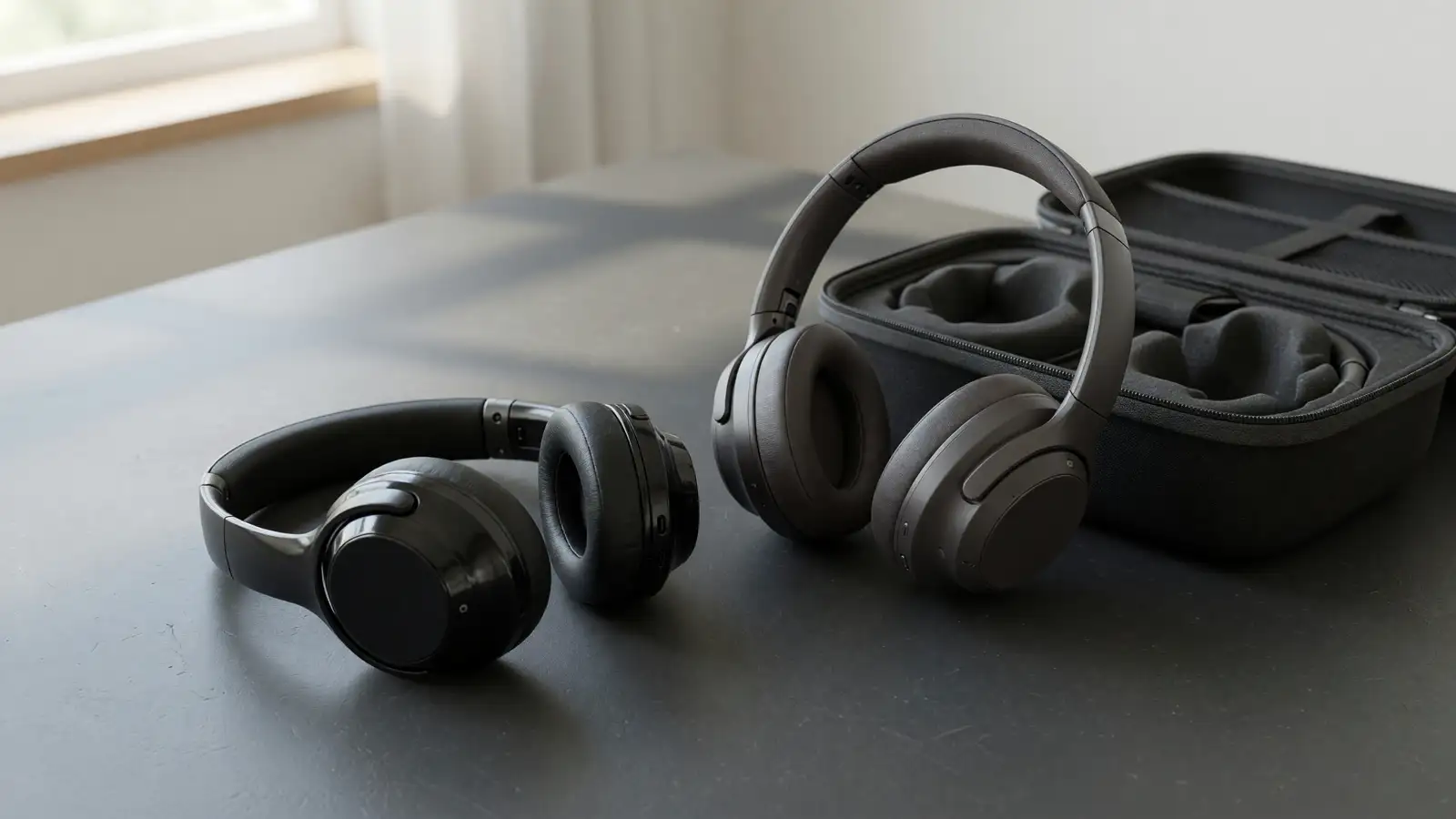
The case is a fight. Hard shell, Pelican energy. Carnoy reads it as a bulkier, armored cousin of Apple’s controversial Max and Max 2 case. He was not thrilled. If you backpack with a laptop, volume is a spec. If the headphones live on a hook, the case is packaging. Do not pay $399 for a box you hate unless the headband already won.
Nothing’s marketing, per Carnoy, still points at younger buyers who want an Apple or Samsung alternative with a value story. The Pro at $400 strains the value story and still undercuts the usual premium shelf. That is the honest middle. It is not a $199 surprise.
ANC numbers, and what they are not
Nothing’s line: best “real-time” Adaptive ANC, up to 46 dB of reduction, 10-microphone system, better in wind and traffic. Versus Headphone (1): 5 dB stronger average reduction, and Headphone (1) had six mics. Nothing also claims 40 percent broader noise-cancellation coverage across the frequency range versus that older model.
All of that is versus Nothing’s last over-ear, not versus XM6. Carnoy did not hand us a “Pro beats XM6 by N dB” table in the extract. Do not invent one. The review’s comparative energy on ANC is the mic count and the 5 dB family upgrade, plus battery hours against Max 2 and XM6.
If your commute is wind on a platform, a 10-mic pitch is aimed at you. If your commute is a quiet office, 46 dB is a number you will not audit. Buy the headband and the mix.
XM6 already won a lot of ANC roundups on this site. That history is not this CNET piece. This CNET piece is a Nothing review that uses Sony as the sound reference. Keep the jobs straight.
Call quality has a heading in the review. The extract we have does not carry Carnoy’s verdict in usable form. I will not fake a sidetone score. If calls are the job, read that section on CNET’s page before you order. Photos in the piece are Andrew Lanxon for CNET. A photo is not a frequency plot. Use it to see the case bulk.
Who should buy which
Buy the XM6 if Carnoy’s ears sound like yours: warmer, calmer stage, fewer extra modes to feel “right,” and you can live with $450. The 30-hour ANC-on claim is a tie with Nothing, not a Sony loss. The extra $50 buys the mix he kept.
Buy the Pro if $399 is the ceiling, if you liked the original Nothing look and wanted the headband and pads fixed, if a flatter switch matters, or if you explicitly want a faster, more aggressive presentation than Sony. Carnoy left that door open. Walk through it on purpose.
Do not buy the Pro because the first Nothing over-ear was “Max minus $250.” Carnoy already killed that line. Do not buy XM6 because a blog said “winner” if you already bounce off Sony’s app. This winner is a tonal preference in one review, written at a desk in late September, not a five-year durability prize.
If you are an Apple-house Max 2 shopper, Carnoy’s other comparison is the one to reread: Nothing can now argue Max 2 sound, Max 2 is $549, Nothing has 6 more ANC-on hours on the claim sheet. That still is not this article’s winner. This article’s other product is Sony.
Travel case: if you already hated the Max case, read Carnoy’s Pelican paragraph twice. Nothing did not solve “small bag.” They solved “armored.”
Bose QuietComfort Ultra 2nd gen at $449 and Sonos Ace Ultra at $449 sit in Carnoy’s price stack as neighbors, not as this test. He did not say he preferred Nothing to Bose. He said Sony’s mix won his ears. If your fork is Bose comfort versus Sony app, that is a different tab on this site. Do not use a Nothing review to launder a Bose decision.
The 8 mm baffle and “twice as soft” pads are the Pro’s hardware story. They exist to make the 10-mic ANC claim less theoretical. A mic array on a leaky pad is a demo. Carnoy felt the pad change. That is as close as this review gets to a comfort lab. If you returned the original Headphone (1) because the clamp or the cushion failed on a long flight, this is the SKU that answers that complaint. If you returned it because you hated the sound, the Pro’s faster voicing may not be the apology you wanted. Carnoy still sent the warmer job to Sony.
Fast charge is a travel spec: 5 minutes on the brick, 2 hours with ANC on, according to Nothing as reported. That is useful if you already own a USB-C charger you trust. It does not make 30 hours into 32. It makes a forgotten charge less fatal. XM6 owners already live in that world. Do not switch brands for a 5-minute trick.
What this does not settle
No independent lab isolation curve in our notes. No distortion sweep. No microphone sample you can hear from here. A September 28 update is still one editor with a lot of headphones on a desk.
AirPods Max 2 versus Bose Ultra remains the Apple-versus-Bose fork. Do not drag Nothing into that fork without Carnoy. He dragged Nothing into Sony, and into Max 2 as a sound target.
Color: CNET shows black and white in the Headphone (1) family photos. Shop the SKU you can return. Finish is not frequency response. White shows dust. Black shows fingerprints. Neither is bass.
If you own Headphone (1) non-Pro, the Pro’s case is two grams, titanium arms, pads, baffle, 10 mics, 5 dB, and $399. That is a replacement pitch, not an accessory. The 329-to-327 gram change is not why you upgrade. The seal and the ANC claim are.
Winner stays Sony WH-1000XM6, on the mix Carnoy described, at a $50 premium. Nothing Headphone (1) Pro is the first Nothing over-ear he will let near Max 2 in a sentence. Near is the review. The soundstage he kept is Sony’s, this week, today.
If you demo both, use the same three tracks and the same ANC setting, and take the case on and off a bag once. Carnoy’s review is a desk. Your commute is a bag. The 327-gram Pro will not save you if the hardshell eats the backpack. The XM6 will not save you if you wanted Nothing’s look and already returned Sony twice. Buy the mix you heard, at the price you can return within the window the store actually honors.