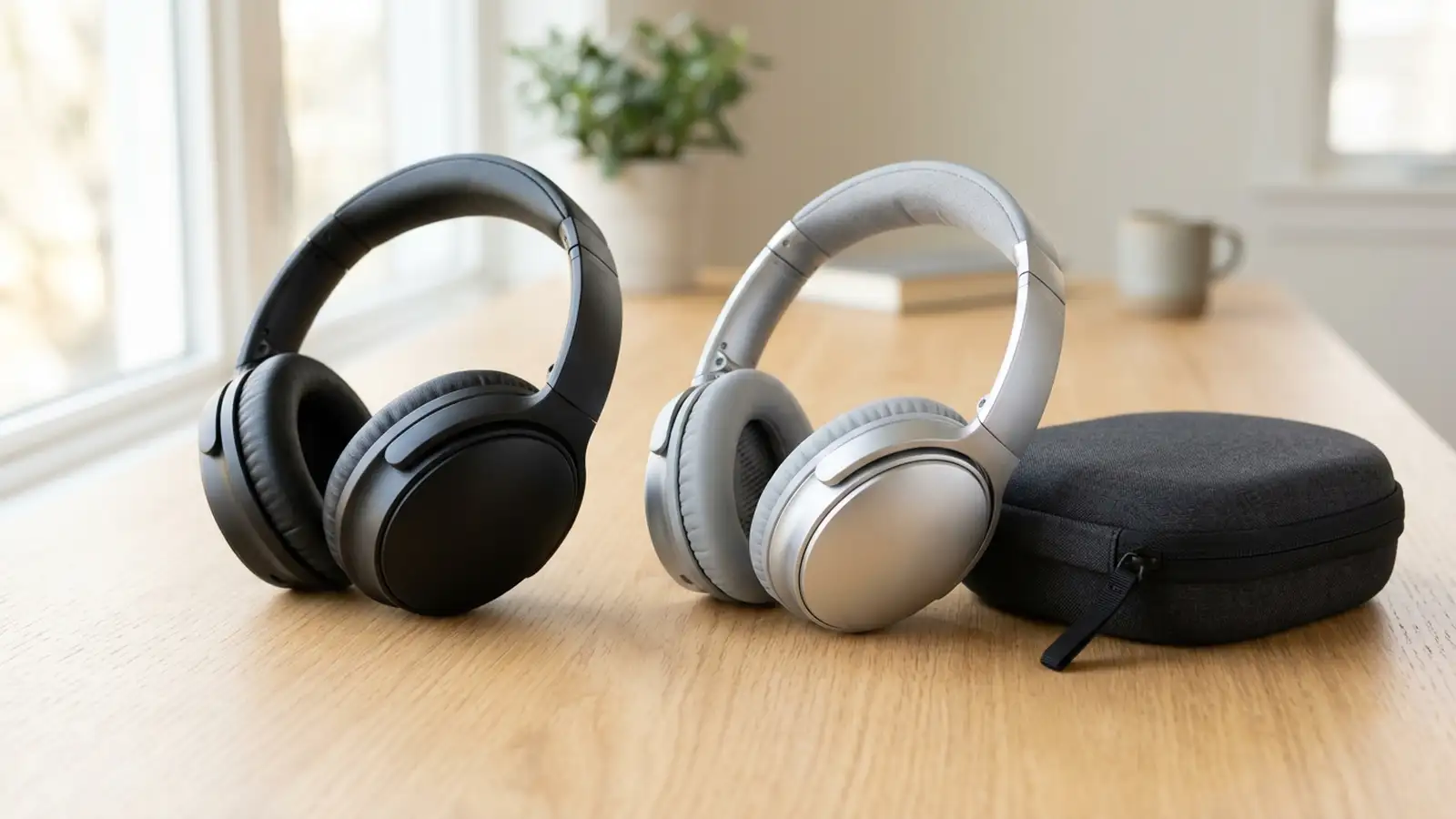
Sony created an unexpected internal competition in late October 2026 with a direct Sony WH-1000XM4C vs Sony WH-1000XM6 rivalry. On October 26, The Verge published its in-depth review of the Sony WH-1000XM4C, a reissue of Sony’s classic 2020 chassis updated with Bluetooth 6.0 and an EU-compliant removable battery. Listing at $299.99, the XM4C enters the market roughly $160 below Sony’s premier over-ear model, the Sony WH-1000XM6, which launched with an MSRP of $449.99 and typically retails between $448 and $450. Both The Verge and ecoustics emphasize that the new XM4C creates an immediate $160 price difference compared to the flagship. Buyers seeking high-grade active noise cancellation now face an immediate choice inside Sony’s own catalog: should you spend extra for the newest flagship, or does the refreshed classic deliver everything you need?
This Sony WH-1000XM4C vs Sony WH-1000XM6 matchup tests whether the modern refinements on the XM6 justify a substantial price premium. We previously evaluated the flagship against premium rivals in our Sony WH-1000XM6 vs Bose QuietComfort Ultra 2 comparison, measured audiophile alternatives in the Sennheiser Momentum 5 vs Sony WH-1000XM6 review, and looked at budget options in Soundcore Space 2 vs Sony WH-1000XM6. Now the true pressure comes from within Sony’s own family.
| Specification | Sony WH-1000XM4C | Sony WH-1000XM6 |
|---|---|---|
| Launch / List Price | $299.99 (£219 / $300 / AU$450) | $449.99 (£400 / €450 / $449 / AU$699) |
| Weight | 255 grams | 254 grams |
| Acoustic Drivers | 40mm dynamic | 30mm carbon fiber composite dome |
| ANC Processing | Sony QN1 processor | HD Noise Canceling Processor QN3 |
| Microphone Array | 4 microphones | 12 microphones |
| Battery Life (ANC On) | 27 hours | 28–30 hours (30 hours rated) |
| Battery Life (ANC Off) | 34 hours | 37.23 hours tested (up to 40 hours) |
| Bluetooth Version | Bluetooth 6.0 | Bluetooth 5.3 |
| Audio Codecs | LDAC, AAC, SBC | LDAC, AAC, SBC, LC3 / LE Audio |
| Wired Listening | 3.5mm (powered or unpowered) | 3.5mm analog |
| Water Resistance | No official IP rating | No official IP rating |
Sony WH-1000XM4C vs Sony WH-1000XM6: Price and Positioning
The pricing gap between these two models establishes distinct expectations. As documented by ecoustics, the WH-1000XM4C carries an official list price of $299.99, which sits $50 below the original 2020 WH-1000XM4 launch sticker and $160 below the current WH-1000XM6 flagship. In testing by The Verge, the XM4C retails for $298 at Amazon and $300 through Sony and Best Buy. Over in the United Kingdom, What Hi-Fi? notes an aggressive £219 test price (£219 / $300 / AU$450), positioning the headset as an entry point into Sony’s premium noise-cancelling range.
The WH-1000XM6 targets the upper tier of wireless audio hardware. As cataloged by SoundGuys, the XM6 carried an official launch MSRP of $449.99 USD upon its release on May 15, 2025. In their review, What Hi-Fi? tested the XM6 at £400 / €450 / $449 / AU$699, reflecting how inflation and advanced engineering pushed top-bracket ANC headphones into the $450 tier. In day-to-day retail, ecoustics notes that the XM6 regular price sits around $450 ($448 at Crutchfield and Amazon, $449 direct from Sony). Both ecoustics and The Verge point out that the XM4C undercuts the XM6 by an exact $160 margin.
That $160 margin creates a practical barrier on store shelves. Choosing the XM4C leaves enough funds in reserve to purchase a secondary pair of gym earbuds or an extended airline travel kit. Sony designed the XM4C specifically to protect its market share against mid-range competitors while preserving the XM6 as its premium flagship model. For shoppers with strict $300 limits, the XM6 cannot enter the conversation without hunting through the refurbished market. The XM4C offers factory-fresh hardware, current warranty coverage, and modern firmware support right out of the box.
Design, Weight, and Travel Ergonomics
Physical design defines how comfortable each pair feels across daily commutes. Independent scale measurements from ecoustics show the WH-1000XM4C at 255 grams, while their lab measured the WH-1000XM6 at 254 grams. Despite weighing almost the exact same figure down to a single gram, their mechanical structures distribute mass differently during travel.
The XM4C keeps the folding hinge design that made the original XM4 a frequent traveler favorite. As The Verge points out, each ear cup folds inward to tuck inside a compact hard-shell zippered case. Sony even moved the carrying loop onto the zipper pull, making it convenient to clip onto luggage or slide into tight laptop bags. The plush synthetic leather cushions provide gentle clamping force, allowing listeners to wear them for several hours without skull pressure building up.
Sony also returned to a folding format on the WH-1000XM6 after consumer feedback regarding the non-folding XM5. According to What Hi-Fi?, the XM6 incorporates stainless steel sliding arm hinges manufactured through metal powder injection molding. These metal joints let the XM6 roll into a compact ball for transport. However, What Hi-Fi? observed that the clamping force was slightly increased on the XM6 to improve acoustic isolation. ecoustics added that the XM6 can feel less forgiving for glasses wearers and tends to accumulate warmth around the ears faster during longer work shifts.
Exterior finishes offer different visual statements. The XM4C provides approachable choices including traditional Black, Platinum Silver, and a fresh Lavender finish. The XM6 maintains an executive presentation with sleek, smooth earcups and dark palette tones. Neither headset carries an official IP rating for water or dust ingress, so users must guard both against heavy rainstorms and intense workout moisture.
Noise Cancellation and Ambient Sound in Daily Use
Active noise reduction represents the primary purchasing factor for both headsets. In benchmark testing from SoundGuys and their WH-1000XM6 product database, both headphones earned an identical 8.7 out of 10 score for active noise cancellation, beating approximately 83 percent of over-ear headphones cataloged.
Underneath the hood, their hardware approaches diverge substantially. As The Verge explains, the WH-1000XM4C relies on Sony’s proven HD Noise Canceling Processor QN1 paired with four sensing microphones. For steady, droning frequencies like airplane cabin hum, subway rumble, or air conditioning fans, the QN1 architecture remains effective. However, John Higgins at The Verge notes that this six-year-old baseline shows its age when dealing with erratic human voices and sudden office disruptions.
The WH-1000XM6 steps up with Sony’s newer HD Noise Canceling Processor QN3 combined with a 12-microphone sensing array. As reported by both The Verge and ecoustics, the XM6 provides superior attenuation across the entire frequency range, particularly in the lower frequencies and chaotic mid-range conversation bands. The QN3 processor introduces additional feed-forward and feed-back correction stages, dampening spikes in surrounding noise without applying heavy acoustic pressure against your eardrums.
Transparency features also demonstrate the generational gap. The XM6 includes an auto-adjusting transparency mode and fast voice-pickup algorithms that let you carry on casual discussions with colleagues or gate agents without taking the headphones off. The XM4C retains Sony’s quick-attention gesture where placing your right palm over the ear cup dips music playback, but voice passthrough sounds slightly more muffled compared to the XM6. If your transit routine consists primarily of blocking jet engines on cross-country flights, the XM4C handles the task well for much less cash.
Audio Fidelity, Drivers, and App EQ Tuning
Internal acoustic components shape the sonic profile of both models. As confirmed by What Hi-Fi?, the WH-1000XM4C retains the classic 40mm dynamic driver utilized in the original XM4. This transducer generates a warm, rich sound signature characterized by rounded bass impact and smooth highs. The Verge noted that the factory tuning can leave the upper midrange sounding slightly polite or veiled on intricate acoustic recordings.
Sony addresses this behavior by upgrading the software control panel. According to The Verge, the companion Sony Sound Connect application unlocks a full 10-band graphic equalizer for the XM4C, stepping up from the original model’s 5-band slider limit. Raising frequencies between 1kHz and 4kHz brings guitars and vocals into immediate focus, giving listeners ample headroom to tailor output to their musical preferences.
The WH-1000XM6 takes a different engineering direction. As ecoustics documents, Sony equipped the XM6 with redesigned 30mm dynamic drivers featuring carbon fiber composite dome diaphragms. The stiffer 30mm assemblies support a wider claimed frequency response of 4Hz to 40,000Hz. This setup yields faster transient response, precise percussion decay, and clearer separation between dense orchestral instrument groups. What Hi-Fi? awarded the XM6 a full five-star performance rating, praising its dynamic nuance and open spatial delivery.
Wireless codec support remains consistent across both models. The Verge confirms that both devices support SBC, AAC, and Sony’s LDAC protocol for streaming high-resolution audio up to 990 kbps on compatible Android devices. The XM6 also adds support for Bluetooth LE Audio and LC3 streaming, while the XM4C skips Bluetooth LE and Auracast broadcast reception.
For analog purists, ecoustics notes that the XM4C offers an impedance and sensitivity profile of 106 dB/mW powered and 101 dB/mW unpowered. This means the XM4C can continue playing music over a standard 3.5mm headphone cable even after the internal battery has completely run out of charge.
Battery Life, Charging, and Wireless Connectivity
Battery architecture marks one of the most significant engineering updates on the XM4C. Both What Hi-Fi? and The Verge explain that Sony re-engineered the XM4C to comply with European Union battery regulation (EU) 2023/1542, incorporating a modular, removable battery cell.
Accommodating the removable battery packaging required Sony to install a slightly smaller cell capacity. Consequently, rated playback with active noise cancellation enabled dropped from 30 hours on the original XM4 to 27 hours on the XM4C, as verified by The Verge. When listening without noise reduction, ecoustics and SoundGuys measure up to 34 hours of passive runtime.
The WH-1000XM6 delivers longer continuous playback. In their standardized battery evaluation, SoundGuys verified that while the XM6 is rated for 30 hours with ANC turned on, their wireless rundown reached 37.23 hours of playback. Furthermore, detailed testing from ecoustics confirms that listeners can expect 28 to 30 hours of runtime with noise cancelling active, extending up to 40 hours during standard listening without ANC. Both headphones provide sufficient endurance to cover several days of typical office work or an overseas round-trip flight without reaching for a wall adapter.
Wireless radio standards feature an intriguing generational divergence:
- The WH-1000XM4C upgrades its core wireless stack to Bluetooth 6.0, as verified by SoundGuys, ensuring stable connection strength and rapid channel hopping in crowded transit stations.
- The WH-1000XM6 runs on Bluetooth 5.3 (SoundGuys), incorporating next-generation Bluetooth LE Audio protocols alongside standard codecs.
Multipoint connection operates smoothly on both models, letting users keep an active wireless link to both a smartphone and a laptop at the same time. Audio automatically shifts to incoming calls and pauses background entertainment during conversations. The XM6 has an advantage in voice call clarity, as its 12-microphone beamforming array isolates speech from gusting wind and urban street clamor more aggressively than the XM4C.
Winner and Buying Advice: Who Should Choose Which Pair?
Deciding between these two headphones comes down to comparing marginal technical refinements against a $160 price difference. The Sony WH-1000XM6 stands as Sony’s premier acoustic benchmark, earning praise from What Hi-Fi? and ecoustics for its 12-mic QN3 noise reduction array, high-resolution 30mm carbon composite drivers, and Bluetooth LE Audio readiness. If you regularly handle important phone calls outdoors in blustery conditions or require top-grade suppression for unpredictable office chatter, the XM6 fulfills its luxury flagship promise.
For everyday travelers, commuters, and value-minded music enthusiasts, the practical winner of this comparison is the Sony WH-1000XM4C. Listing at $299.99 (street tested around $298 to $300 by The Verge and £219 by What Hi-Fi?), it preserves the proven compact folding hinges, comfortable 255g weight, 10-band app EQ tuning, and 27 hours of reliable ANC endurance. As John Higgins at The Verge concluded, the XM4C delivers nearly the full performance of Sony’s flagship for substantially less money.
Buy the Sony WH-1000XM4C if:
- You want dependable travel noise cancellation and rich sound without exceeding a $300 budget.
- You favor a traditional folding design that collapses into a slim, travel-friendly zippered case.
- You prefer gentle clamping pressure and comfortable ear cushions for multi-hour listening sessions.
- You want the ability to listen via standard 3.5mm wired audio even after the battery is fully depleted.
Buy the Sony WH-1000XM6 if:
- You need top-tier active noise cancellation that dampens irregular human voices in open office spaces.
- You take frequent voice and video calls in windy outdoor locations where 12-mic beamforming is necessary.
- You prefer the tighter acoustic precision and wide 4Hz to 40kHz range of 30mm carbon composite drivers.
- You want modern Bluetooth LE Audio and Auracast compatibility for future wireless broadcasts.
The $160 savings offered by the Sony WH-1000XM4C makes it the smarter recommendation for the vast majority of listeners in late 2026.